|
As a result, British WW1 fuzes models and marks are numerous. Only a sample of the most noticeable is presented hereunder.
From the end of the XIX century, the numbering of these fuzes was following a coded nomenclature, initially dedicating the lower figures (up to 19) to the percussion fuzes, intermediate figures (from 22 to 50) to the time fuzes, and the upper figures (51 and over) to the time and percussion fuzes. This principle was soon violated by the arrival of new designs and this code exceptions became the habit : as early as 1913, the main percussion fuze was the N°44...
British artillery fuzes are almost exclusively made in brass or bronze, explaining why they usually have quite well resist to corrosion and are generally found in good conditions nowadays.
N°44, N°44-B, N°44/80 and N°44/83 fuze |
||
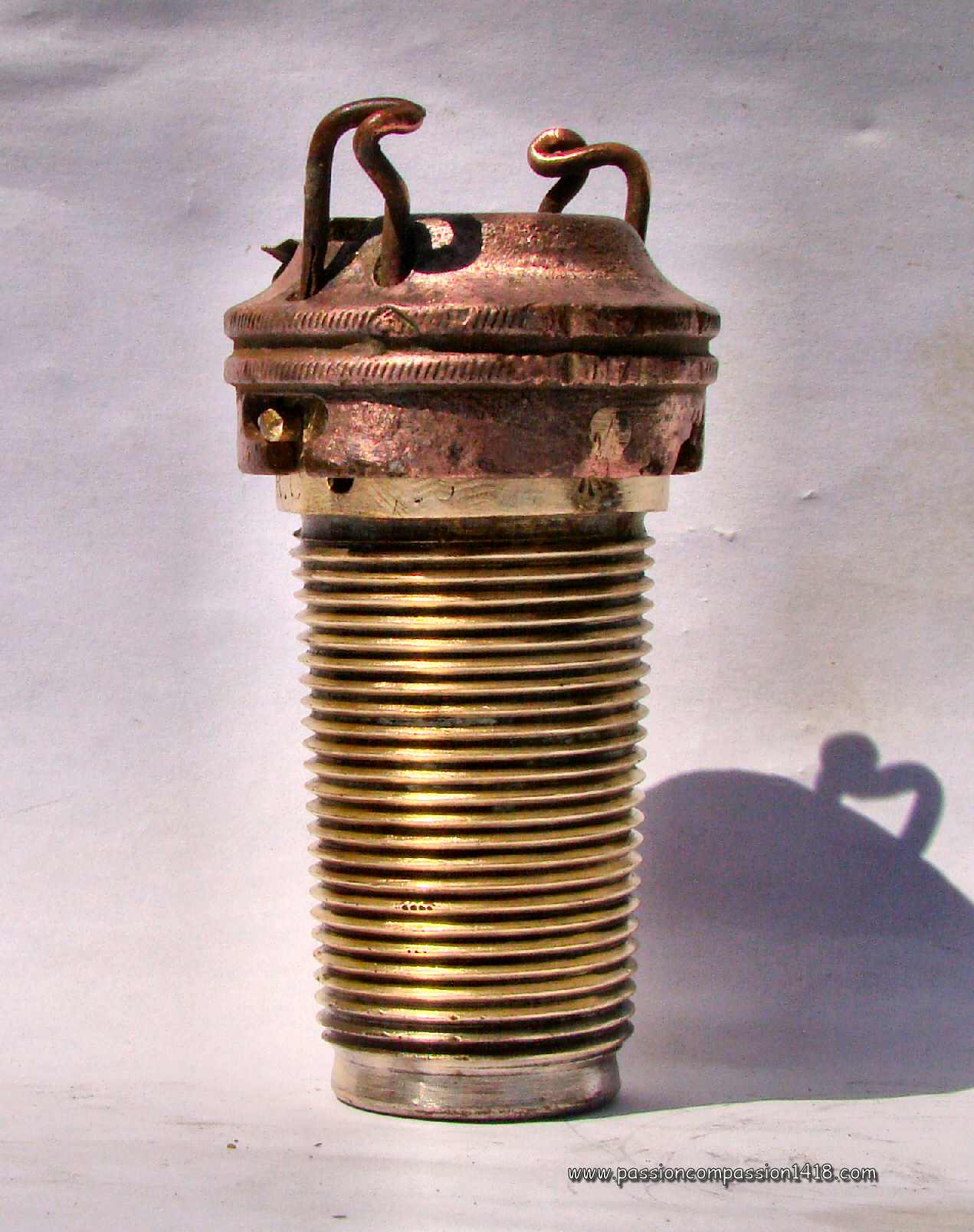 |
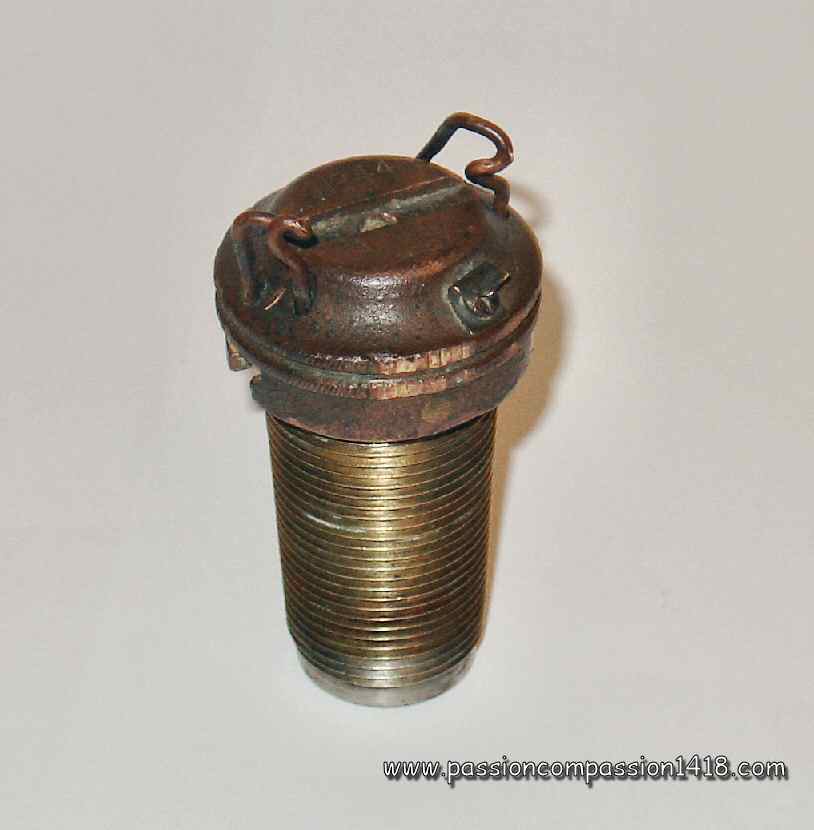
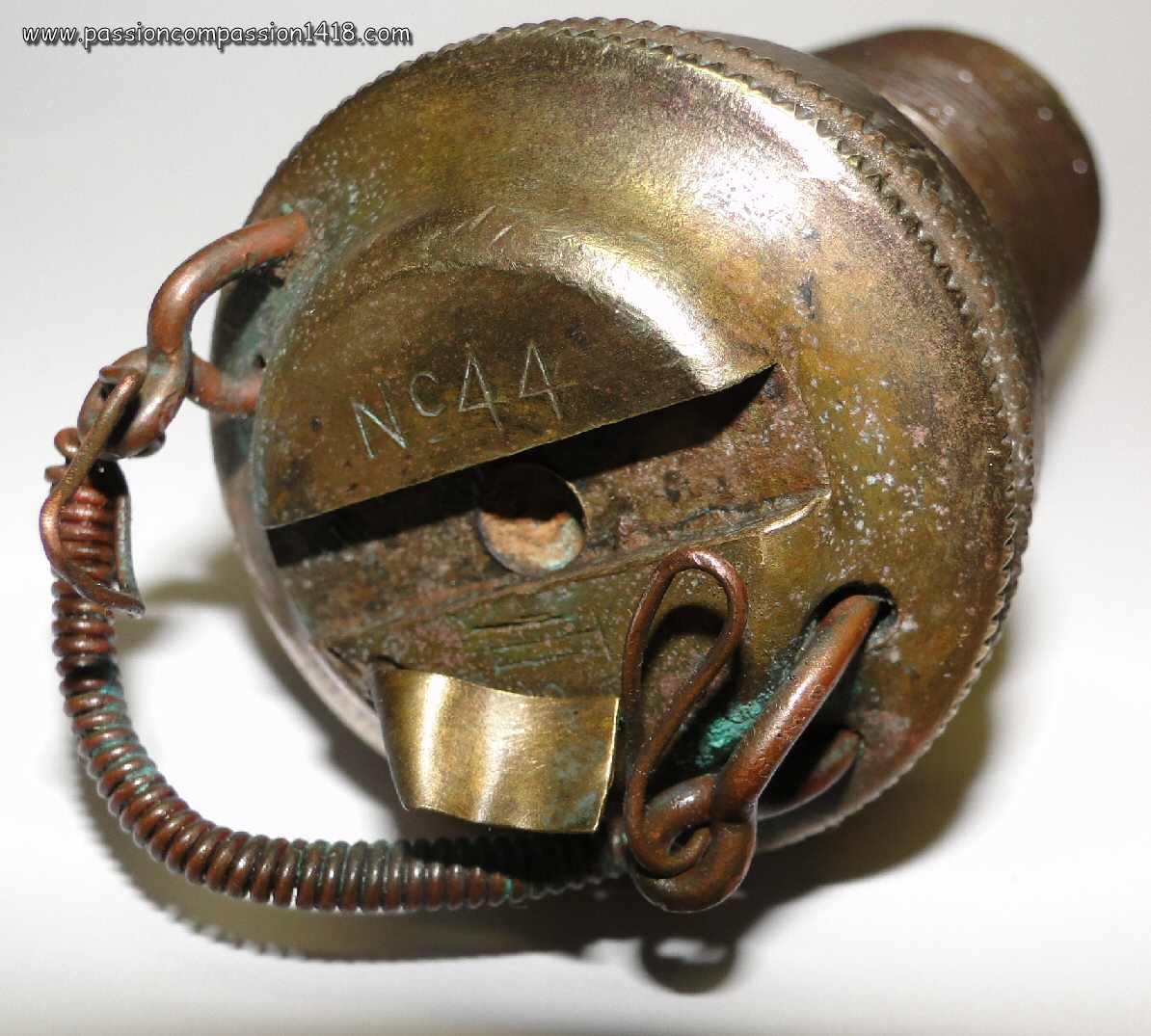
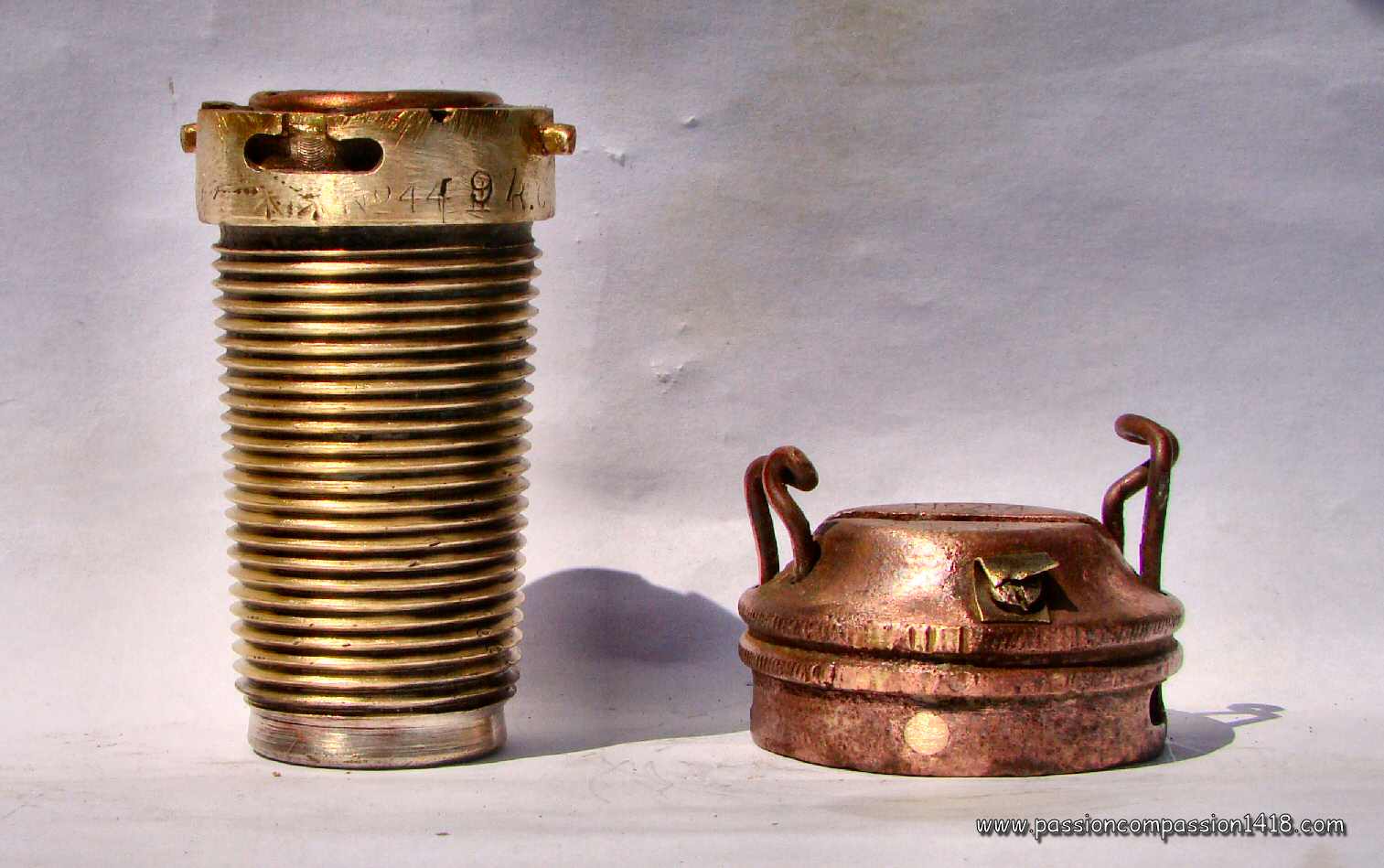
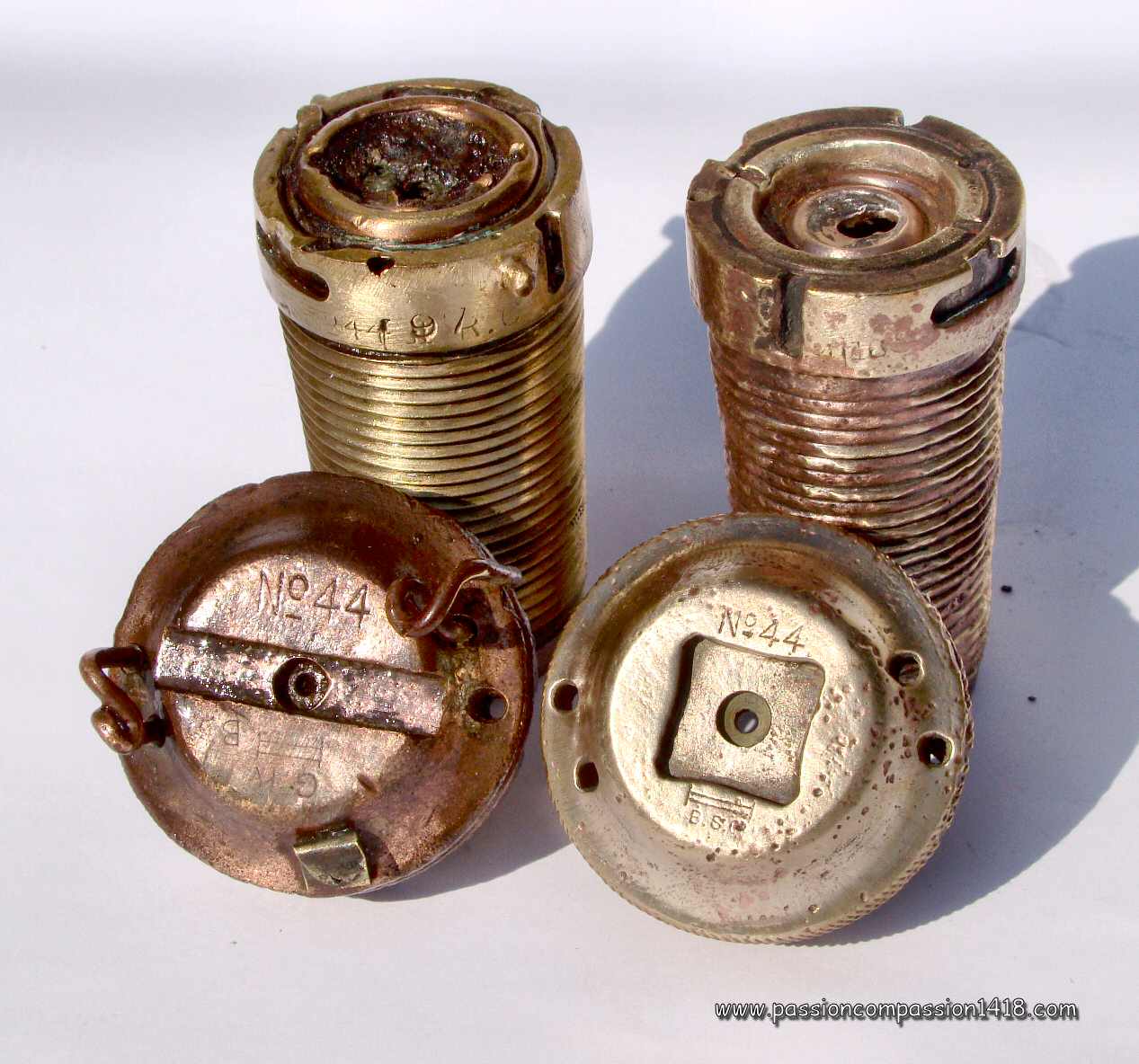
Introduced in 1913, the percussion fuze N°44 was designed on the simpliest of the percussion systems, named 'système à refoulement' in France and 'direct action fuzes' in Great Britain. It was composed of a small threaded brass truncated cone, with a Tetryl explosive load in its tail side, and closed at its upper side by a 'percussion disk' made in copper and shaped like an upside down dish plate with a percussion pin in its center.
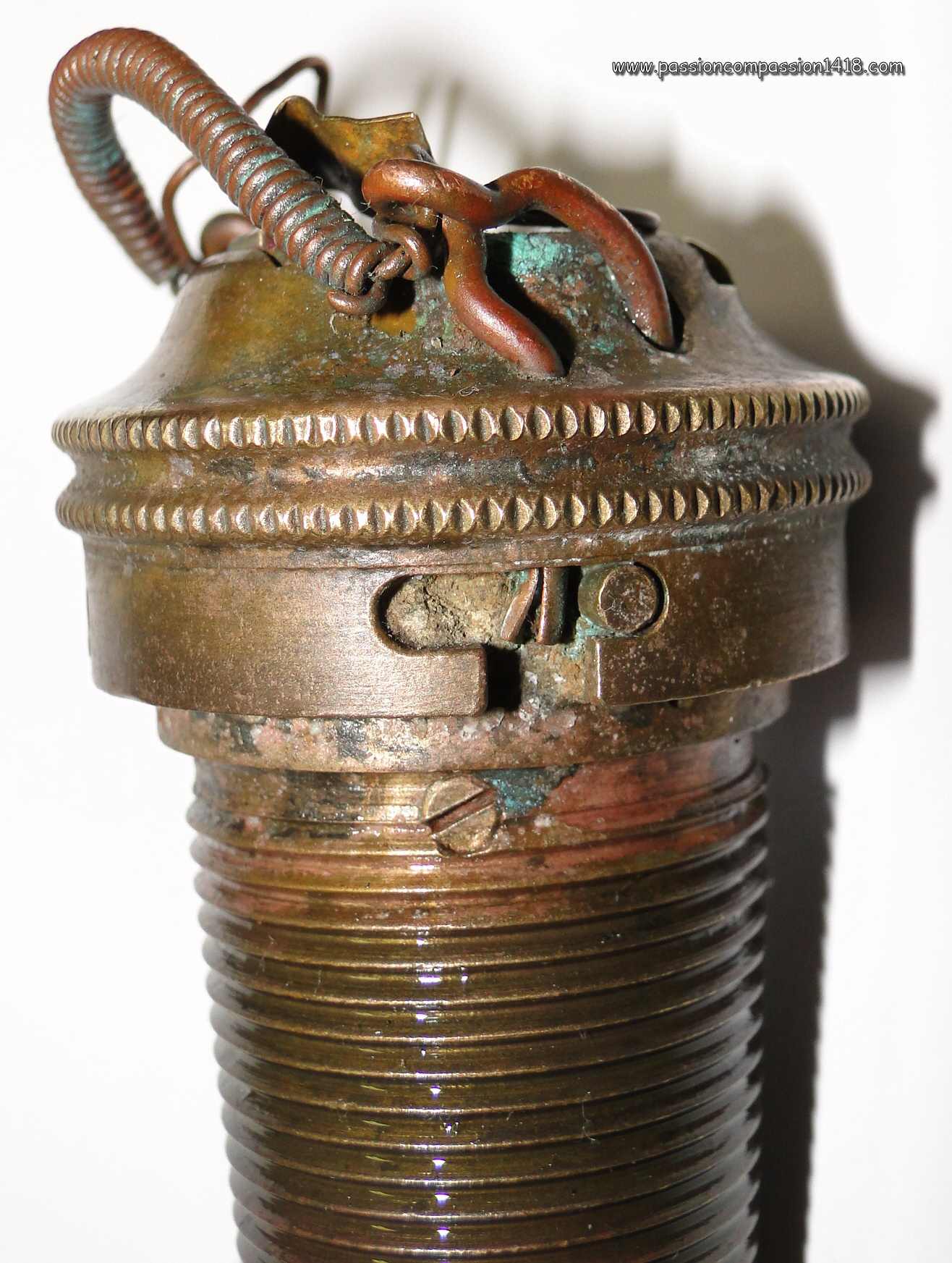
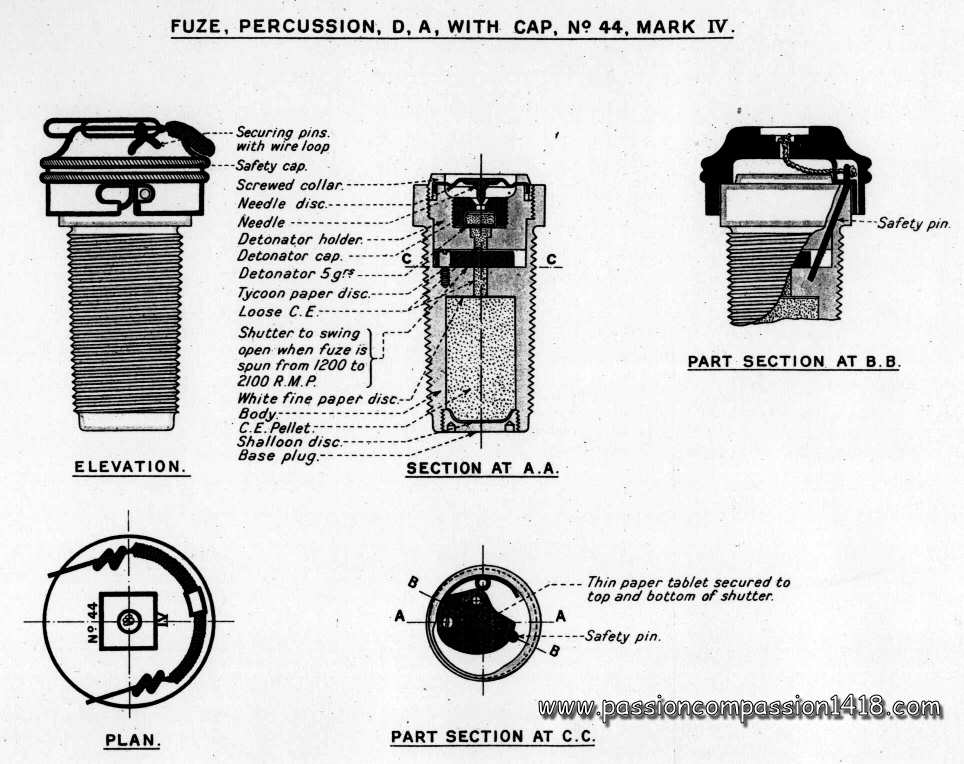
At impact, the percussion disc was deformed by the shock, pressing the percussion pin against a detonator cap whose spark was communicated to the detonating charge through a Tetryl-filled channel. The same principle was in use in the British fuzes N°1, N°3 and N°17, all obsolete in 1914. Concerning the N°44 fuze, and for the very first time in the British fuzes history, a safety system was added by means of a centrifugal action shutter that was closing the flame communication channel at rest, and was opened in flight under the action of the shell spin just after it left the gun tube. A brass cap that had to be removed before use was protecting the percussion disk from accidental triggering by handlings. It was including a safety pin that was also keeping the centrifugal shutter in 'closed' position. There was a variant, the percussion fuze N°44-B, whose more sensitive centrifugal shutter was designed for the lower spins of the shells of the heavy artillery. More surprising variants, the precussion fuzes N°44/80 and N°44/83 were not not equipped with a top cap nor safety pin, but included a stronger centrifugal shutter spring, and were designed to be used in series with a time fuze N°80/44 or N°83/44 that didn't have a percussion system or a detonator. In this configuration, the percussion disk of the N°44 fuze was pressed down by the small explosion of time fuze primer charge, so that the percussion fuze was rather a secured detonator. The N°44 fuze was used with the explosive shells of the :
|
|
Percussion fuze N°44. |
||
 |
 |
|
Percussion fuze N°44. Cap markings : 'N°44 - GK - B'; body markings : 'N°44 - 97 - RC - R8' |
Percussion fuze N°44. The two metal wires were linked to a small rope designed to help removing the safety cap. Picture courtesy Luc Malchair |
|
 |
||
Percussion fuze N°44. Saefty cap removed |
||
 |
||
Percussion fuzes N°44. Two identical models, but different caps |
||
 |
 |
|
Percussion fuze N°44. Zoom on the top safety cap assembly system. Picture courtesy Luc Malchair. |
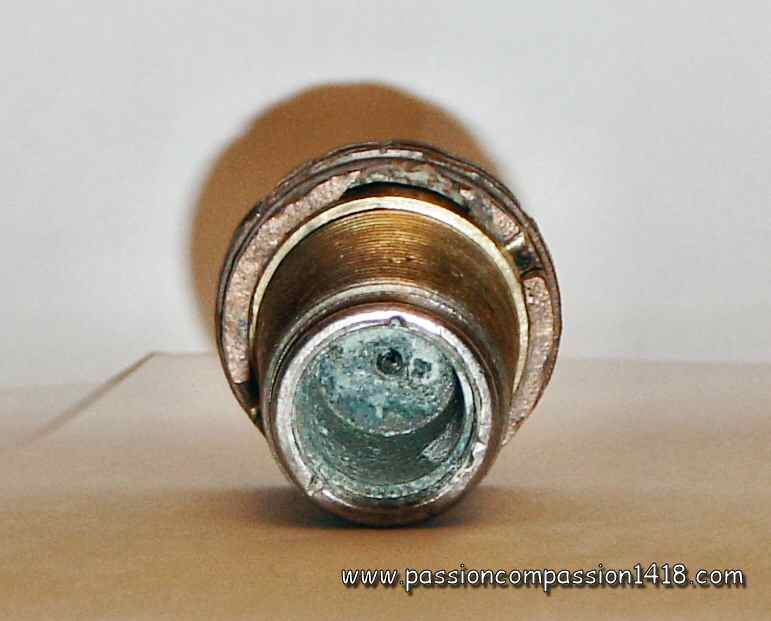
Percussion fuze N°44. Inne view of the detonator charge, with the communication channel hole. |
|
 |
 |
|
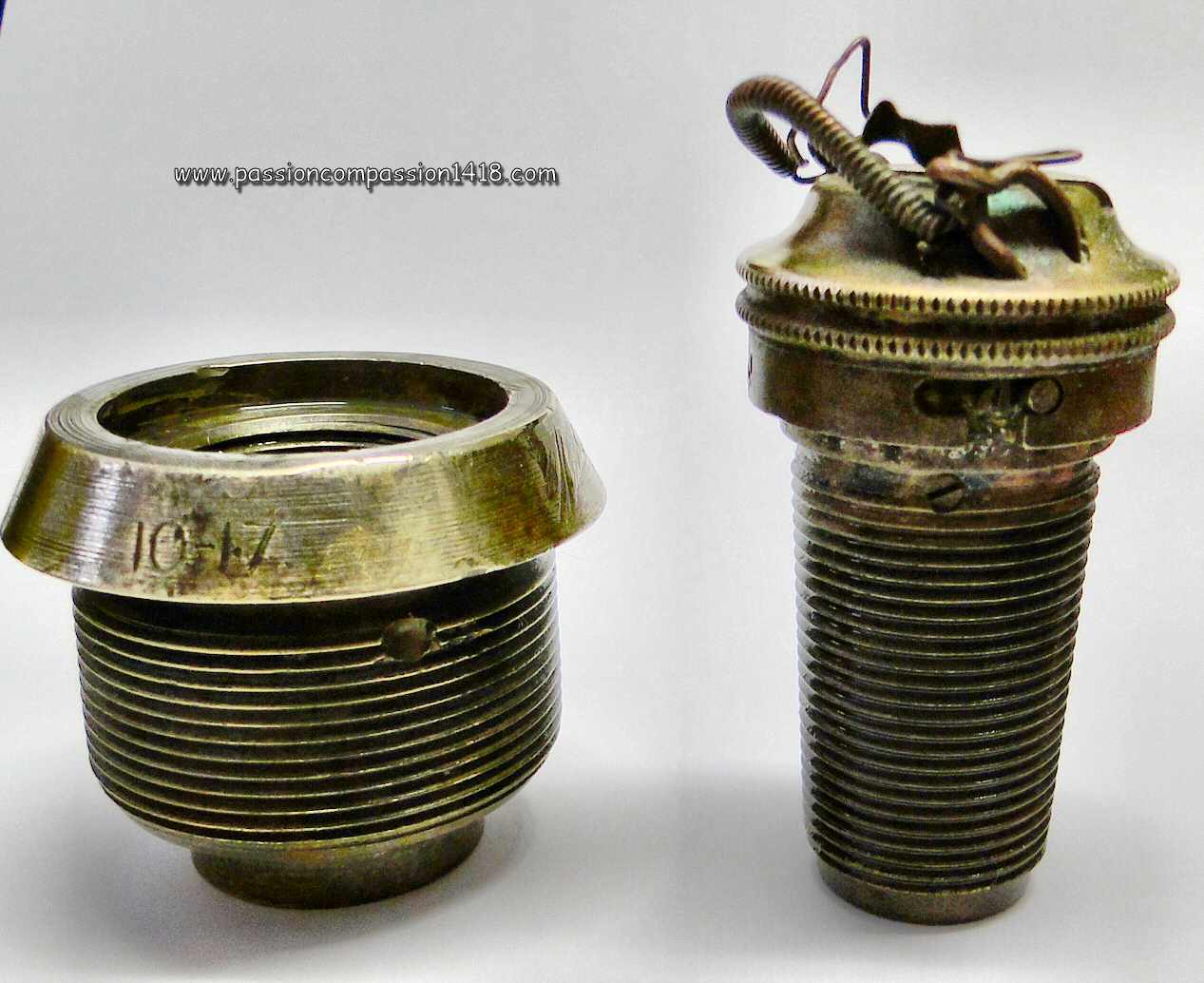
Percussion fuze N°44. This small fuze was usually assembled inside a thread adaptor that was needed to fit to the shell nose threaded holes. Picture courtesy Luc Malchair. |
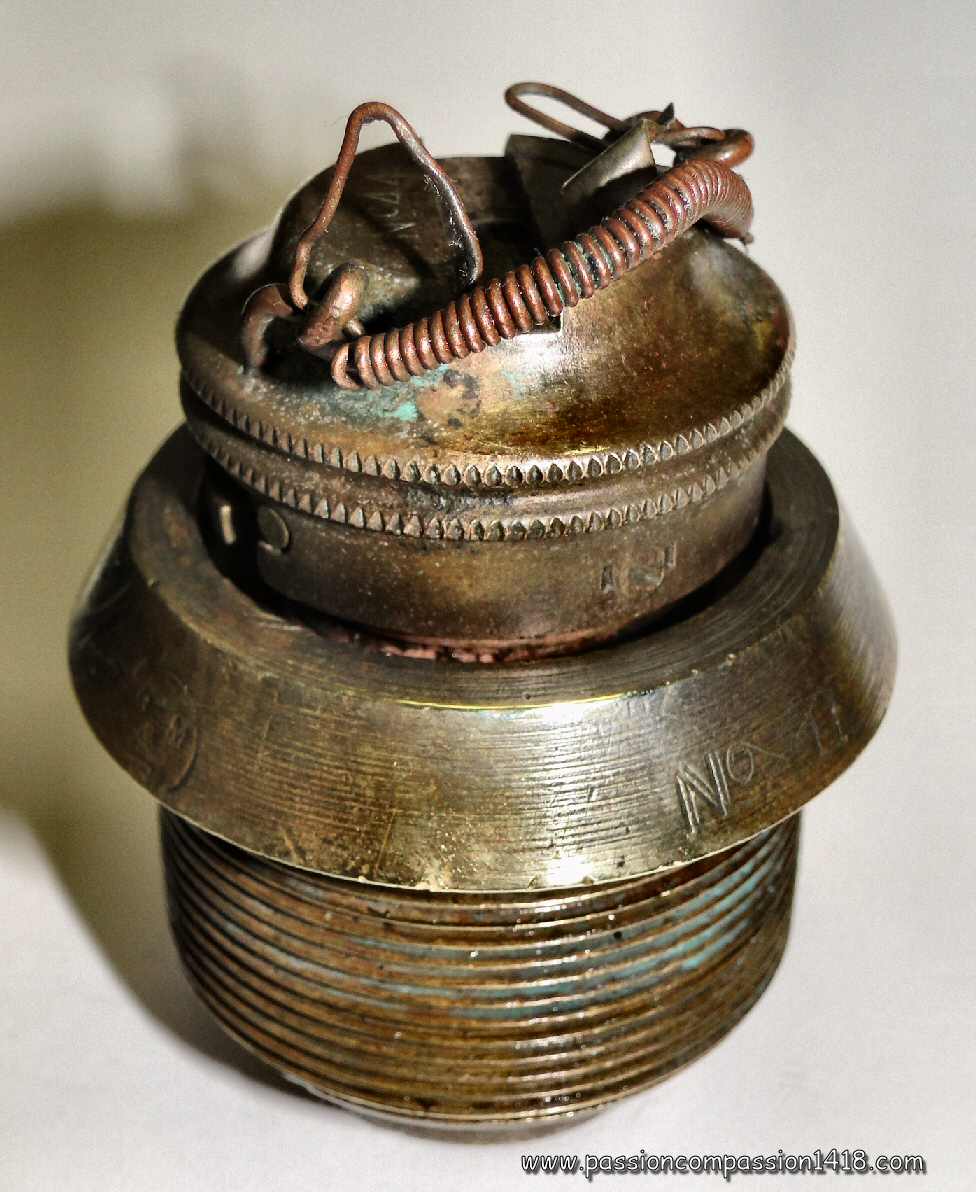
Percussion fuze N°44. Fuze assembled with the adaptor. Picture courtesy Luc Malchair. |
|
 |
||
Percussion fuze N°44. Wartime scheme |
||
Return at the top of the page |
||
N°100 fuze |
||
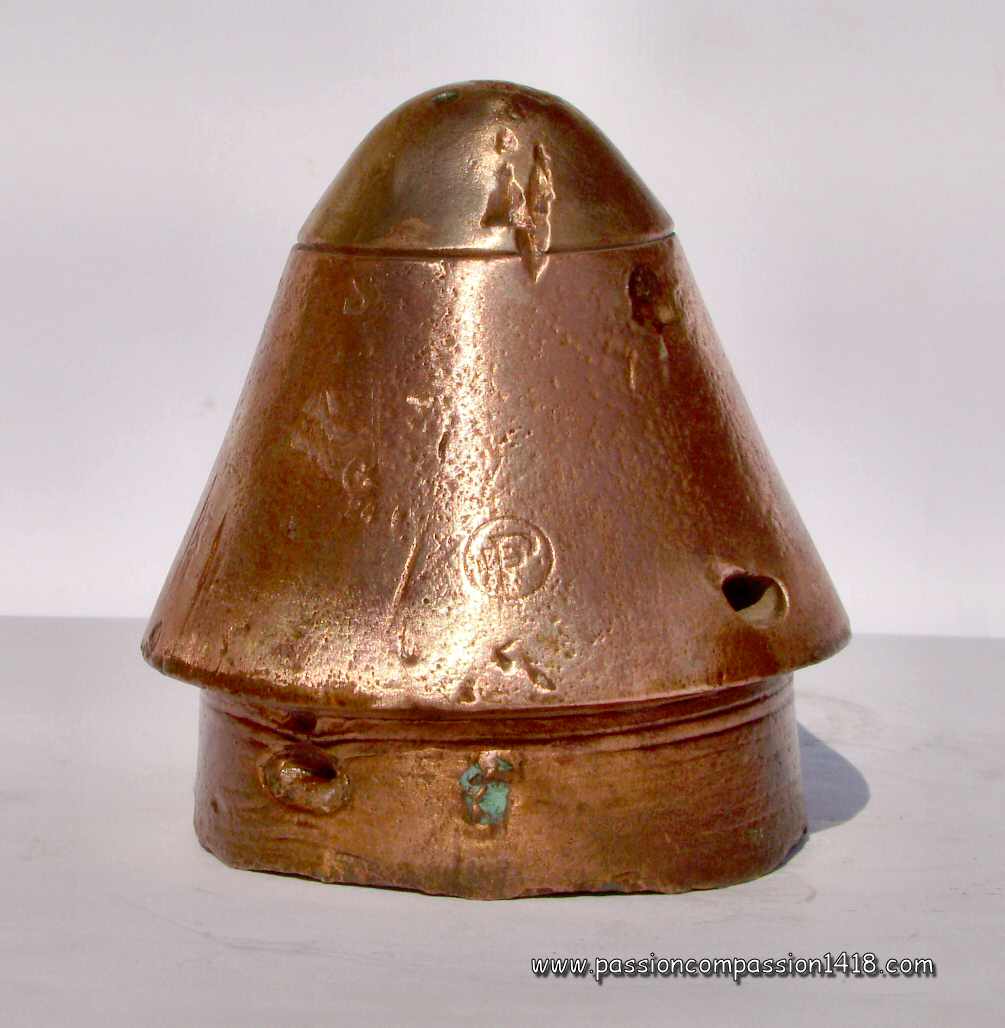 |
More sophisticated than the 'direct action fuzes', 'Graze fuzes' are the most usual percussion fuzes in WW1. The N°100 percussion fuze is the root of a rich family of numerous British percussion fuzes including the famous N°101, N°102, N°103, N°104, N°108, N°109, etc....
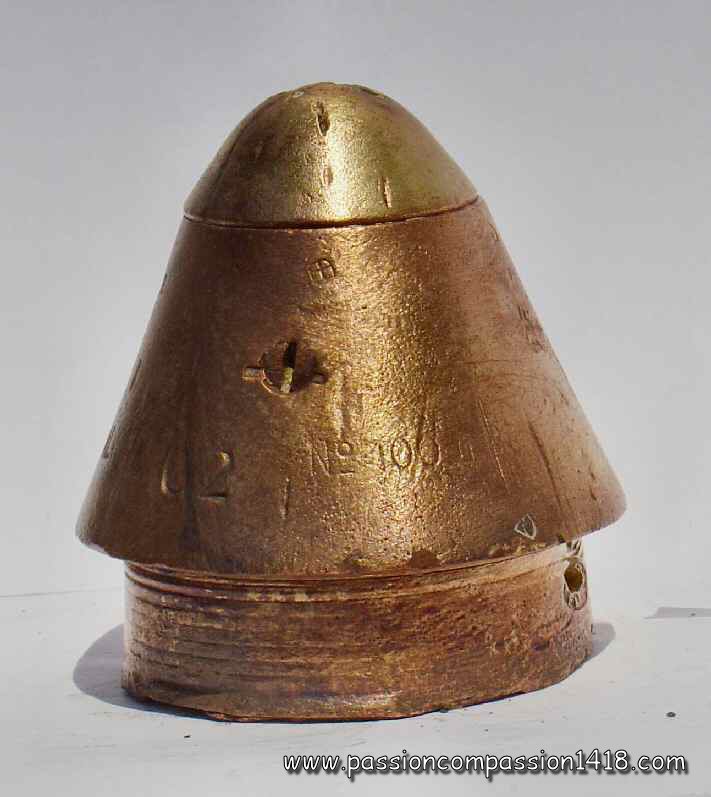
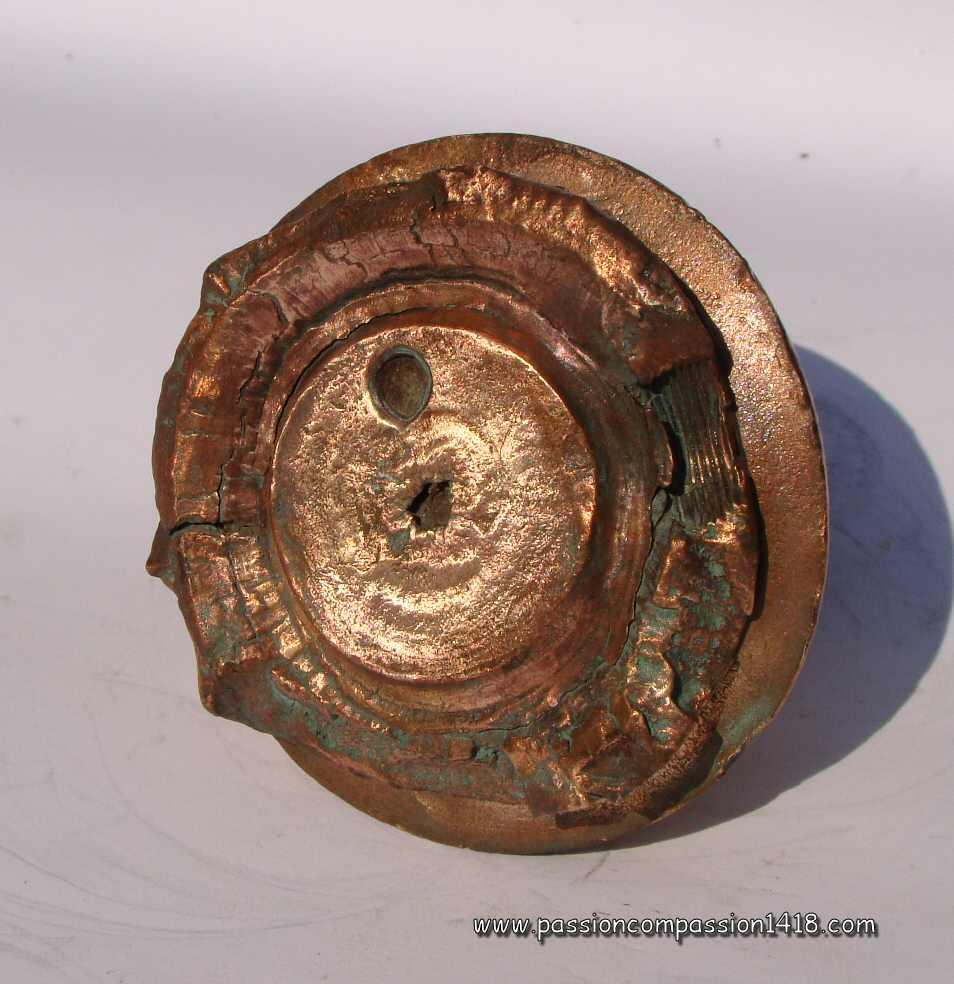
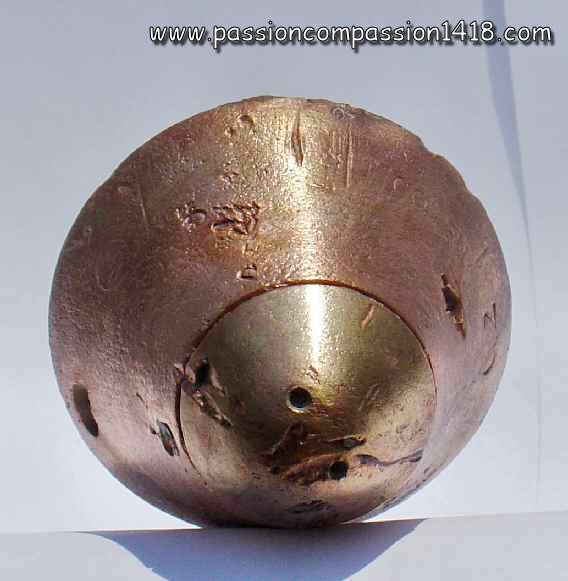
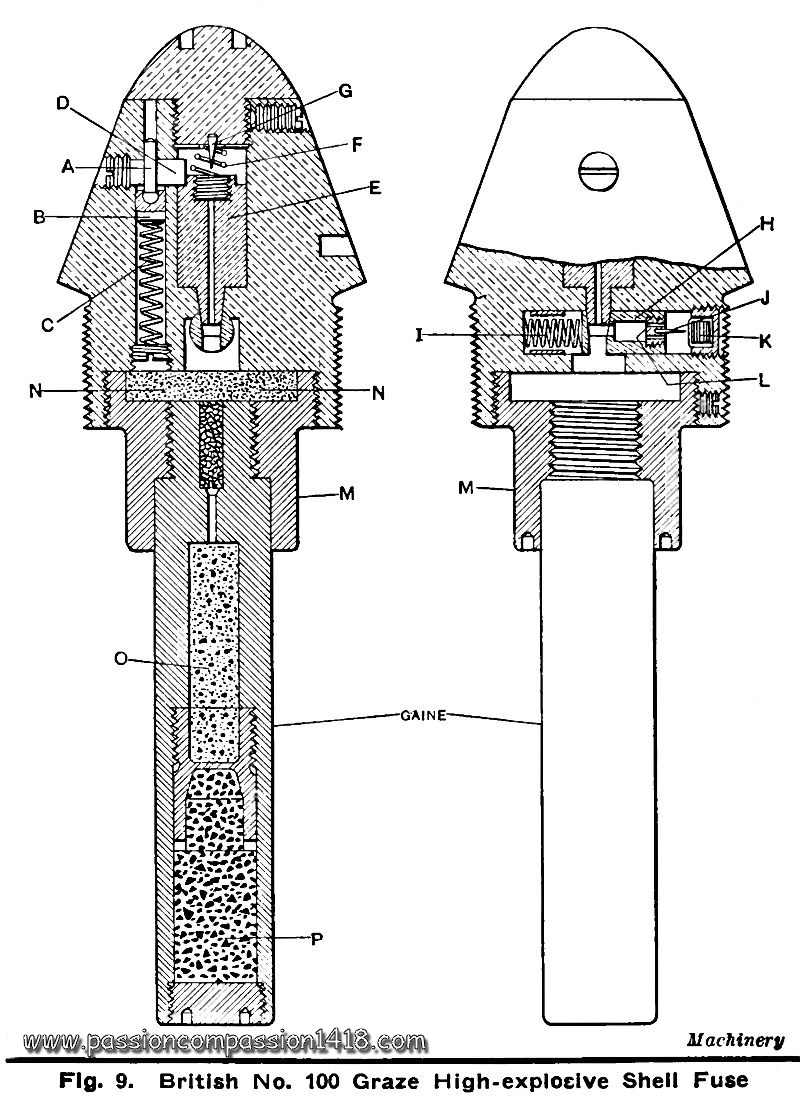
Designed in the emergency of the end of 1914, this model went from the engineering table to the production in 10 days only ! This unbelievable performance was a real success, but obviously didn't leave enough time for optimizing its manufacturing and the fuze properties. Despite its imperfections, the fuze N°100 was continuously used from 1915 to 1917. It was a classical graze action percussion system, working on the momentum action, although including a pretty specific design : the detonator cap / percussion pin was placed within a transversal cylinder machined at the fuze base. The detonator cap was static, and the mobile percussion pin could be projected against it by the action of a rear spring, just like a rifle striker. This movement was blocked by an axial stem linked to a mobile pellet located in the fuze axis and compressed by a spring. At impact time, this pellet was propulsed forward pressing on its spring, and provoked the freed the movement of the percussion pin striker towards the detonator cap. A centrifugal safety system was integrated that blocked the mobile pellet at rest. This lock was itself secured by a vertical rod compressed by a spring, retracred by the shock of discharge momentum. This ingenious system was allowing an identical detonator cap percussion force whatever was the angle of the shell impact on the target (as far as the axial stem worked) This fuze equipped the explosive shells of the :
|
|
Percussion fuze N°100-I. |
||
 |
 |
|
Percussion fuze N°100-I. Item in average condition. Markings : N°100 IB - S - G26 - circle with two P - RL - 3 I - 3/16 - 02 |
Percussion fuze N°100-I. Rear view |
|
 |
 |
|
Percussion fuze N°100-I. Top view |
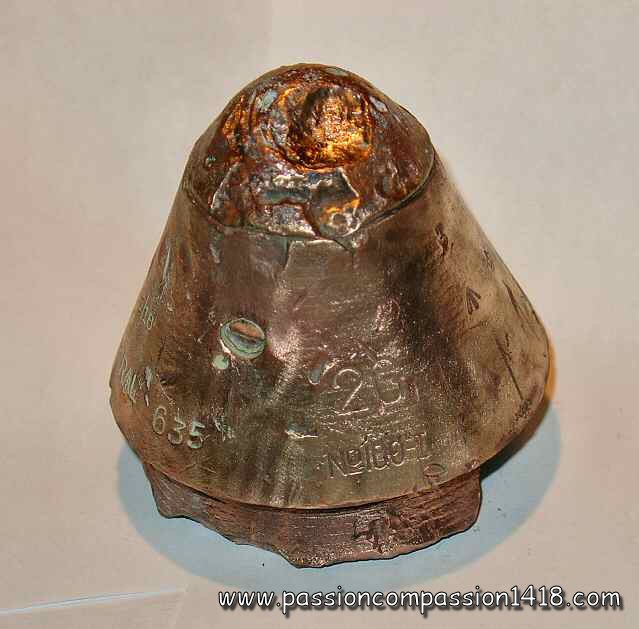
Percussion fuze N°100-I. A more corroded piece. Markings : N°100-I - 2G - 8 - circle with one Z - 1915 - 1/16 - LOT RAL 635 |
|
 |
 |
|
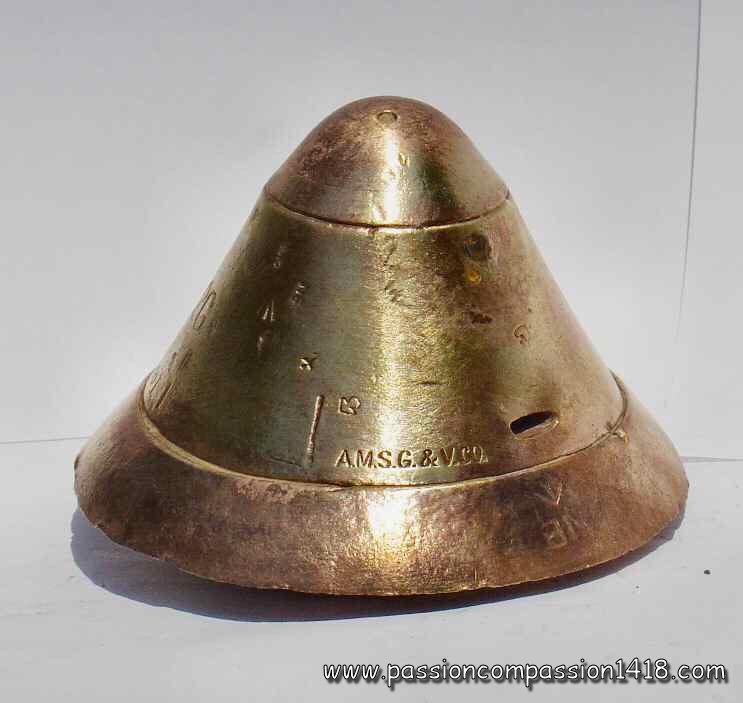
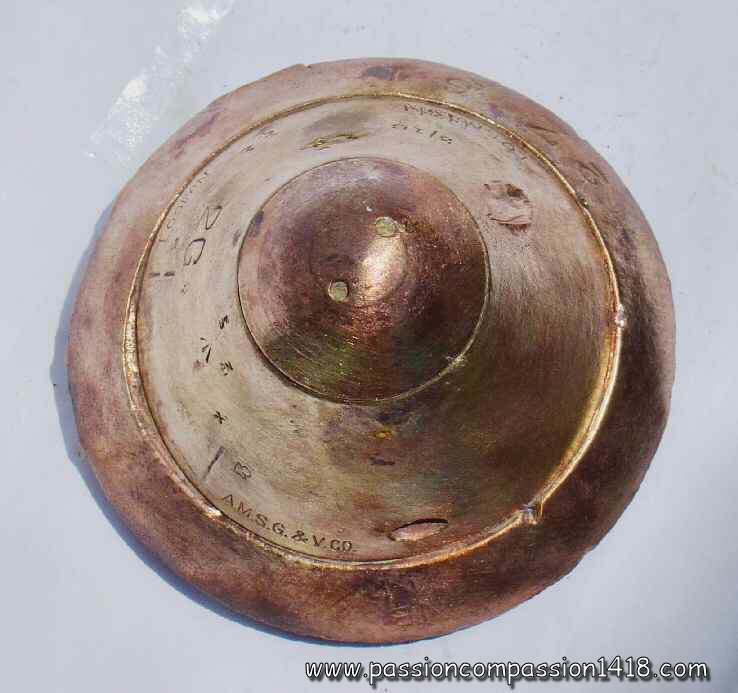
Percussion fuze N°100-I. Nice piece assembled with an adaptor. |
Percussion fuze N°100-I. Top view. Markings : N°100 I - 2G - A.M.S.G. &V.CO. - 3/16 - LOT N°255 - RAL - 88. On the adaptor : 2 Z 6 1 |
|
 |
||
Percussion fuze N°100-I. Wartime scheme. On the scheme at the right see the transversal percussion system specific to this design. |
||
Return at the top of the page |
||
N°101, N°101 B, N°101 E, N°101 EX and N°101 ER fuze |
||
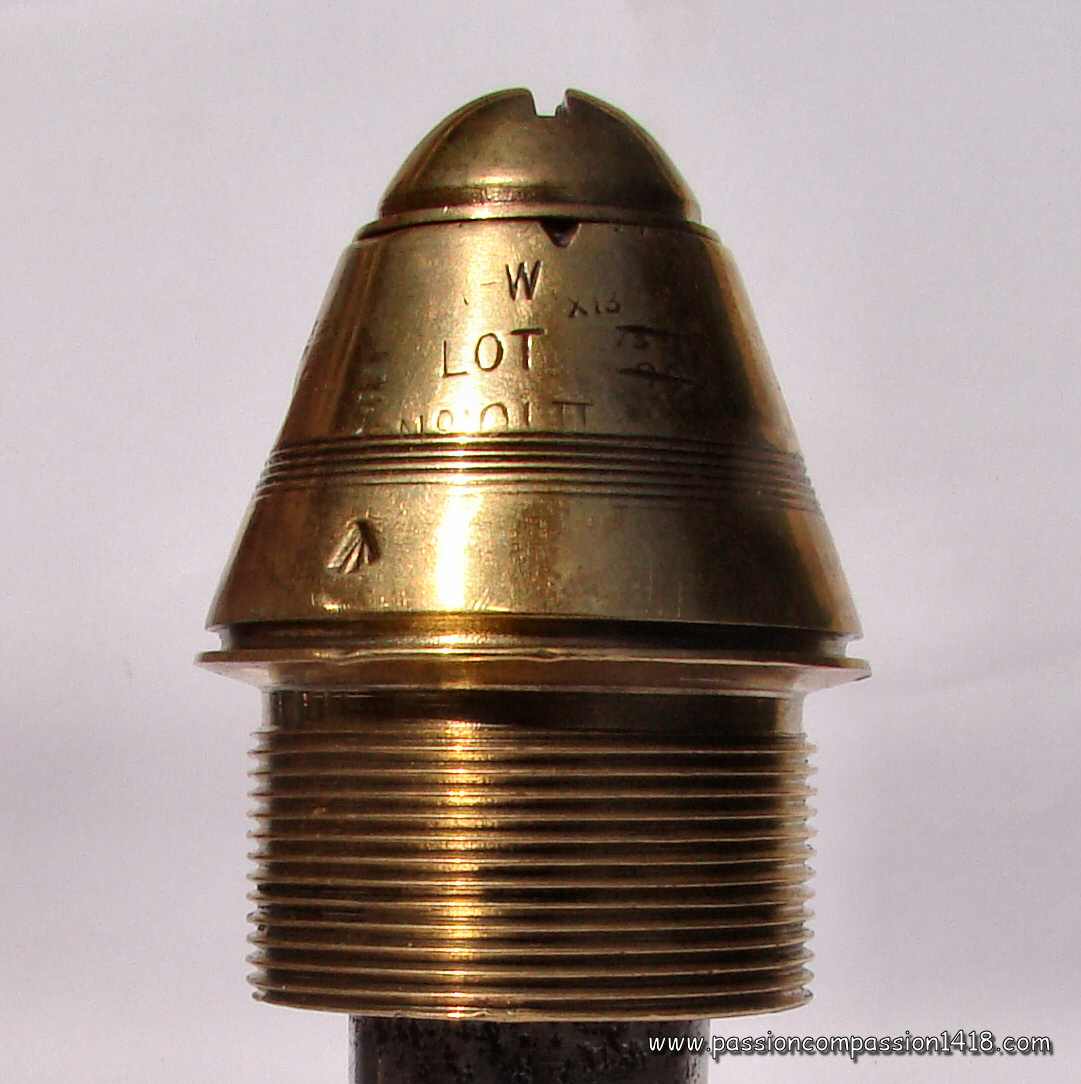 |
The British Armies standard percussion N°100 fuze, introduced in emergency in 1915, gave its place to successive improved models named Percussion fuze N°101, N°102, N°103, N°104, N°108, N°109, that altother include more than 89 different fuzes when adding their different models and versions !
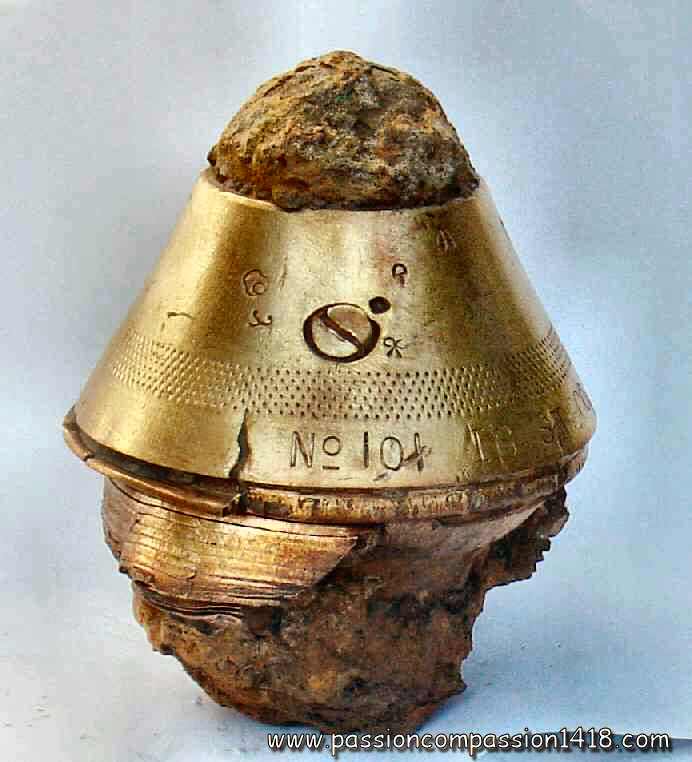
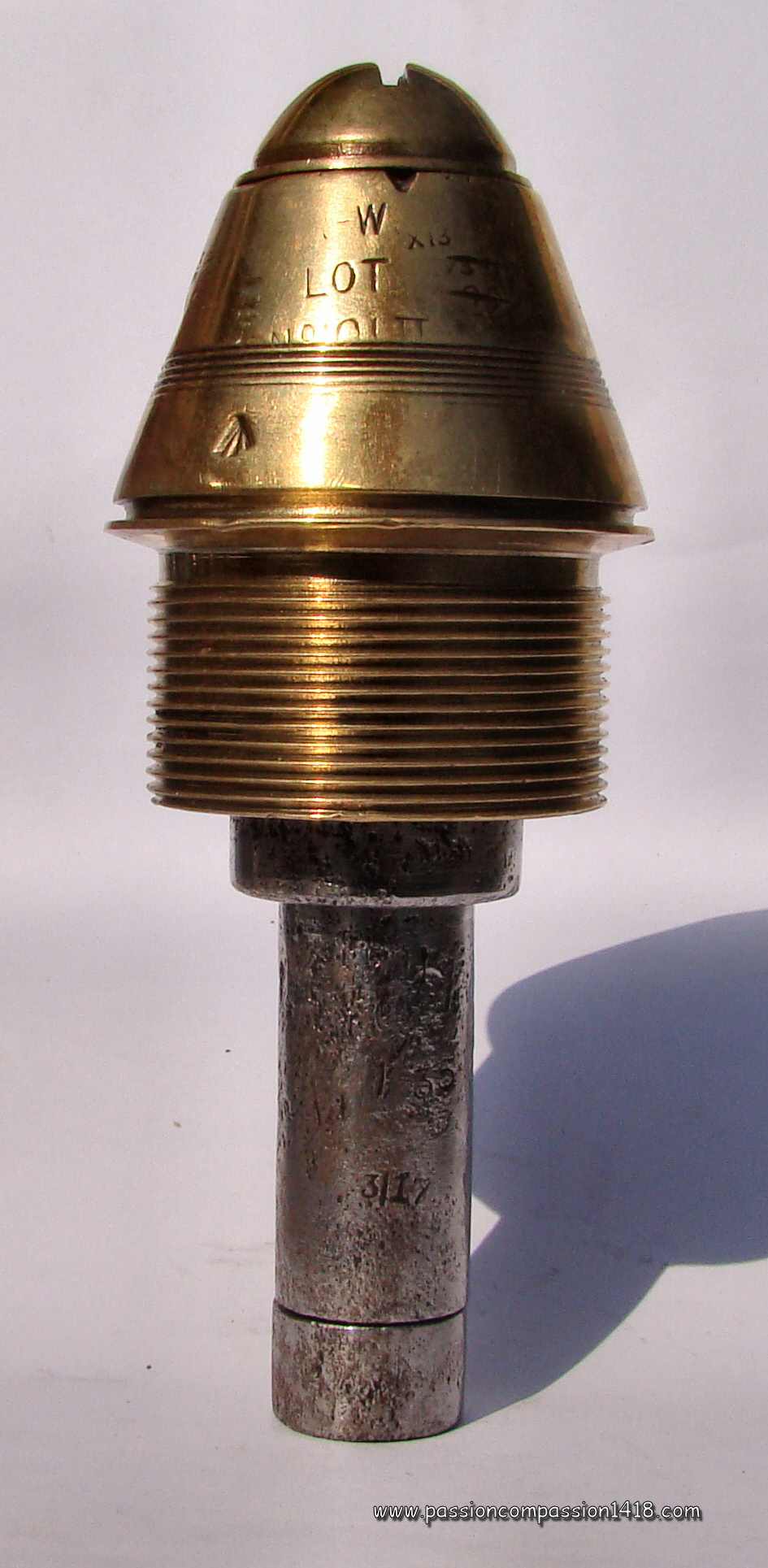
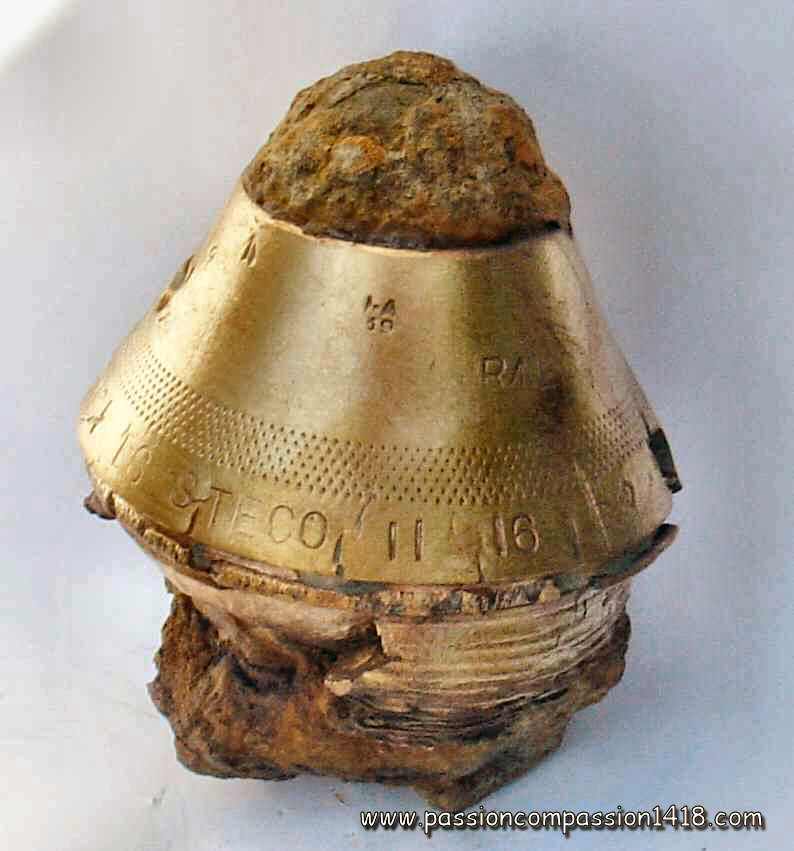
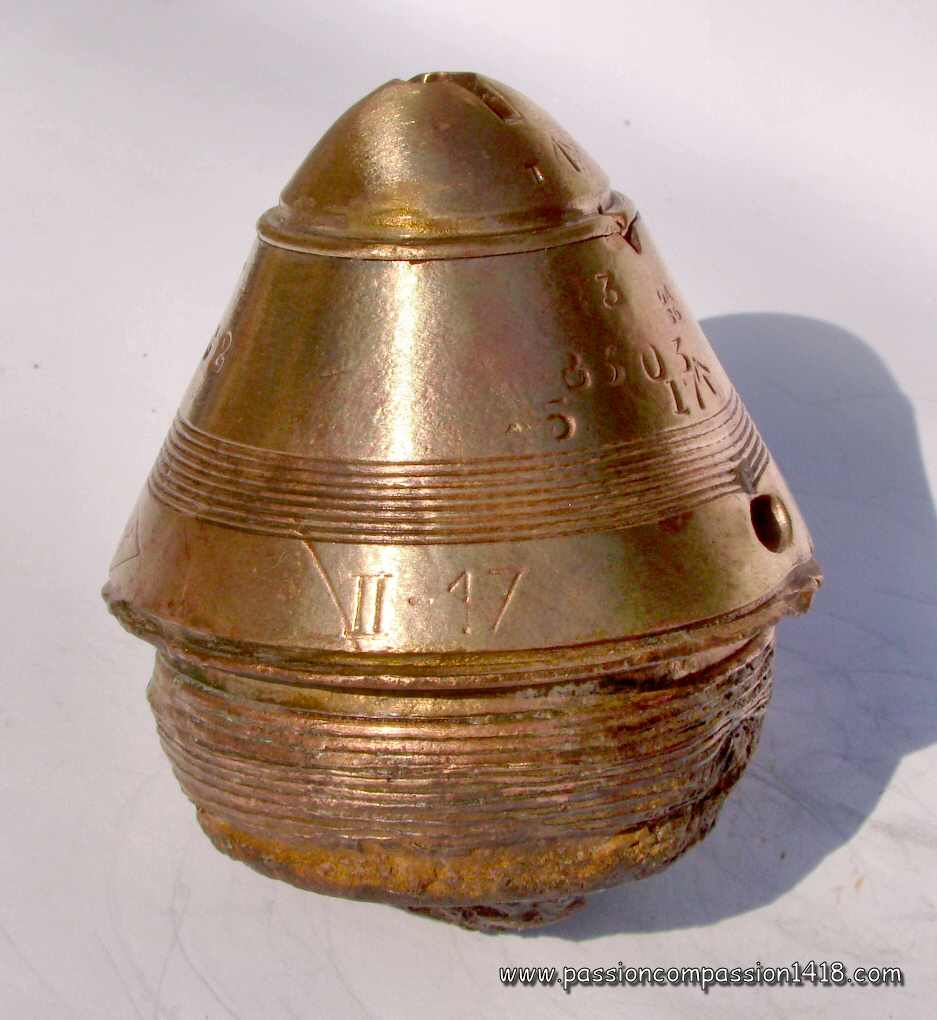
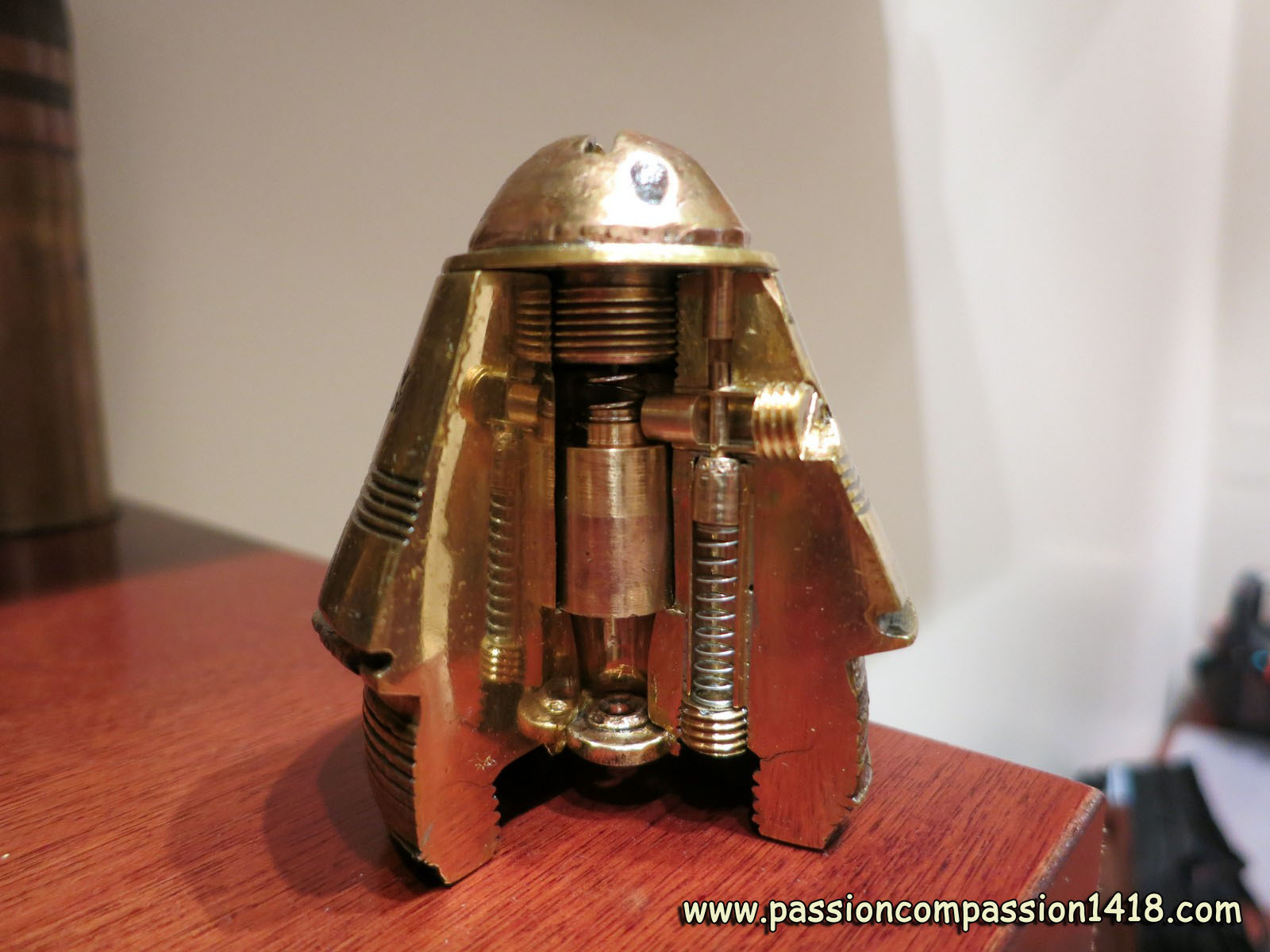
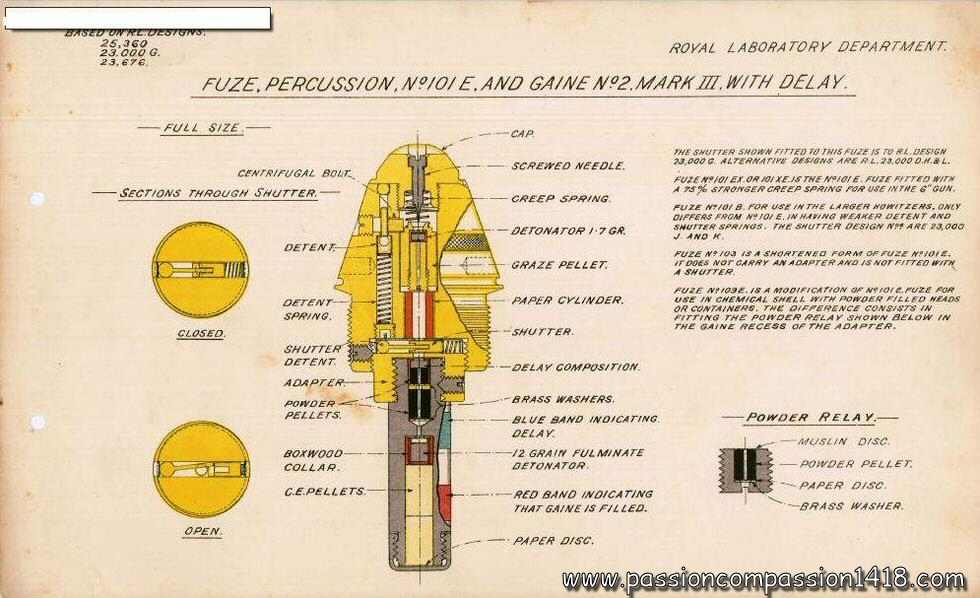
The N°101 percussion fuze is the first evolution introduced in 1916 with the replacement of the unusual transversal percussion system by a more conventional percussion system where the detonator cap is mounted on an axial graze pellet and the percussion pin (needle) fixed under the fuze head cap, both being separated from eachother at rest by a safety creep spring. The fuze centrifugal safety system (transversal bolt restraining the pellet movement) remained unchanged. A gunpowder relay charge was included under the pellet, and the pyrotechnic chain could be added with a small delay charge. The fuze body was still in brass (sometimes with a steel cap) with a similar shape to the N°100, the only visible difference being machined circular grooves on the cone face, and a deeper groove at its base used for blocking the fuze on the shell after mounting, by crimping this zone with a hammer and a stamp. In addition to the different marks (I to IV) several variations of this fuze were introduced during WW1, including :
This fuze was therefore used mainly with the high explosive shells of the :
|
|
Percussion fuze N°101 II. |
||
 |
 |
|
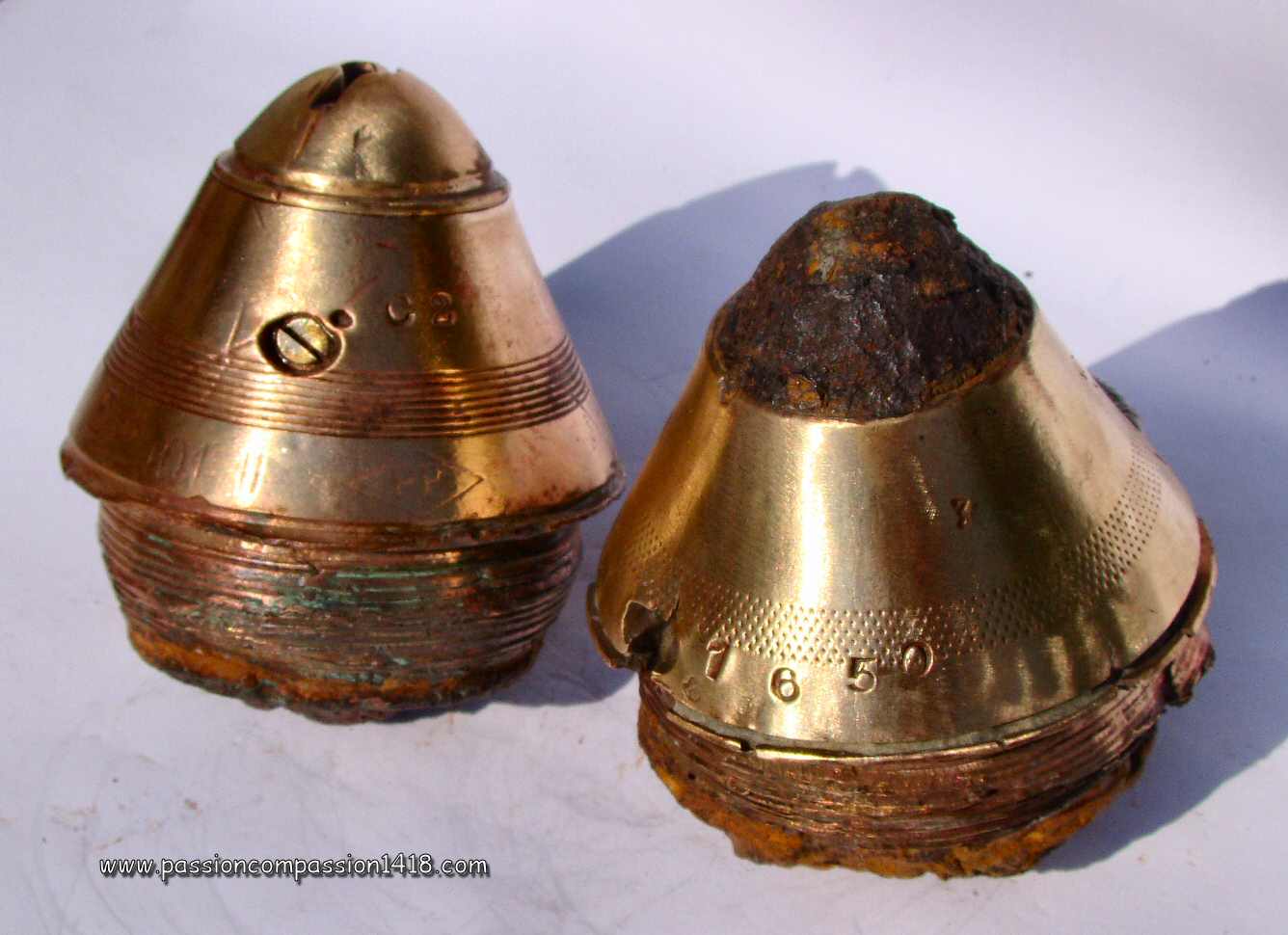
Percussion fuze N°101 I. Markings 'N°101 - IS - STECO - II - 16 - 500 - 1 - 6 - 5 - 0 - RAL '. Brass body and steel head. |
||
 |
||
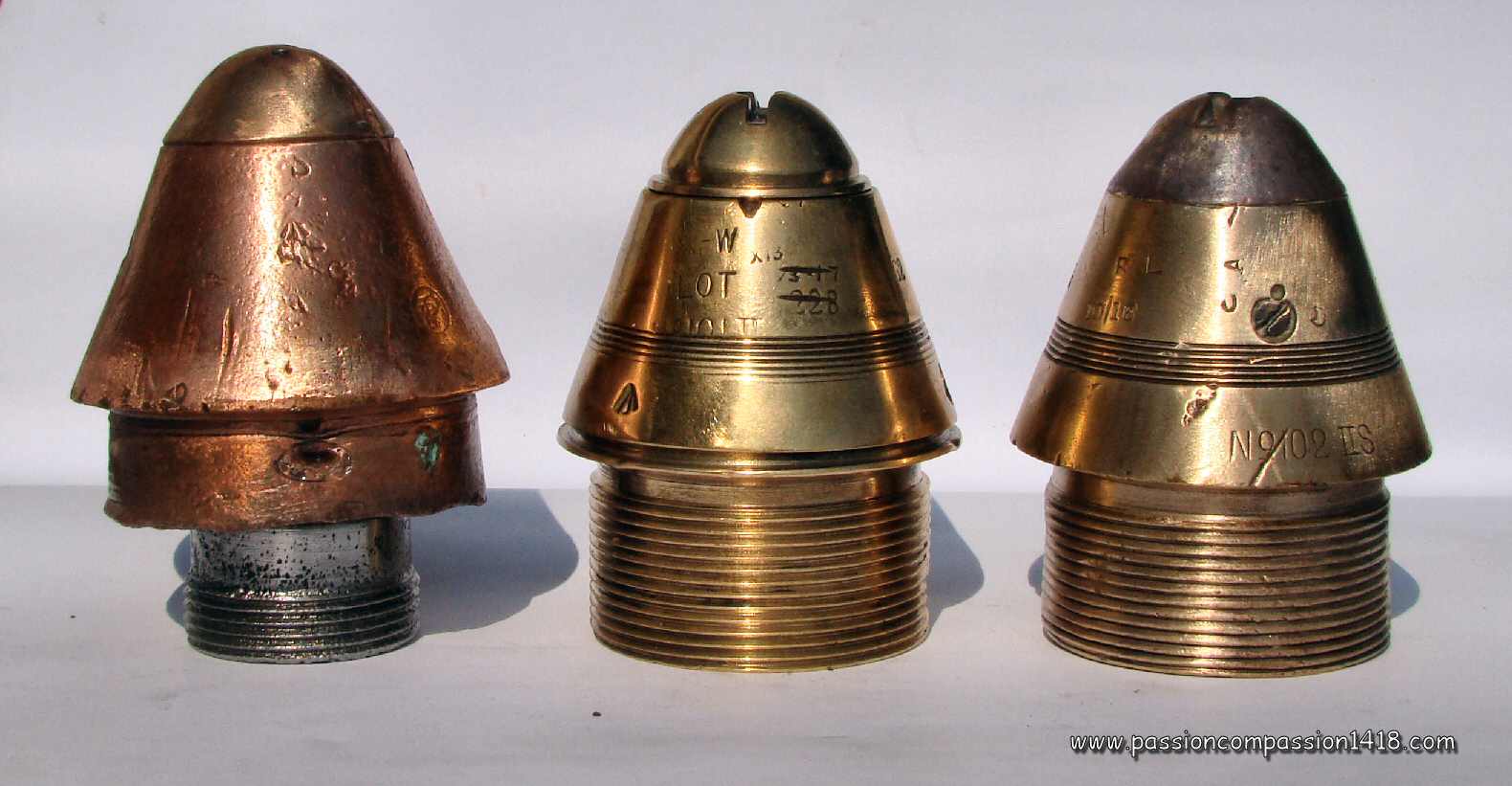
Percussion fuze N°101 I. Markings 'N°101 - II - LOT 3 17 (barred) 228 (barred) - G2 - F21 - 4/17 - 1060 - NB. Brtass head and body; assembled with a detonator (markings 135 - 3/17). |
Percussion fuze N°101 II. Markings 'C2 - PP - II-17 - 1 - F3 - GA65 - 8303 - 5 17 (up arrow) - 6 - E - N°101 II'. |
|
 |
||
Percussion fuze N°101. Note the circular grooves on the cone faces were sometimes replaced by a pattern |
||
 |
 |
|
Percussion fuze N°101. Cut through showing the percussion system and centrifugal bolts safety rooms (courtesy Vladimir M). |
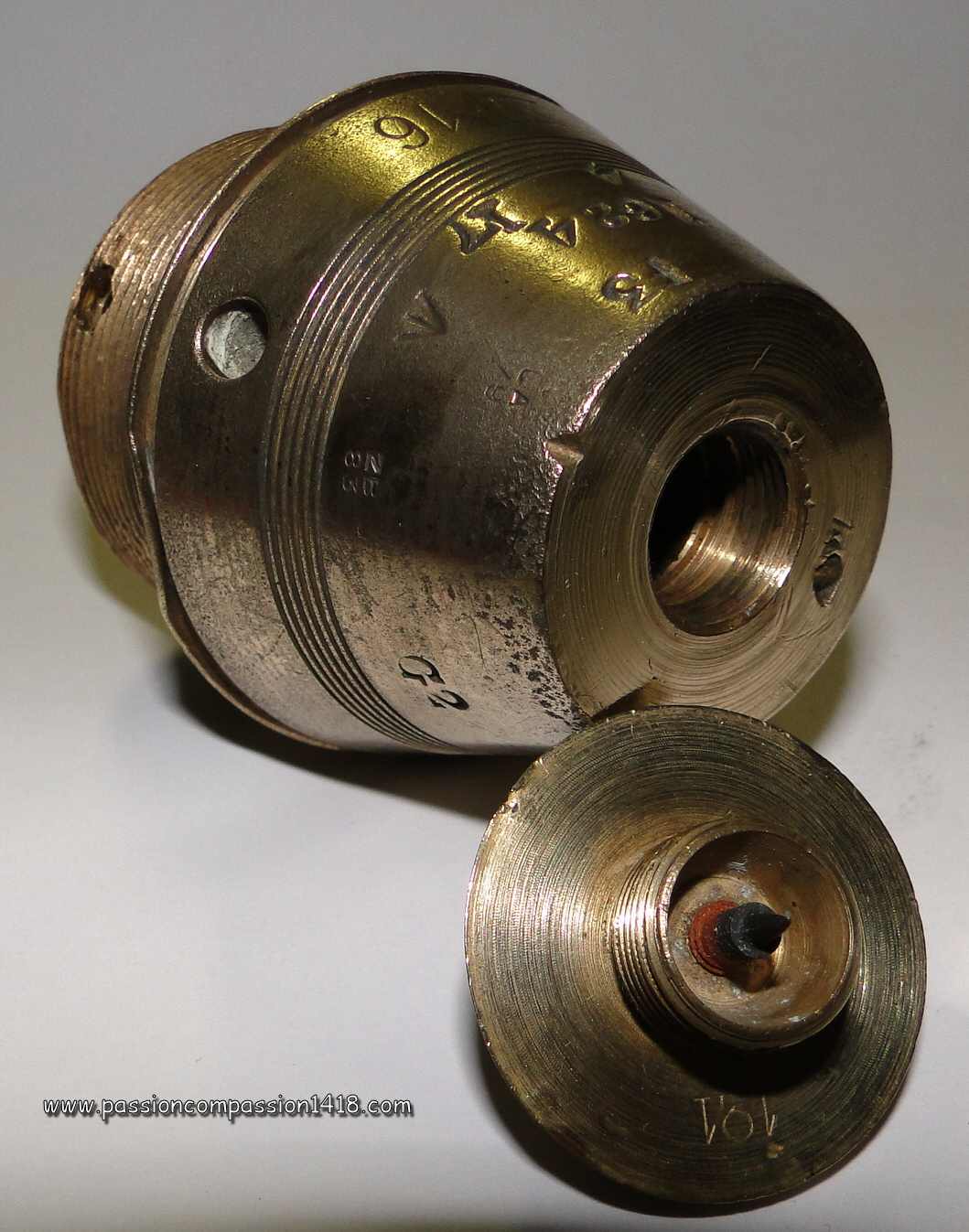
Percussion fuze N°101 II. Cap unscrewed and percussion pin. Picture courtesy Luc Malchair. |
|
 |
||
Percussion fuze N°101E with detonator and delay, wartime scheme |
||
Return at the top of the page |
||
N°102, N°103, N°108, N°109 and N°109 E fuze |
||
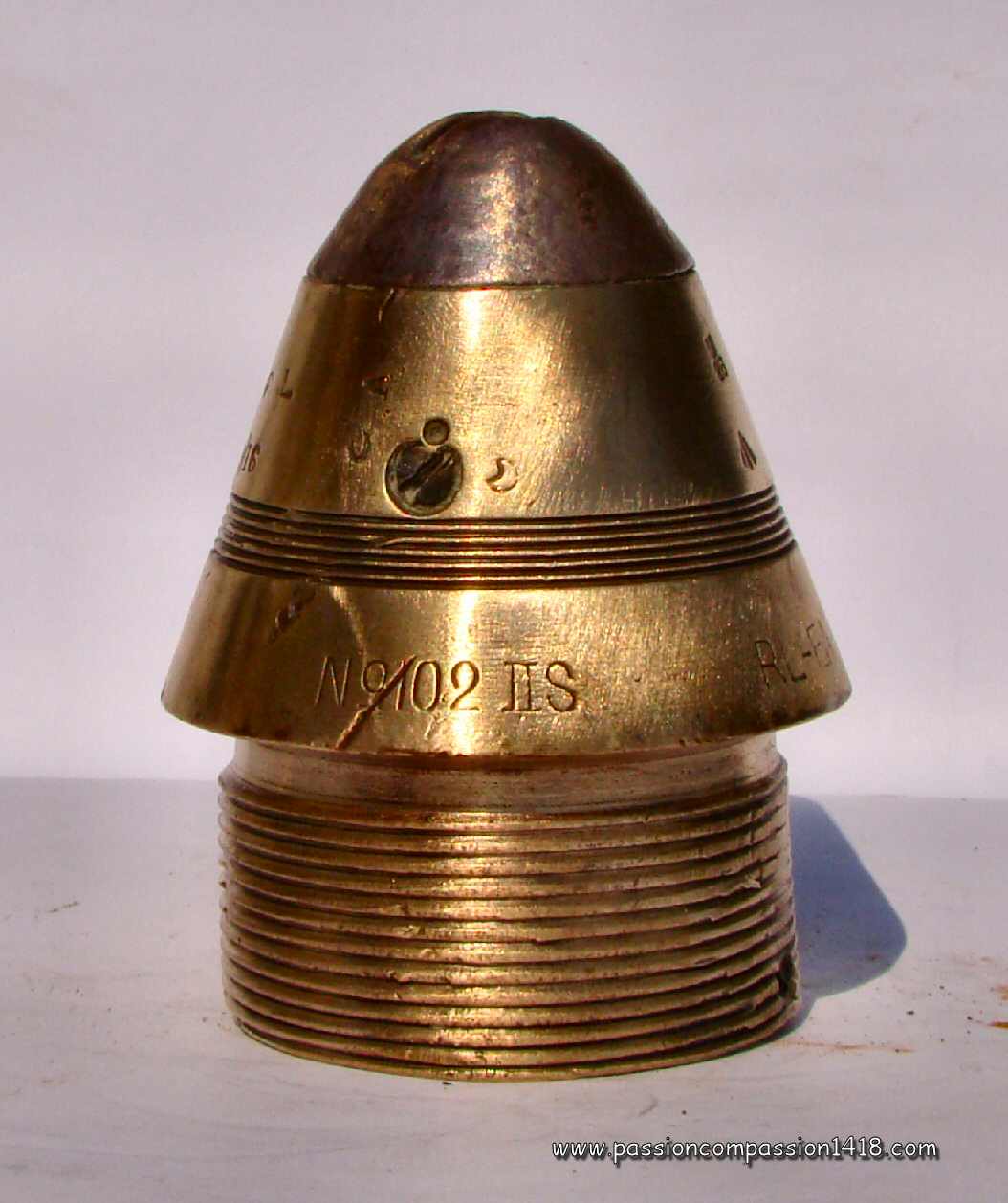 |
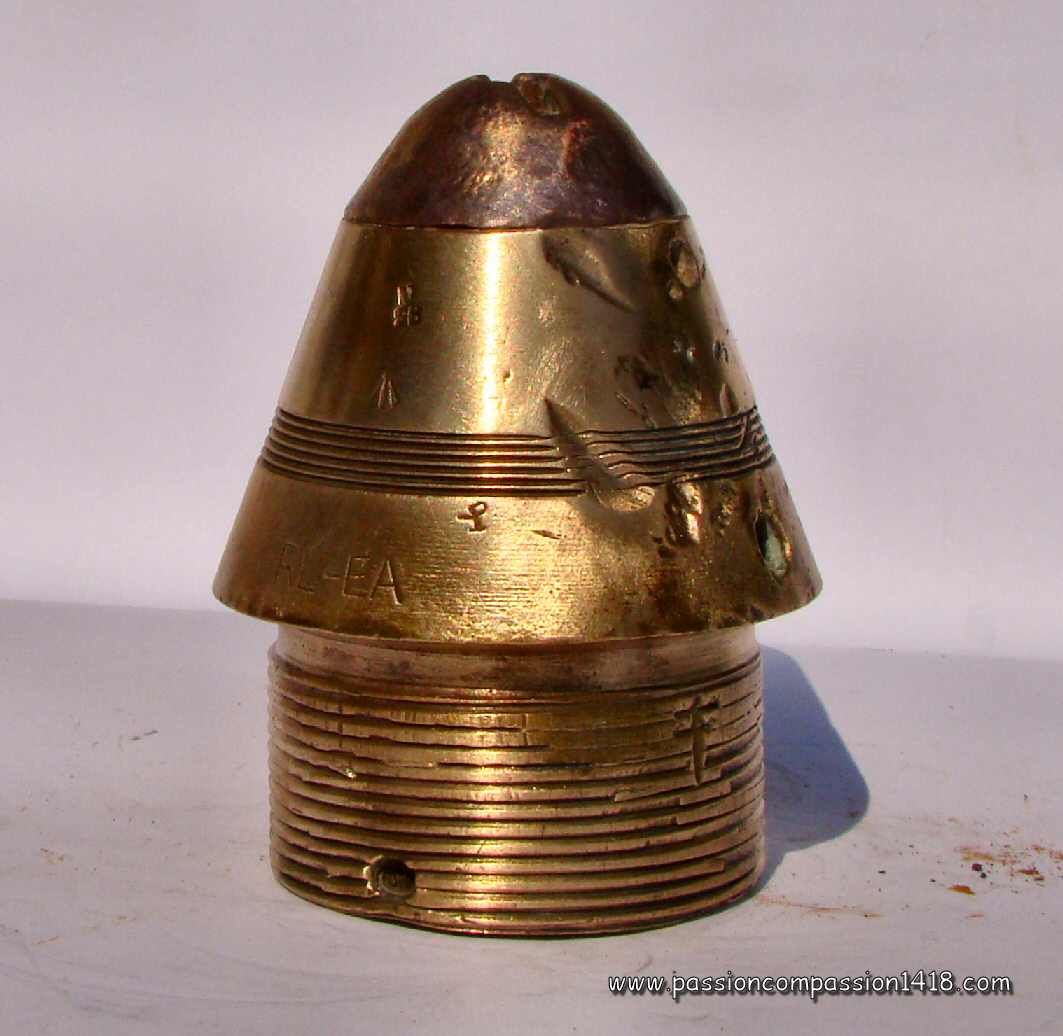
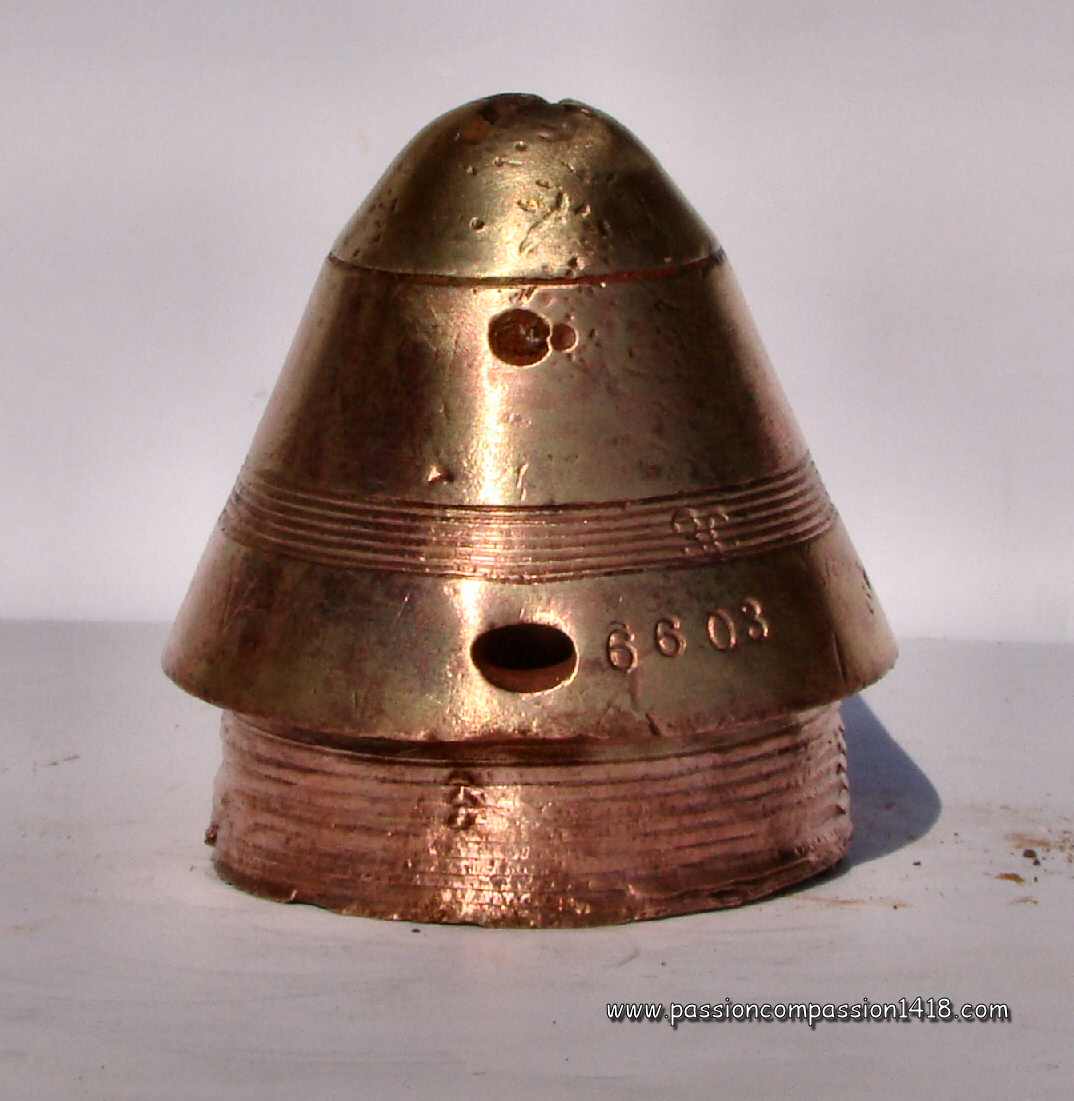
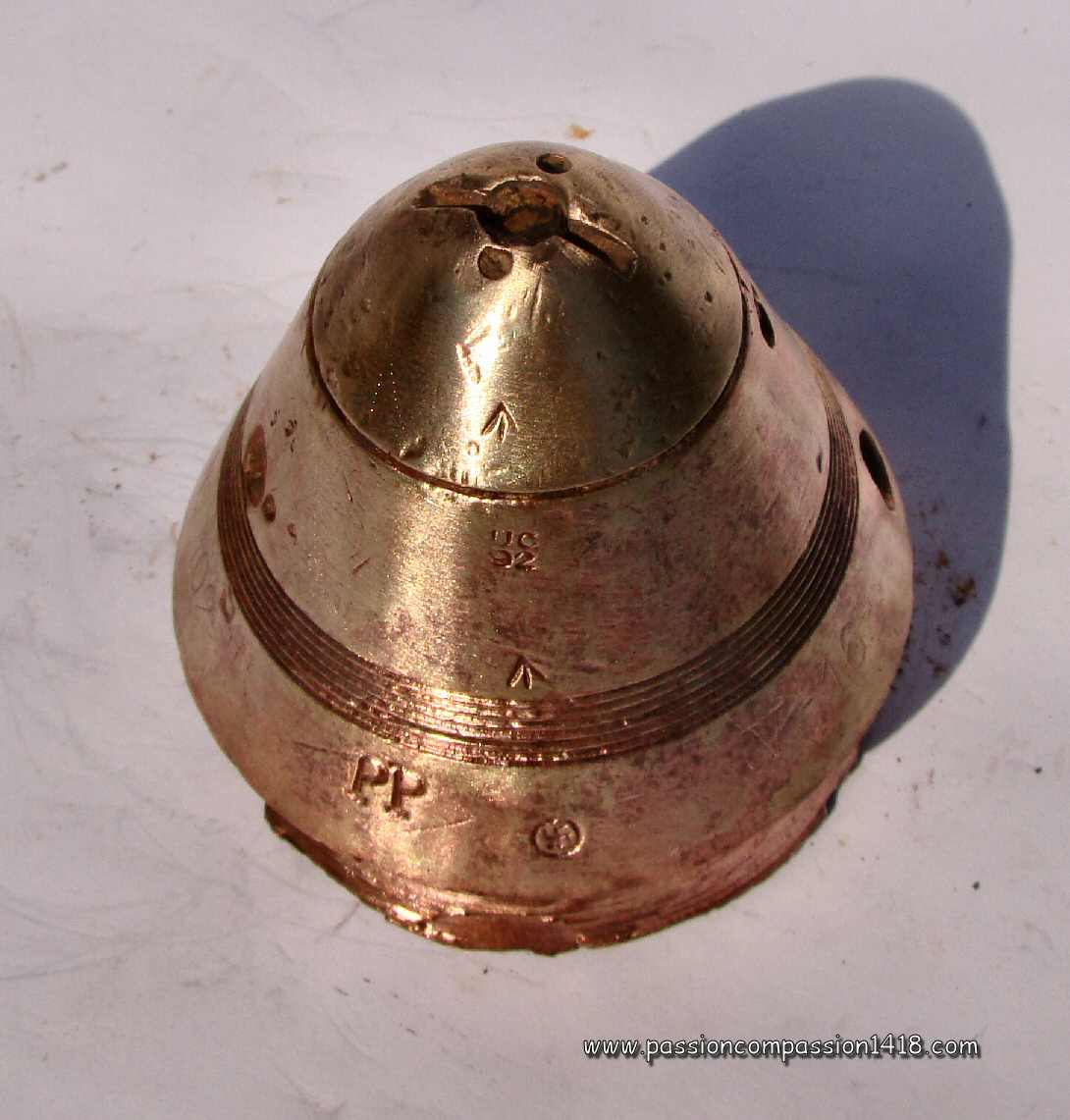
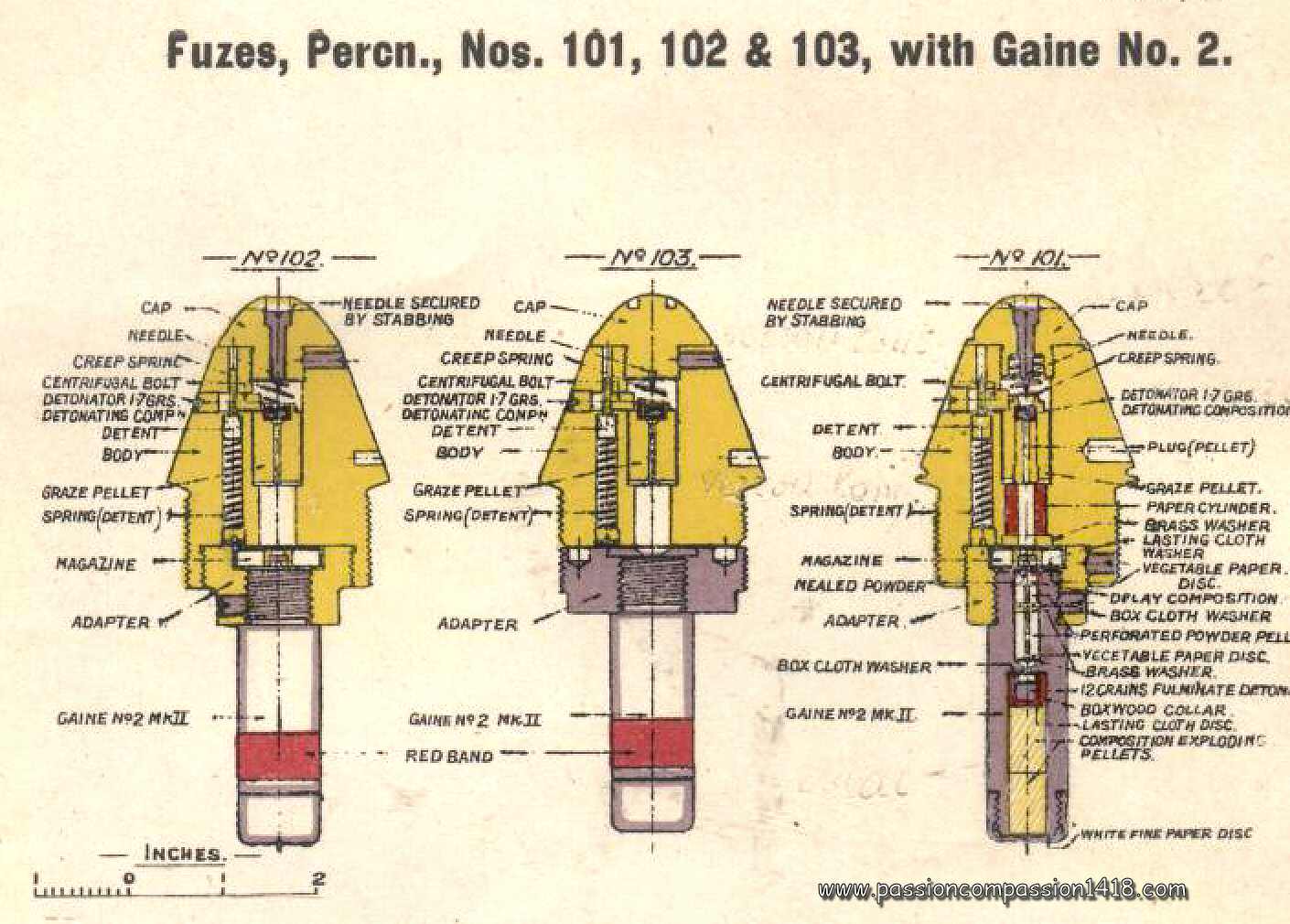
The N°101 graze percussion fuze gave birth to several variants during WW1 :
|
|
Percussion fuze N°102 II. |
||
 |
 |
|
Percussion fuze N°102 II. Brass head and body. Markings 'N°102 IIS - RL-EA - 41 - RL - 10/16' |
Percussion fuze N°102 II. Brass head and body. Markings 'N°102 II - PP (in a rhombus) - V-16 - 3C - 6603 - 3/17 - RL' |
|
 |
 |
|
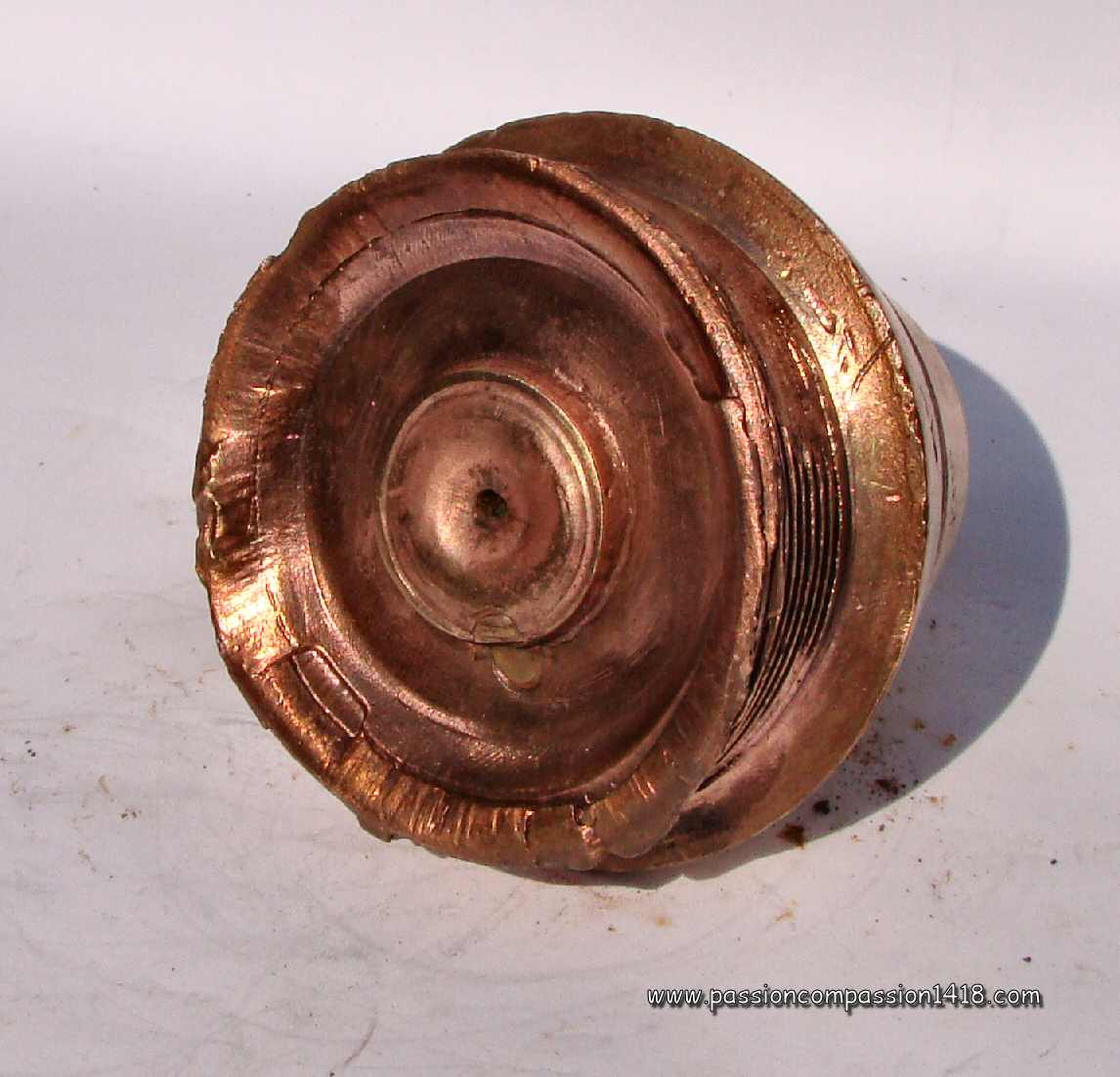
Percussion fuze N°102 II. Top viem with the cap groove |
Percussion fuze N°102 II. Bottom view |
|
 |
||
External shape evolution of the N°100, 101 and 102 fuzes |
||
 |
||
Percussion fuzes family N°101, N°102 and N°103. Wartime scheme |
||
Return at the top of the page |
||
N°106, N°106E and N°115 fuze |
||
 |
The lessons learned during the war years led the fighting countries armies to continuously develop new equipments. In particuliar, the percussion fuzes sometimes failed in the muddy grounds battlefields of Flanders where the British Armies were engaged. In these conditions, the landing impact energy could be so much absorbed by the mud that the fuze deceleration was not quick enough to trigger the usual mechanisms of the existing graze percussion fuzes, or the ground not hard enough to deform the head of the 'direct action fuzes'.
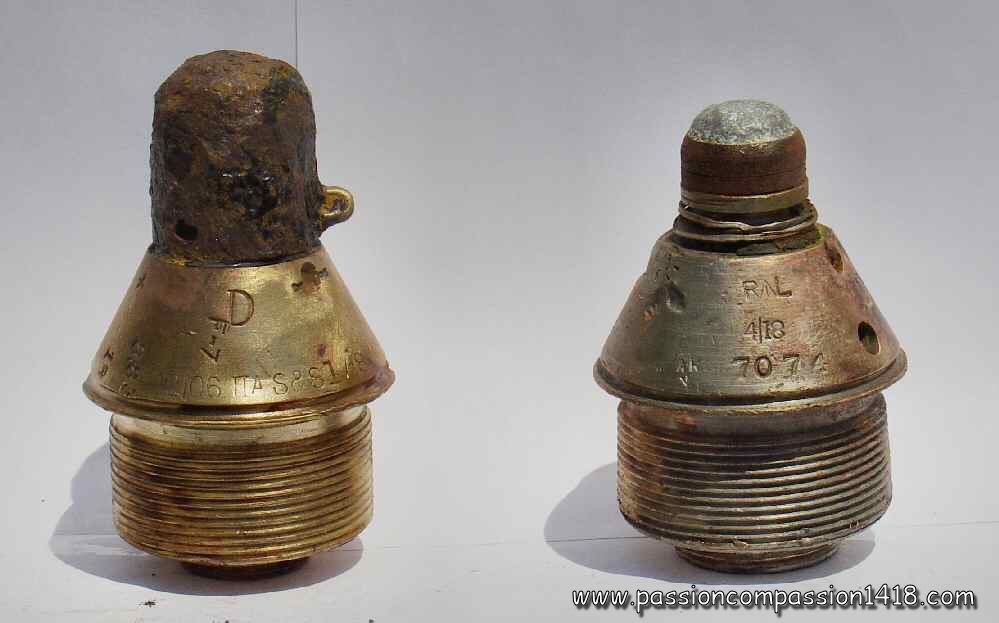
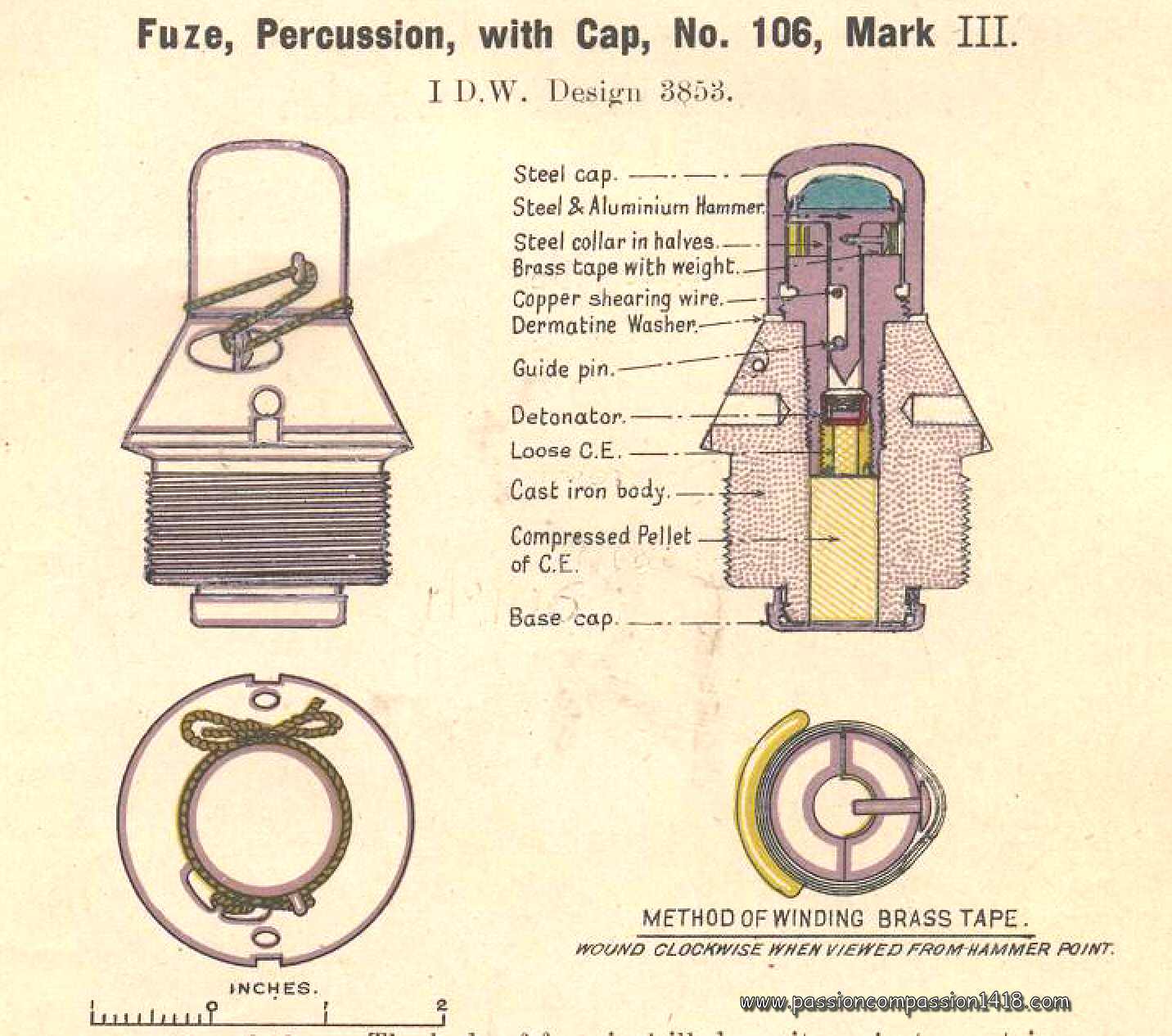
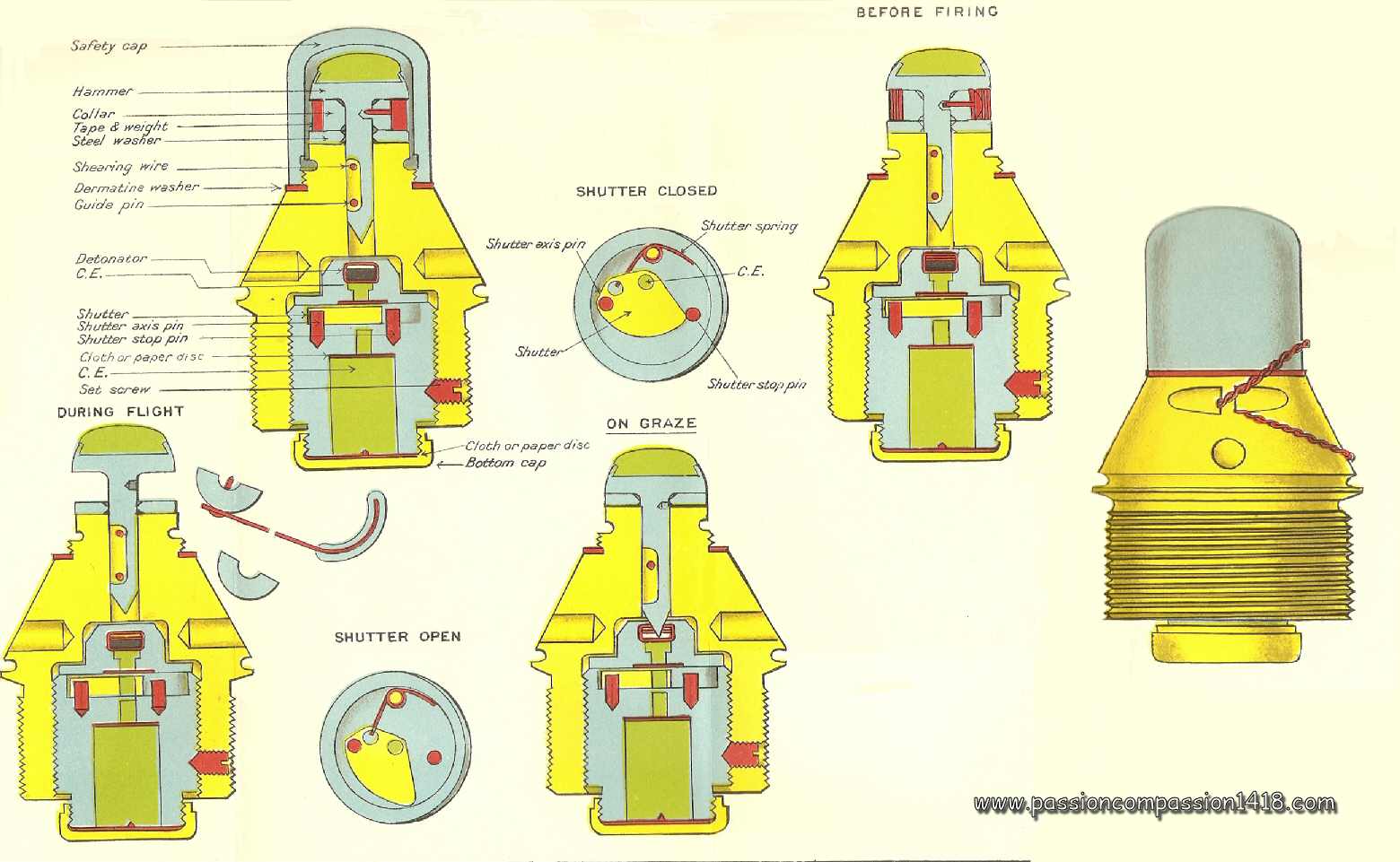
Moreover, the classical projectiles and their fuzes were not really efficient for barbed wires destruction, that were too weak a target to trigger the percussion fuzes of high explosive shells, and a too small one to be aimed by shrapnell shells. The N°106 super-quick percussion fuze is the British answer to these new requests. Inspired by a French 1915 concept (the 'fusée IAL'), it was designed to be very sensitive to landing impacts, even in soft grounds or on non resisting targets. It was therefore a 'super quick' direct action fuze. It was tested at the end of the summer of 1916, and distributed to the batteries in the early 1917. The basic principle was very simple, asa direct action fuze can be : a mobile percussion head, composed with a steel hammer covered by a hemispheric aluminium hat was mounted on an axial steel rod acting as a percussion pin able to hit a detonator cap that would burst a flame via a central communication channel to the rear explosive load. On the contrary, the safety devices of this ultra-sensitive system were very complex, avoiding any kind of safety springs that would have given some mechanical unwanted delay, but including :
|
|
Super-quick direct action percussion fuze N°106 IIA. |
||
 |
||
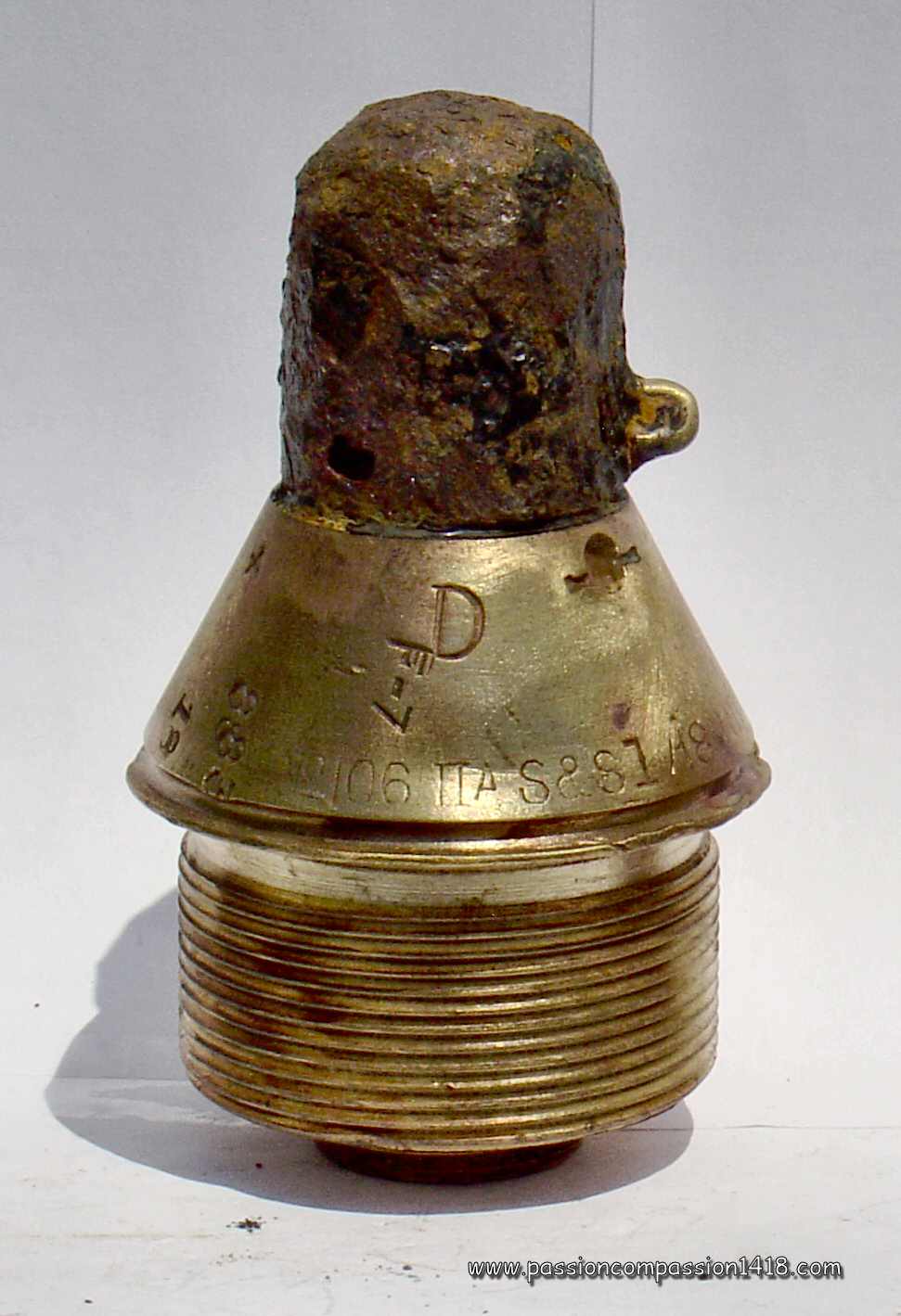
Super-quick direct action percussion fuze N°106 IIA. The item on the right side has lost its protective hard hat and shows the percussion mechanism. Traces of black paint on the hard hat of the item on the left side. Markings on the left side fuze : N°106 IIA S&S L A8 LOT - 235 - UL3 - 4/18 - 883 - D - F7.) |
||
 |
||
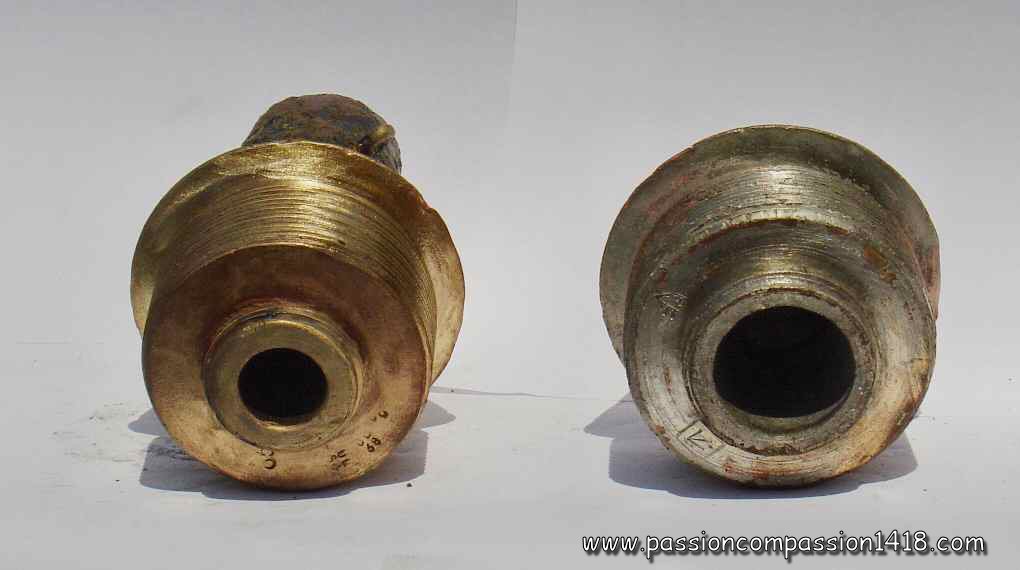
Super-quick direct action percussion fuze N°106 IIA. Bottom view. Despite the fact the two fuzes are exactly of the same model and mark, the size of the central holes is different. Markings of the fuze on the right side : N°106 IIA LOT 288 - A.T.M.318 - AK - RL 4/18 707 - D |
||
 |
 |
|
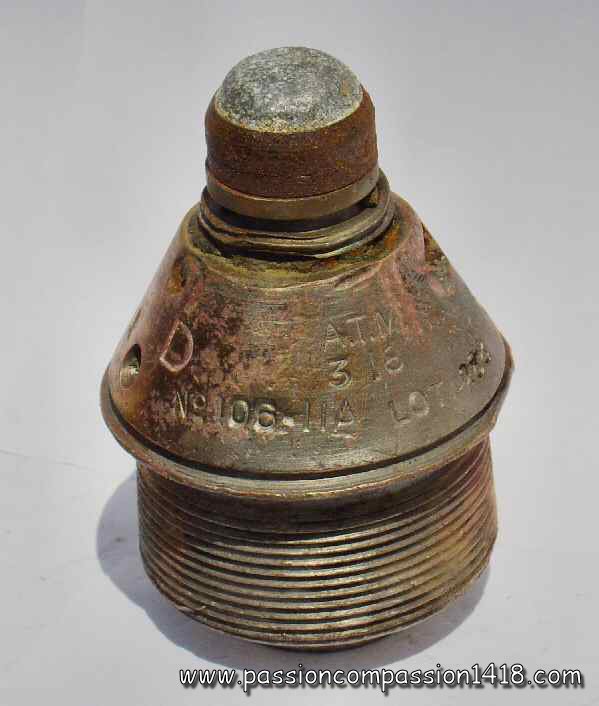
Super-quick direct action percussion fuze N°106E. Markings details |
Super-quick direct action percussion fuze N°106 III. Wartime scheme |
|
 |
||
Super-quick direct action percussion fuze N°106E. Wartime scheme |
||
Return at the top of the page |
||
N°54 fuze |
||
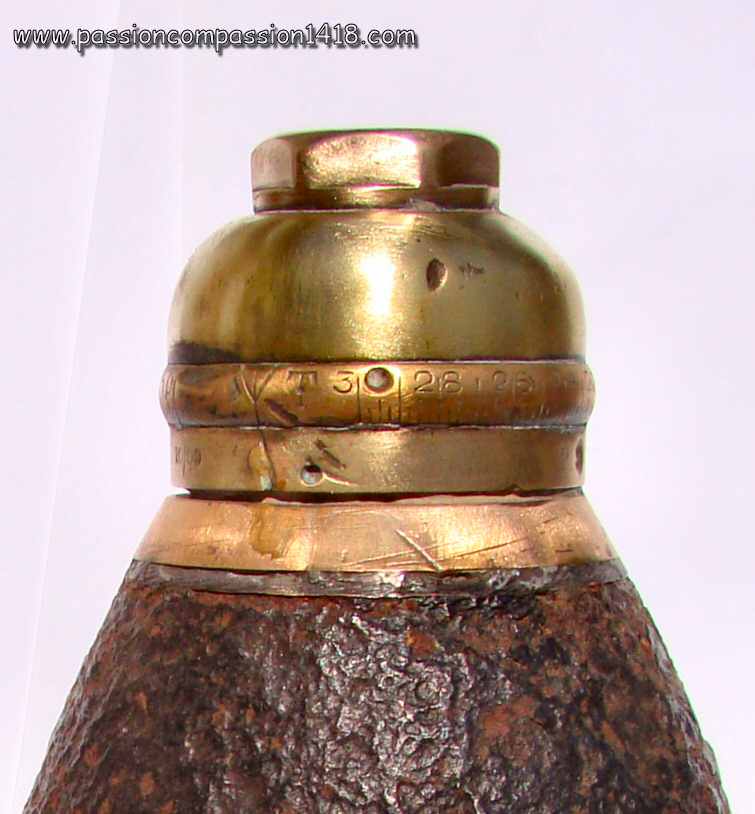 |
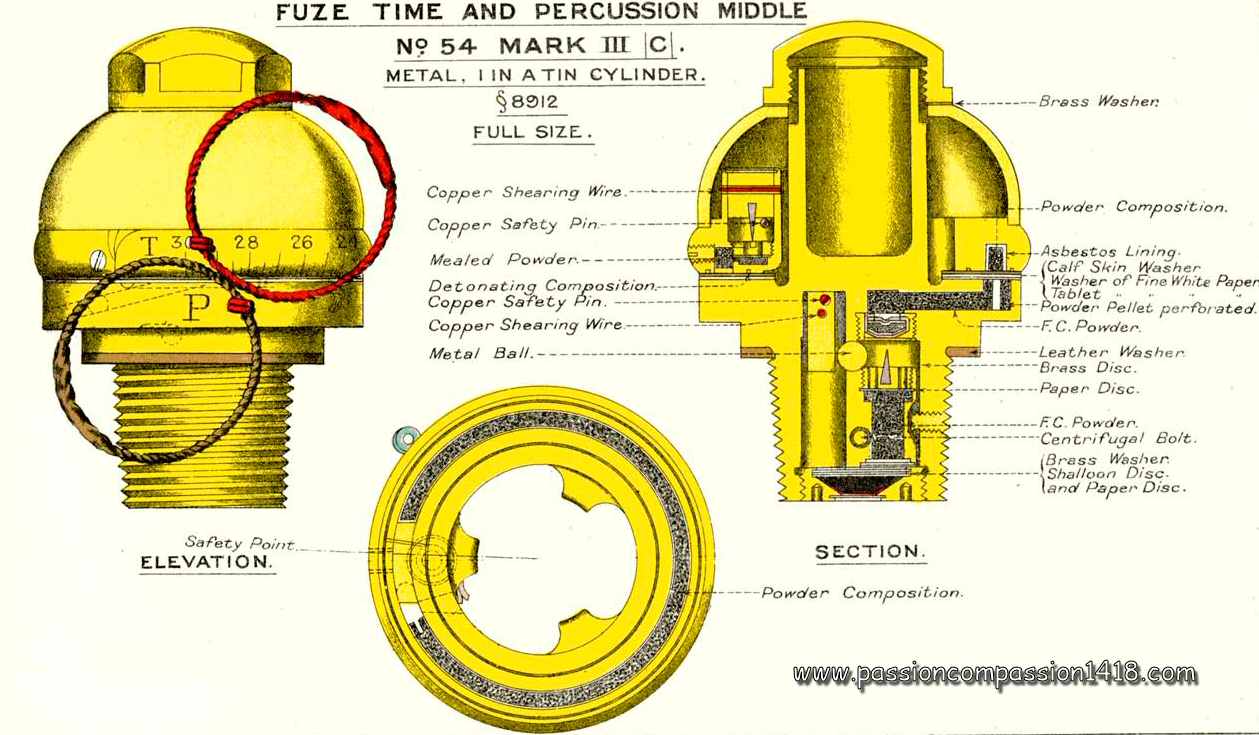
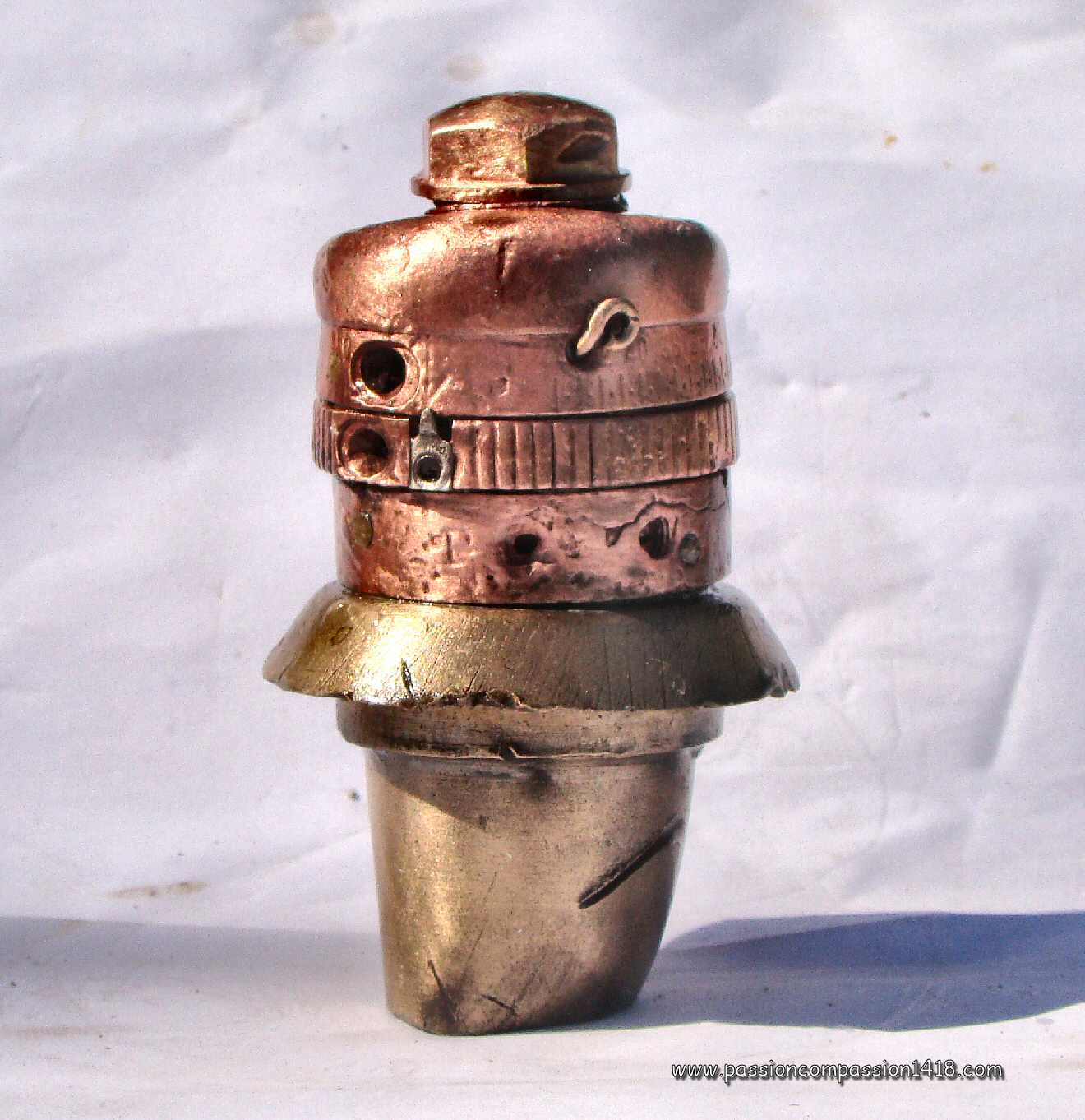
In the fourth quarter of the XIXth century, a new kind of time fuze appeared in Great Britain with the Fuze Nr24. This kind of equipment gave way to a rich series of time, then time and percussion that will survive long and participate to WW1, all reckognizable with their cylindric or hemi-spherical shape and presence of a top hexagonal locking bolt. One of the first time and percussion fuzees of that family was the Middle Time and Percussion Fuze Nr54 designed in 1887.
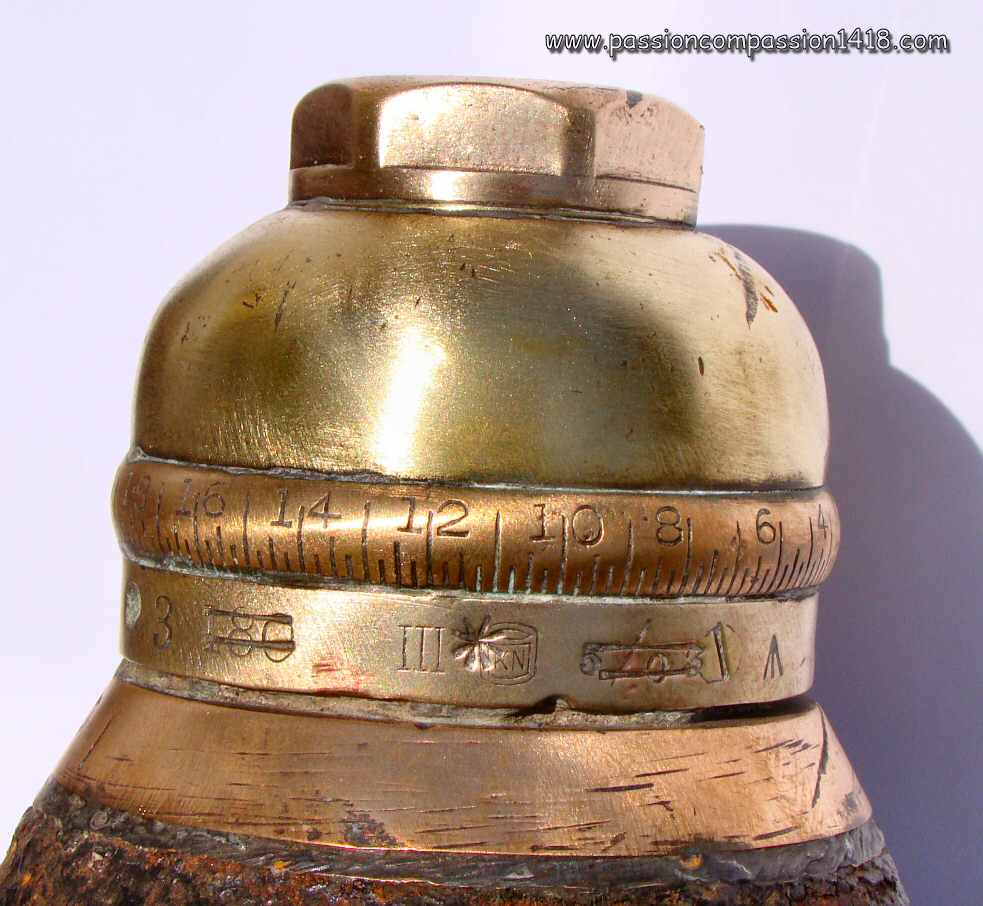
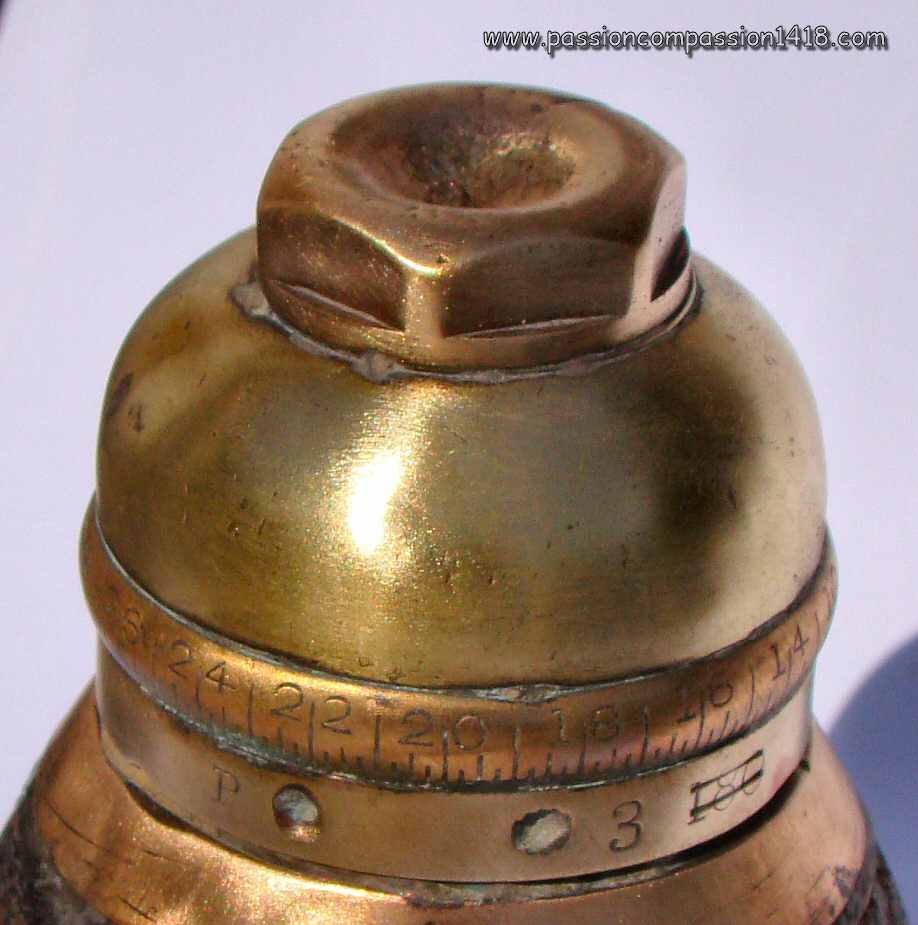
The N°54 was organized on a time system and a percussion system, both separated and selectionable by a safety pin marked with a 'T' and a 'P' respectively allowing the activation of the movements of the time system pellet firing the time ring powder track, or the percussion pellet that would enable the inertia block movements at arrival, under the action of the shell departure shock. The time behaviour was limited to 16 seconds (graduations from 0 to 30) on this single time ring model, whose setting was secured by tightening the top bolt. The N°54 fuze was used mainly with the shrapnell shells of the :
Officially service until 1921, the N°54 was though quickly replaced by its son-models Nr 62 and N°64 with compatible threads but longer combustion times. |
|
Time and percussion fuze N°54, graduated from 0 to 30, assembled on shrapnell shell head |
||
 |
 |
|
Time and percussion fuze N°54. Markings : '3 - 180 (barred) - III - KN - 5/03 (barred) - 10/09'. |
Time and percussion fuze N°54. The time setting locking bolt has been stamped in when the fuze landed |
|
 |
||
Time and percussion fuze N°54. Wartime scheme |
||
Return at the top of page |
||
N°65A and N°65C fuze |
||
 |
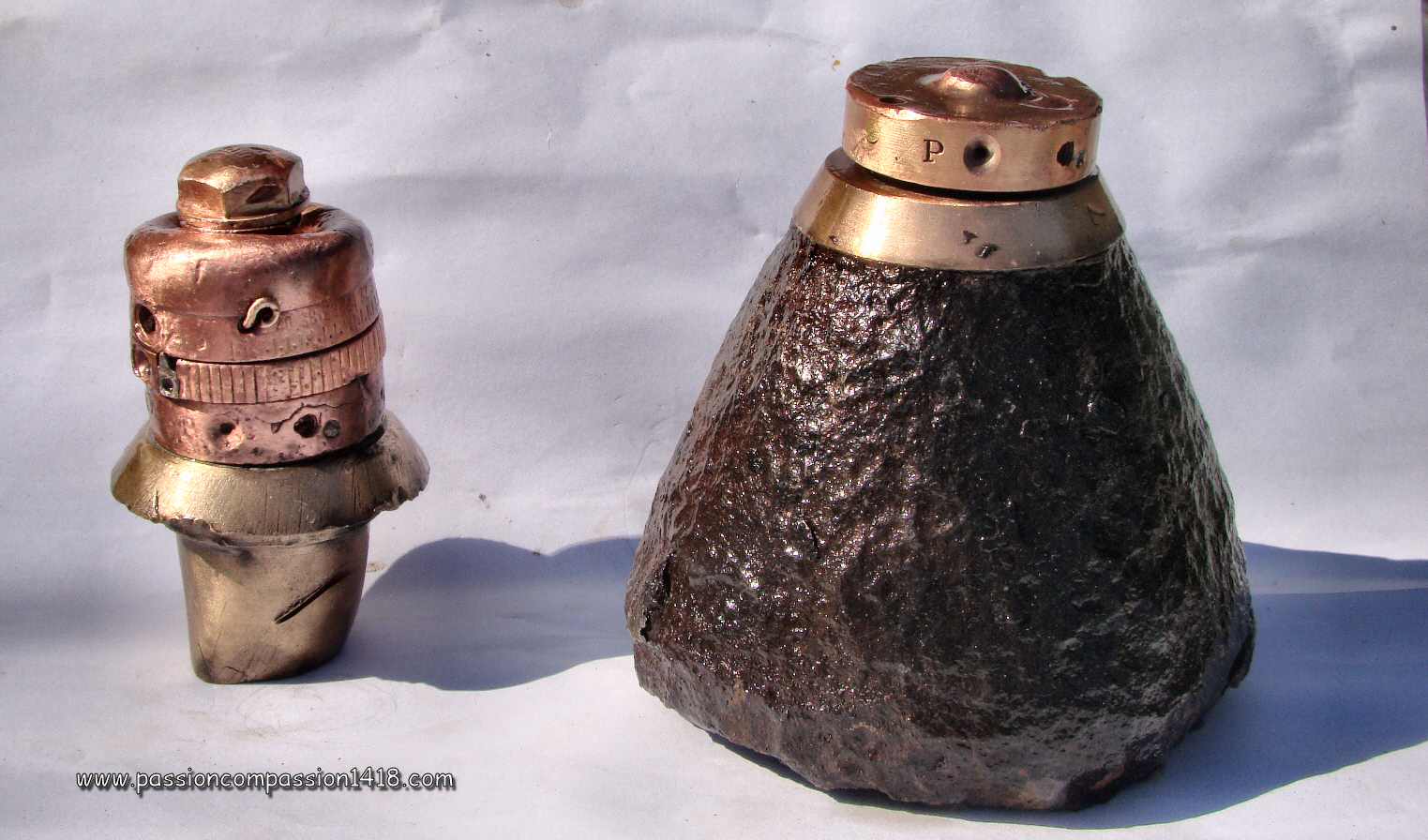
Evolution of a family of fuzes based on the same principles and including the fuzes N°56 (1894), N°57 (1900), N°60 (1901) and N°63 (1904), the original time and percussion fuze N°65 (1910) was only a conversion of these latters. Its properties were however considered so interesting that a new design was introduced in 1914 : the time and percussion fuze N°65A.
All these fuzes had a similar profile, easily recognizable by its cylindrical shape, a graduated ring and a top hexagonal locking bolt.
The new fuze N°65A was organized on two separate systems : a time system and a percussion system, each secured by a safety pin.
In service until 1932, the N°65A gave way to a more sensitive N°65C fuze (1916) (weaker shearing safety pin) for the nay service, and a AA dedicated N°66 fuze (1916) that was never bring to service. |
|
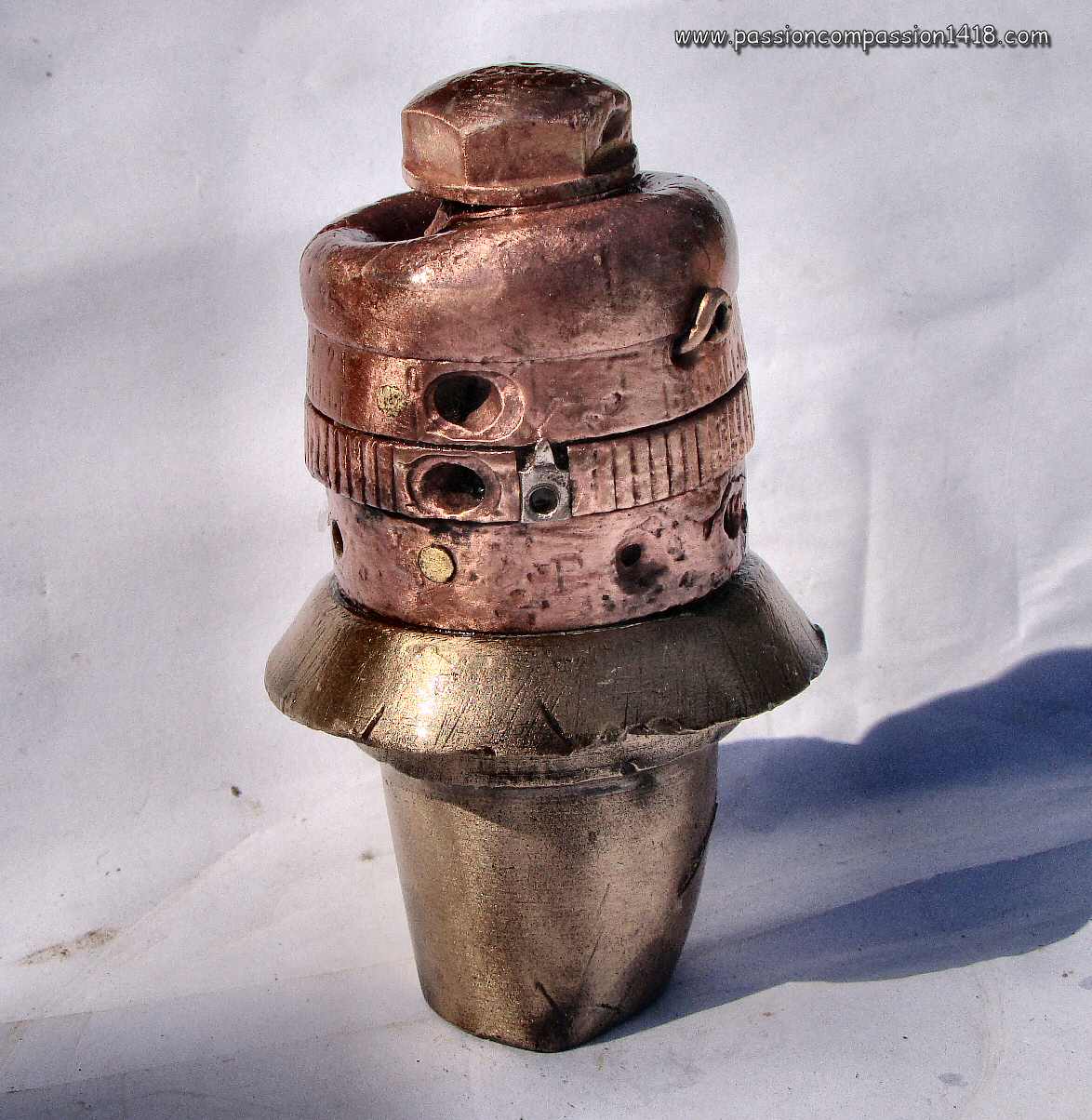
Time and percussion fuze N°65A, assembled on a adaptor |
||
 |
||
Time and percussion fuze N°65A. The first item is in rather good condition, while the other one only kept its base and adaptor and is mounted on a shrapnell shell 4.7in. Both fuzes are dated '12/14' |
||
 |
 |
|
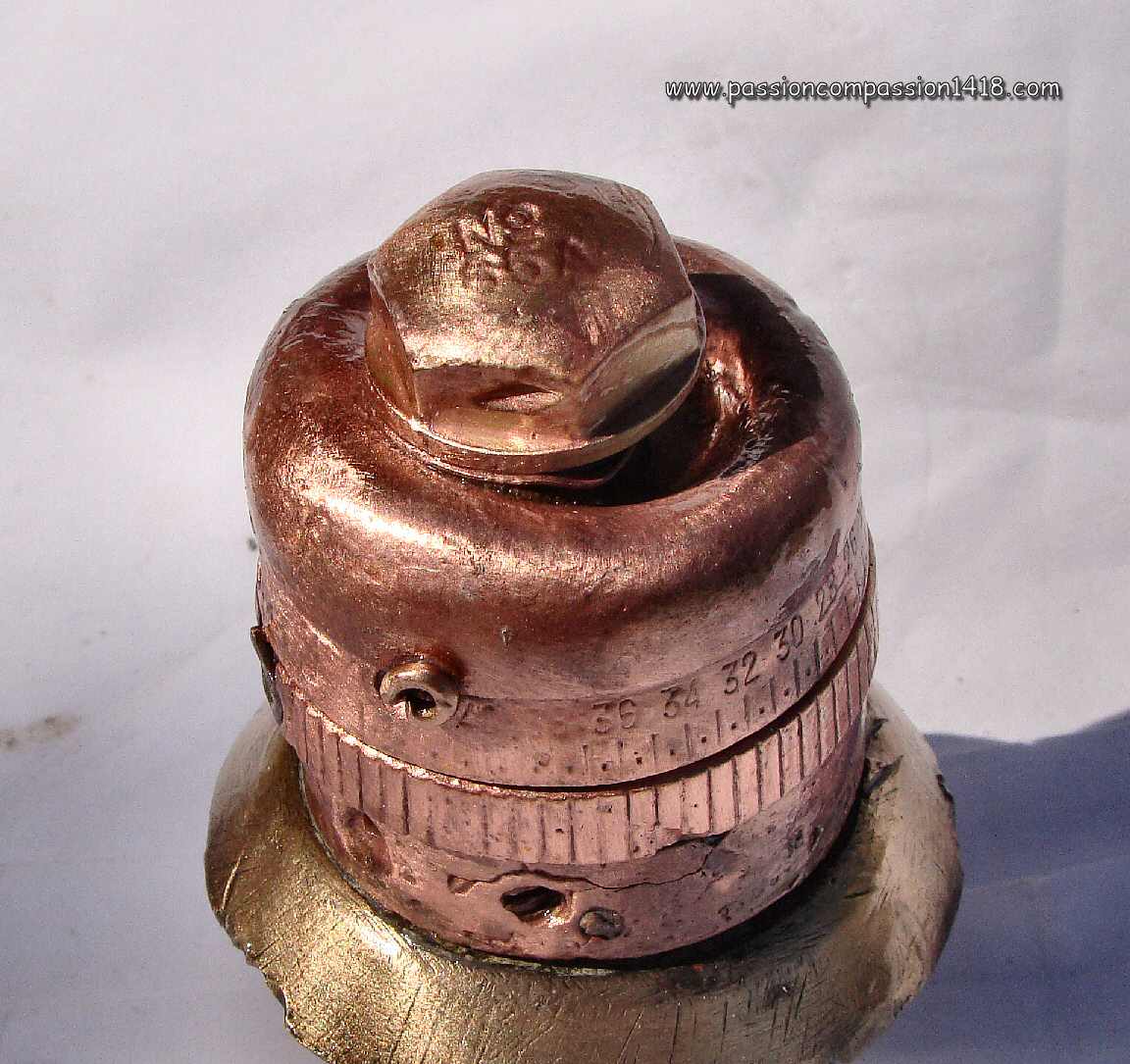
Time and percussion fuze N°65A. View on the rotation locking hexagonal bolt with marking 'N°65A' |
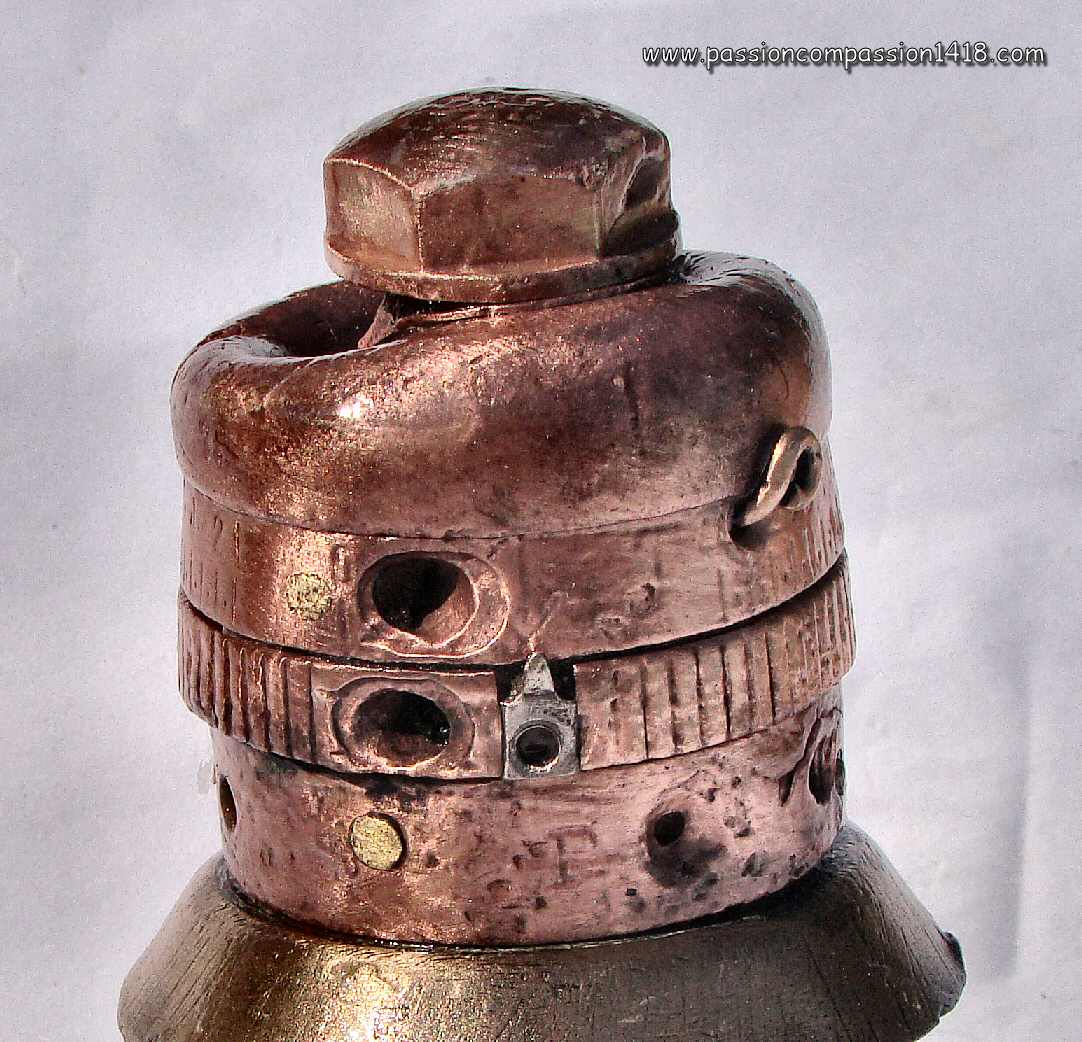
Time and percussion fuze N°65A. Overall viw with two smoke vents, the 1 to 44 graduated disk and the grey metal time setting index. |
|
 |
 |
|
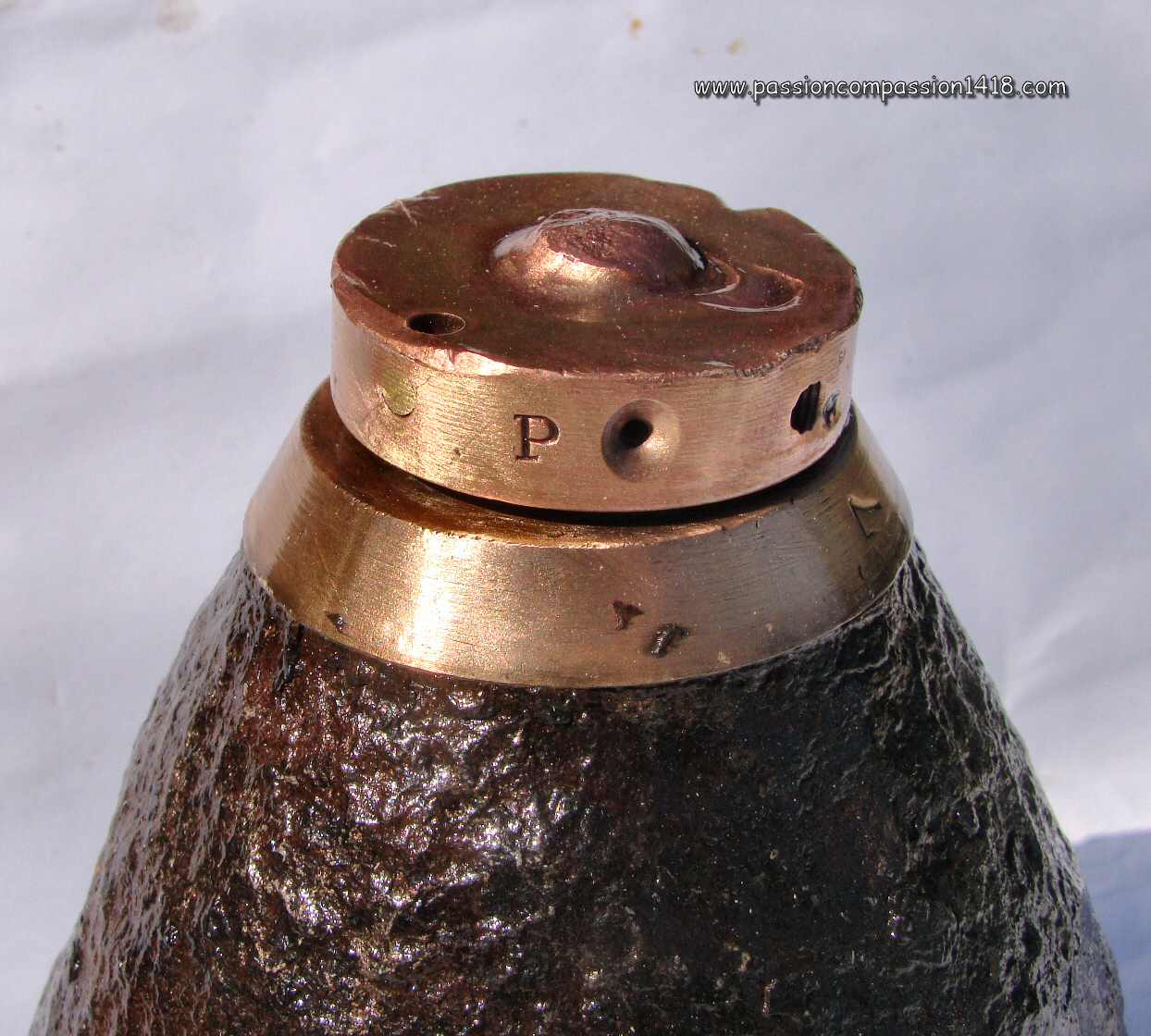
Time and percussion fuze N°65A. Fuze base with the 'P' marked hole for the percussion system safety pin |
Time and percussion fuze N°65A. General view with the safety pin of the time system, still in place into its hole marked with a 'T', and the 'P' marked hole for the time safety pin (disappeared). So it seems this fuze has been fired in a percussion behaviour setting. This looks confirmed by the time ring setting as well. |
|
 |
||
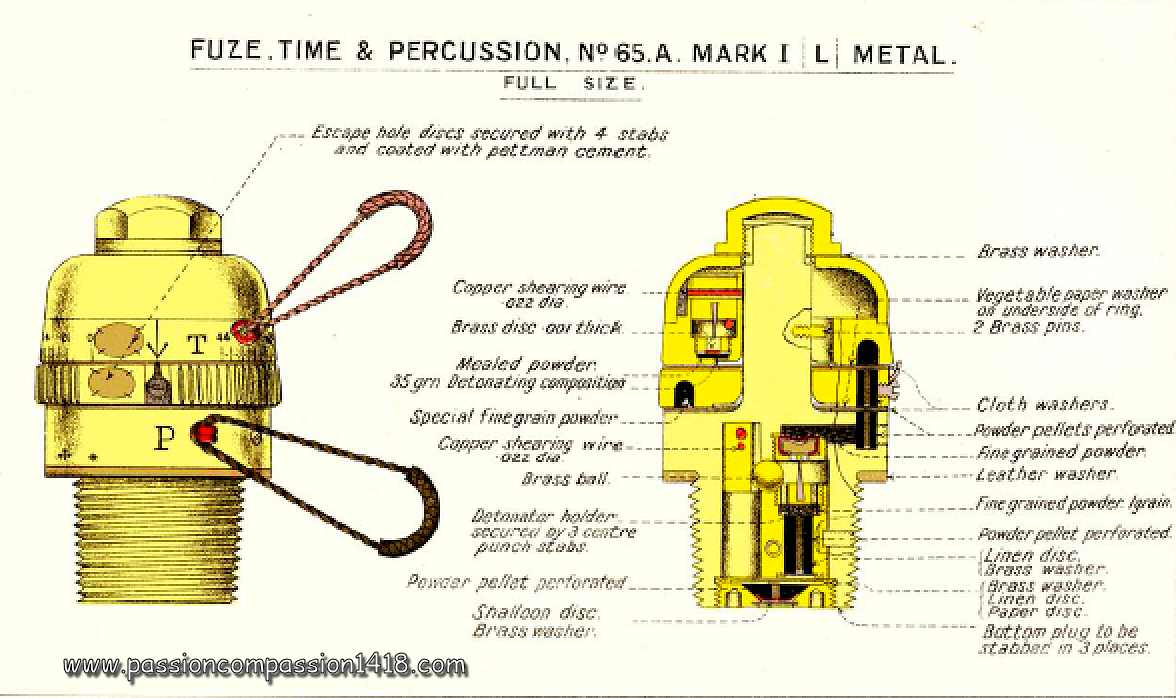
Time and percussion fuze N°65A. Wartime scheme |
||
Return at the top of page |
||
N°80, N°80B, N°80/44, N°80/44B, N°180 and N°180B fuze |
||
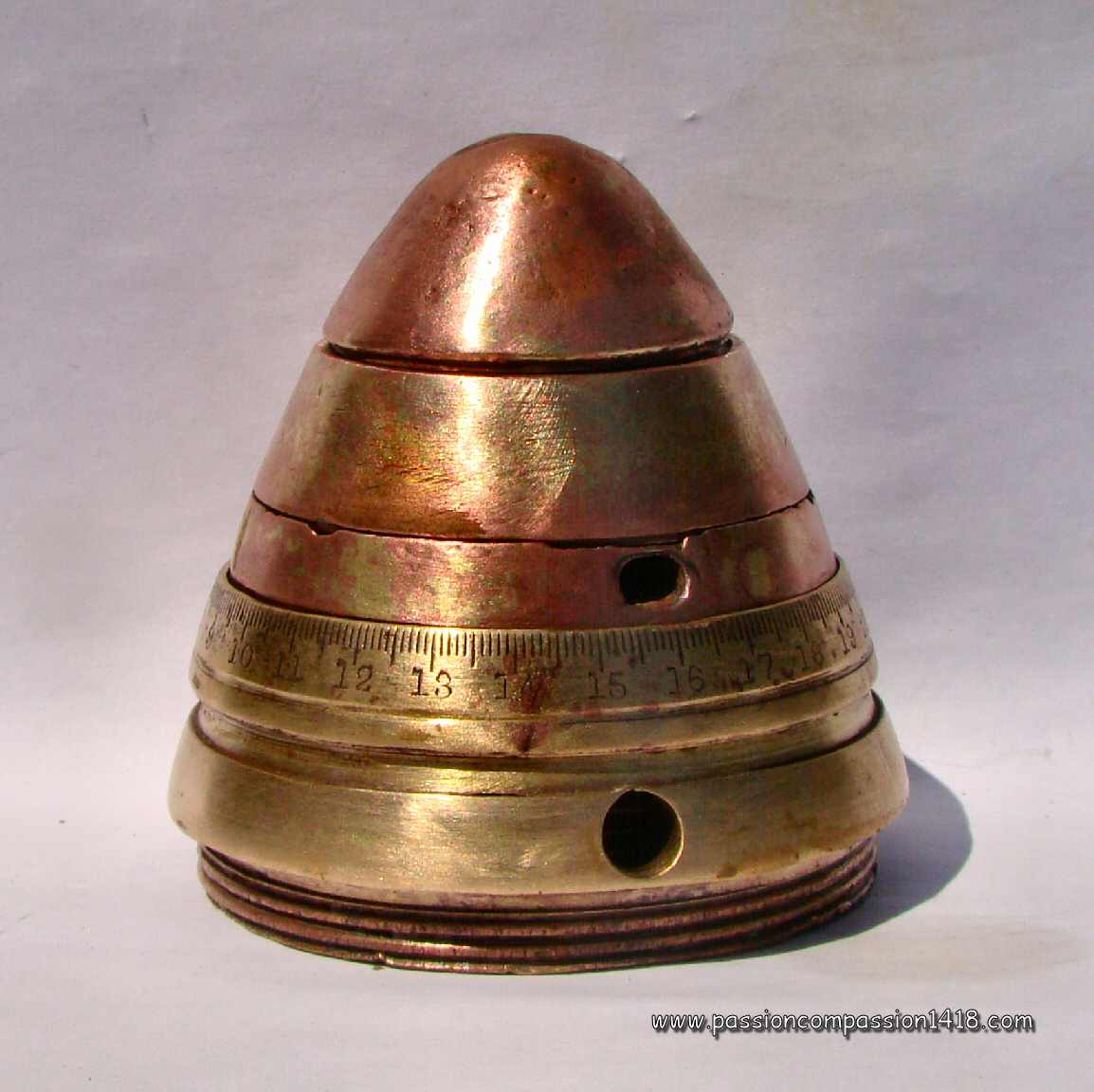 |
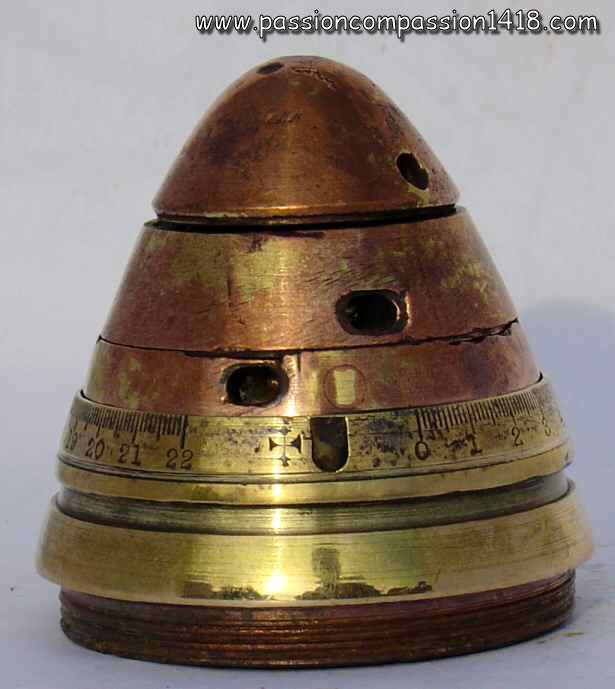
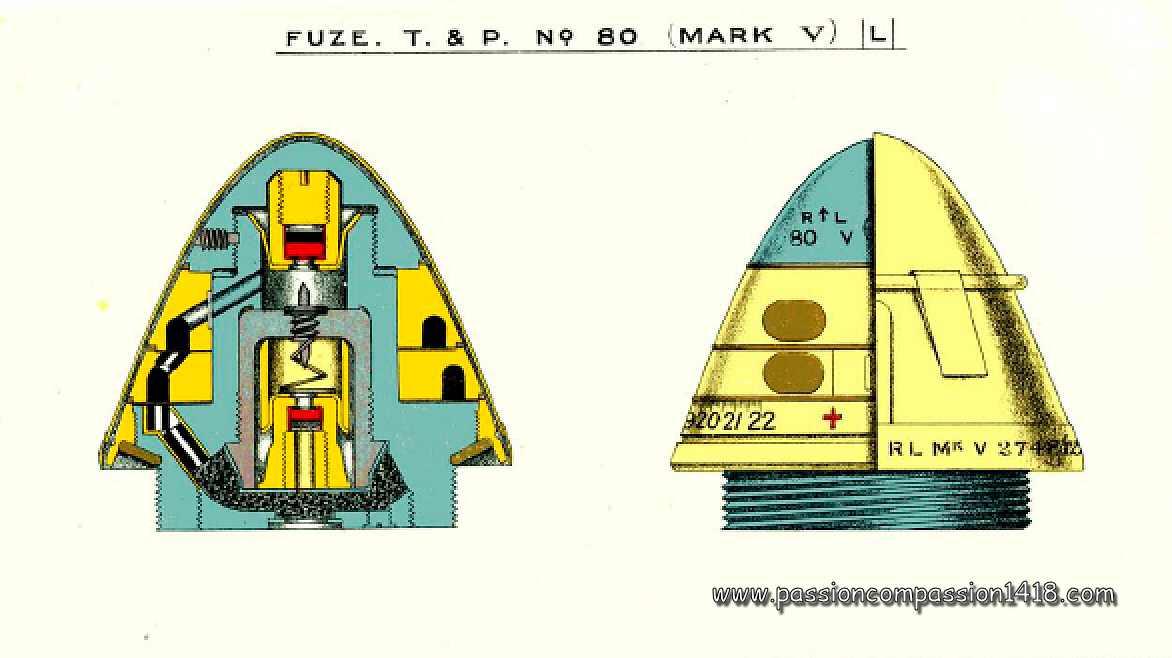
The time and percussion fuze N°80 was the fuze usually used with the British shrapnell shells of the famous 18 pounders fieldguns in WW1. Designed by the German company Krupp in 1905 and manufactured under license in England before the war and during it, its peculiar story will feed the arguments of the believers of a war wanted by the weapons international industry since once the war over, the British company Vickers Armament Industries, who manufactured these fuzes between 1914 and 1918, kindly accepted to pay to Krupp 40 000 £ royalties...
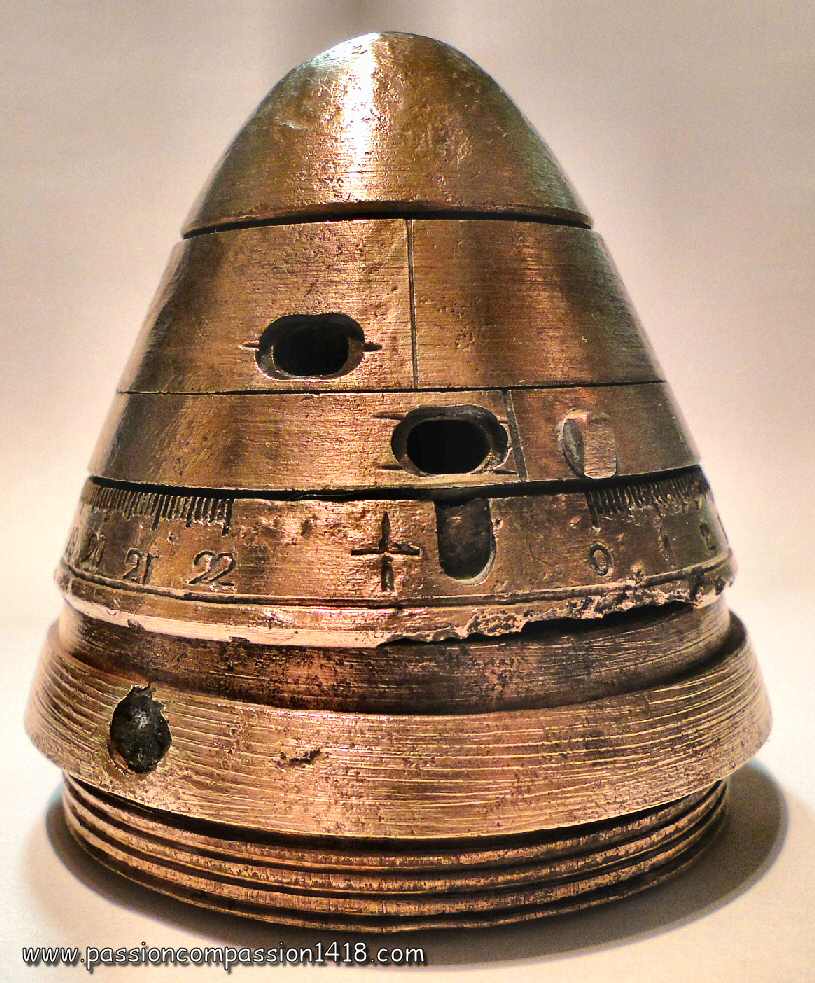
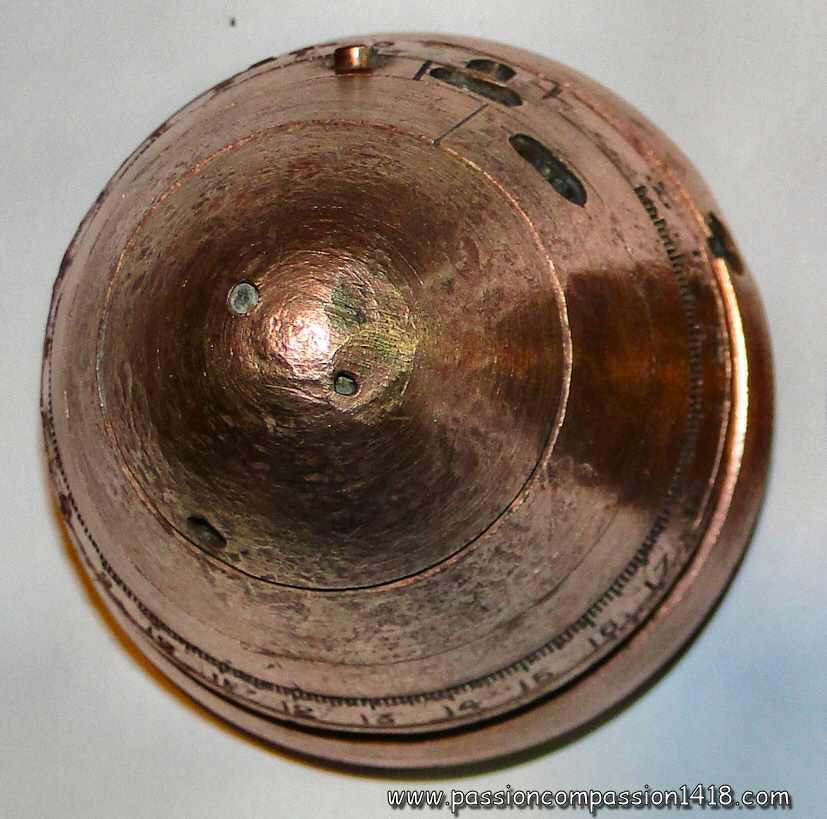
Although the initial models were made in aluminium, this fuse was entirely made in brass. The time system is a classical rotating disk system, with a ring graduated from de 0 to 22 secones, a departure ignition caused by an axial time pellet caused by the discharge shock momentum. The percussion system, selectable by choosing the rotating disk graduation marked with a roman cross was a very classical one as well, of graze type, with a staple safety device actionned by the shell departure shock. A gunpowder load was placed at the base of the fuze to ignite the shell (with an additional detonator if needed). Living through 16 different marks, it will remain in service until the middle of WW2. Known variants are :
Initially dedicated to the shrapnell shells of the famous :
|
|
Time and percussion fuze N°80/VII. |
||
 |
||
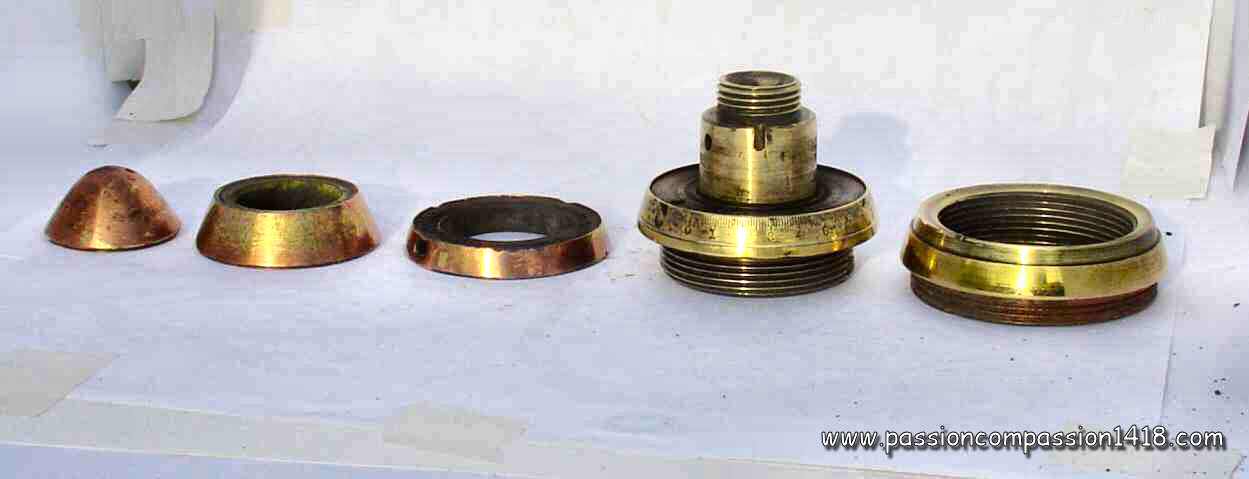
Time and percussion fuze N°80. Disasseembled, from left to right : the top cap with its thread, the first mobile disc, the second mobile disc, the fuze body with the graduated disc and the fuze base |
||
 |
 |
|
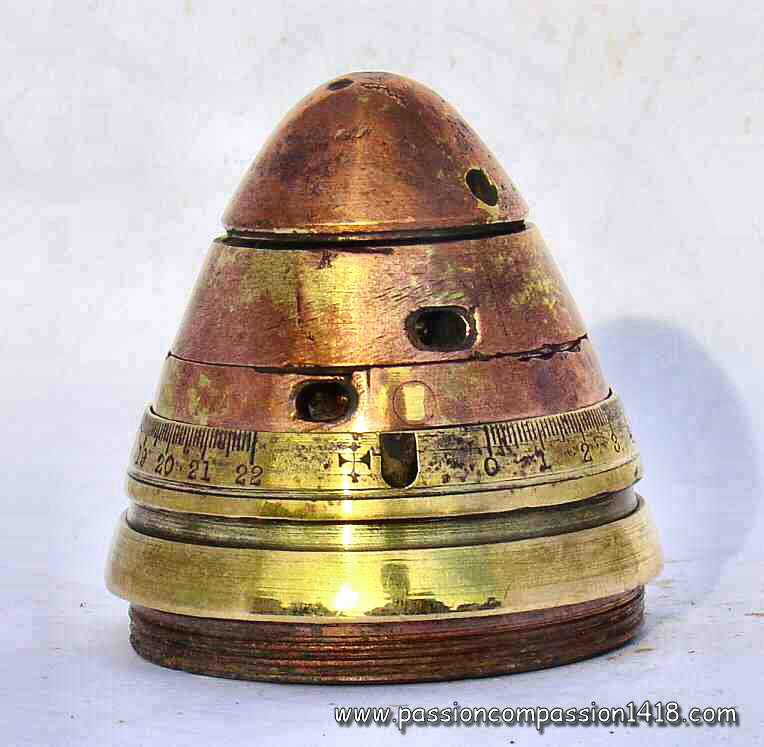
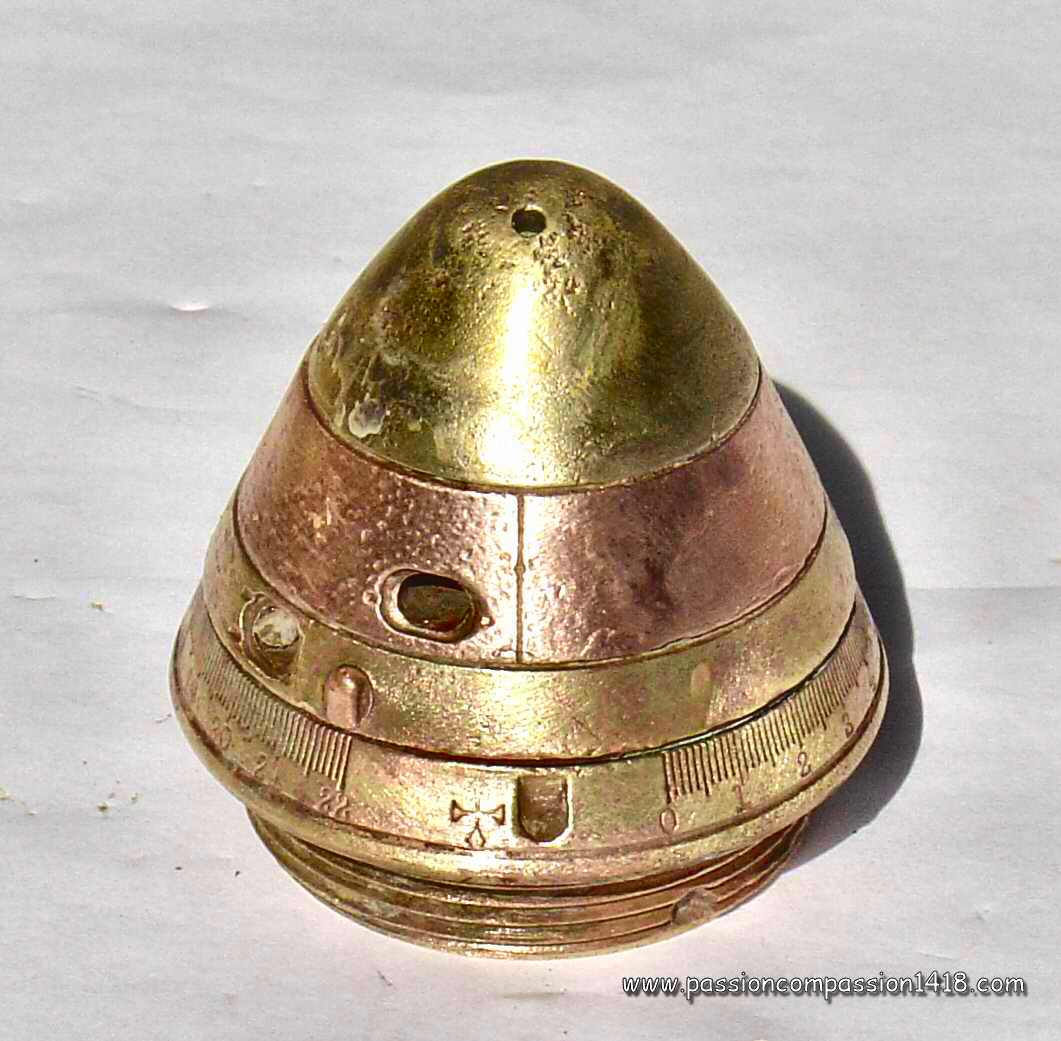
Time and percussion fuze N°80. General view. Markings on the bottom '328 - 80/VII - (AB inscribed in a fuze shape) - B - 1916 - 40' |
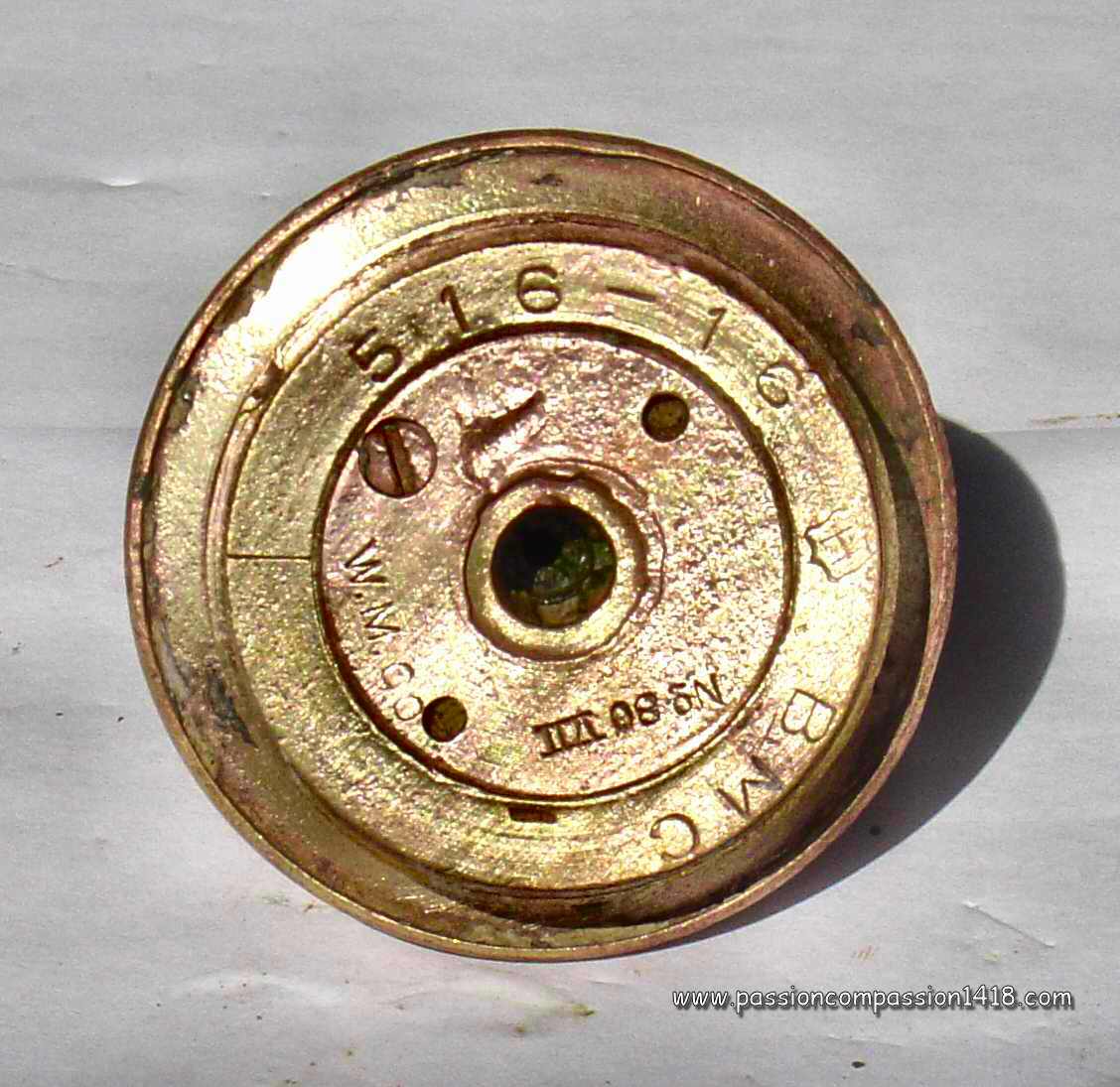
Time and percussion fuze . An item a little more damaged, by a longer saty undergground (Somme area). Markings on the fuze bottom : '516 - 16 - H (in a shield shape) - B.M.C. - N°80 VII - W.M. Co' |
|
 |
 |
|
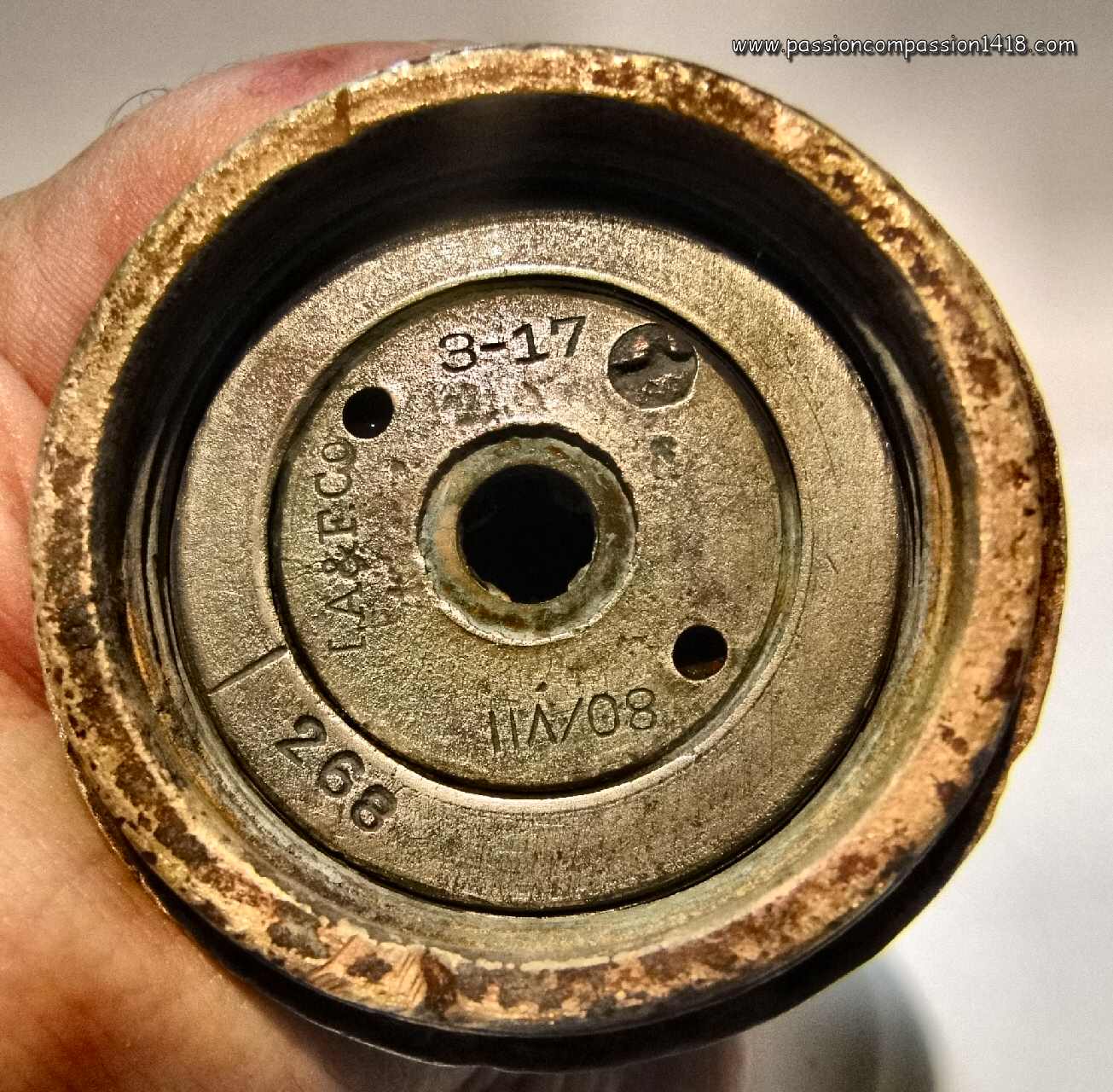
Time and percussion fuze N°80. Bottom view with markings. |
Time and percussion fuze N°80. Bottom markings : 3/17- LA&F Co - N°80 VII - 268'. Picture couretesy Luc Malchair |
|
 |
 |
|
Time and percussion fuze N°80. Picture courtesy Luc Malchair |
Time and percussion fuze N°80. Front view. Picture courtesy Luc Malchair. |
|
 |
||
Time and percussion fuze N°80. Wartime scheme |
||
Return at the top of the page |
||
N°83, N°83R, N°83/44 and N°94 fuze |
||
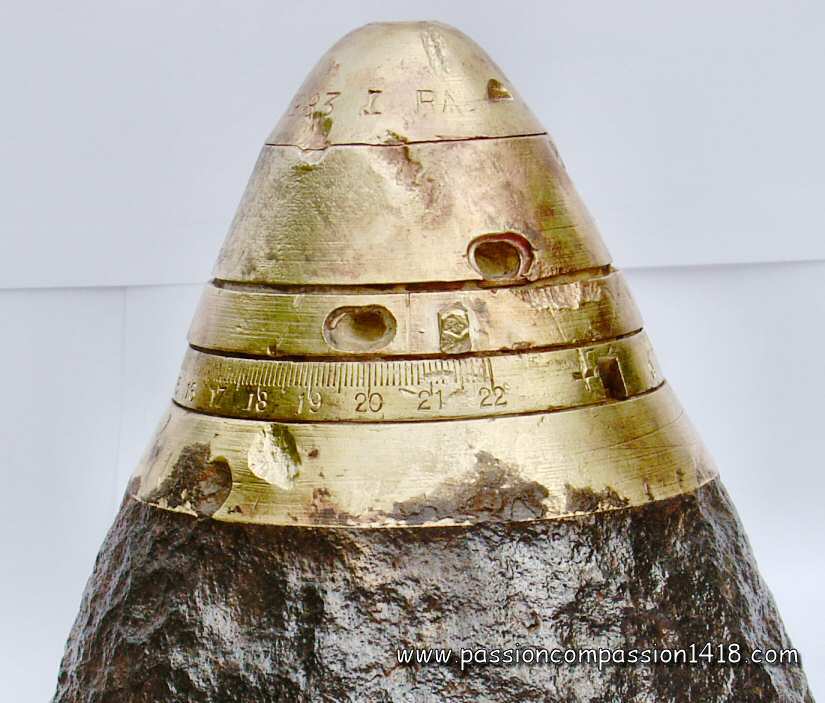 |
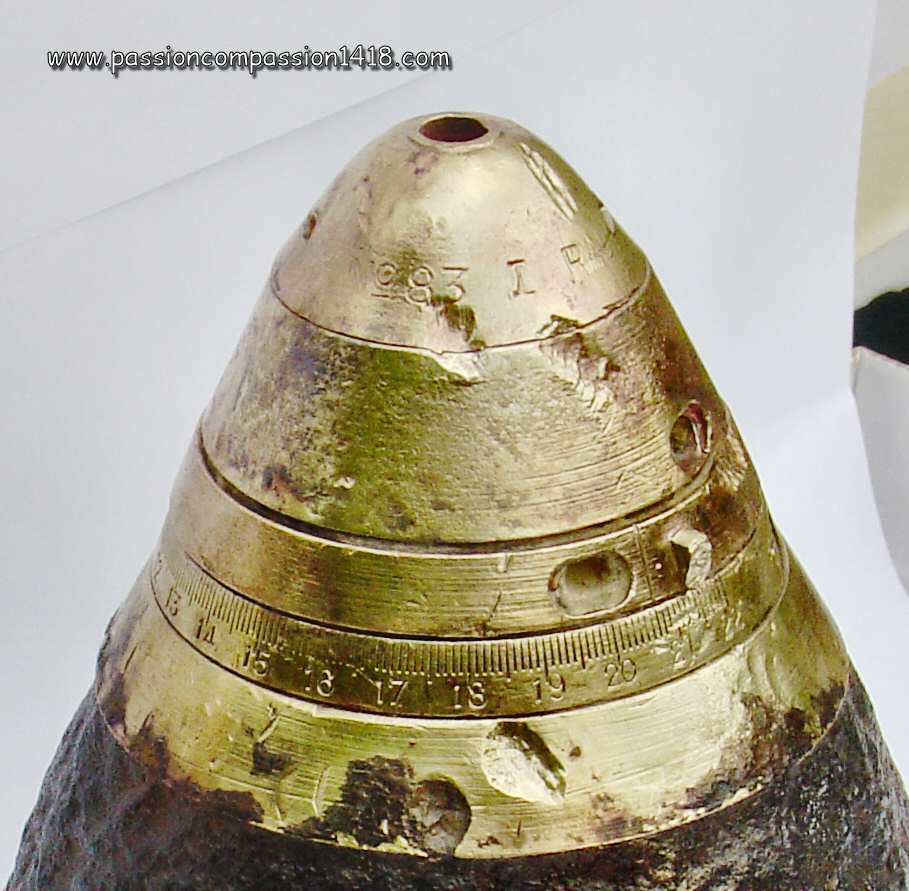
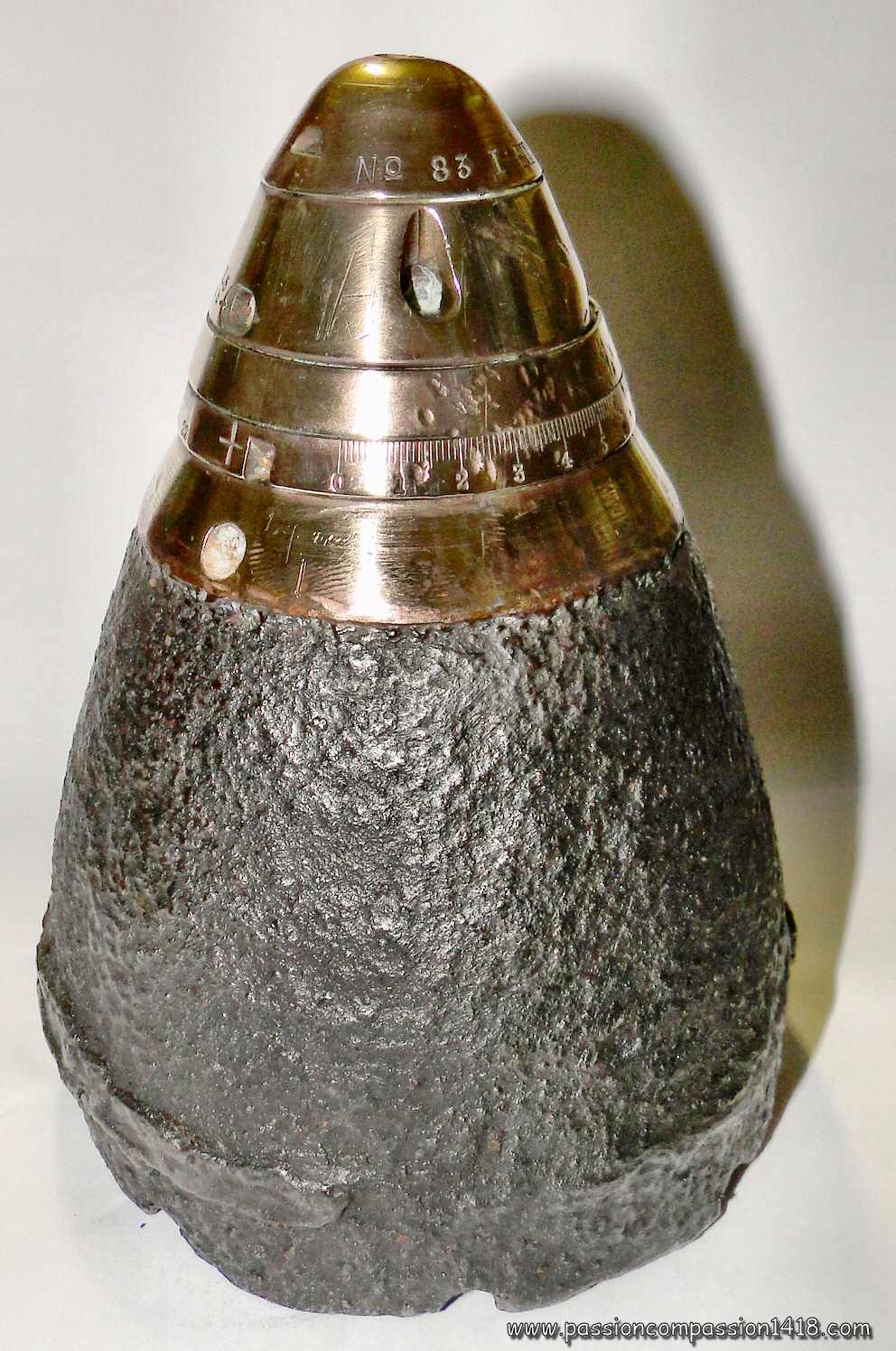
The time system of the Time and percussion fuze N°83 introduced in 1911 is very similar to the one of the famous fuze N°80, at the exception of the excentric pyrotechnic arming system. The time ring was graduated from 0 to 22 time units, for a maximum combustion time of 30 seconds.
The differences are much bigger for the percussion system, where the graze staple arming system of the fuze N°80 was replaced by a bronze ball centrifugal system, more adapted to the firing conditions of heavy caliber shells. Several variants are listed :
|
|
Time and percussion fuze N°83. Set on a time behaviour at 21,5 time units. |
||
 |
 |
|
Time and percussion fuze N°83. Used as a time fuze at 20.5 time units. Head markings : 'N°83 I R - 9/16 - 27' |
||
 |
||
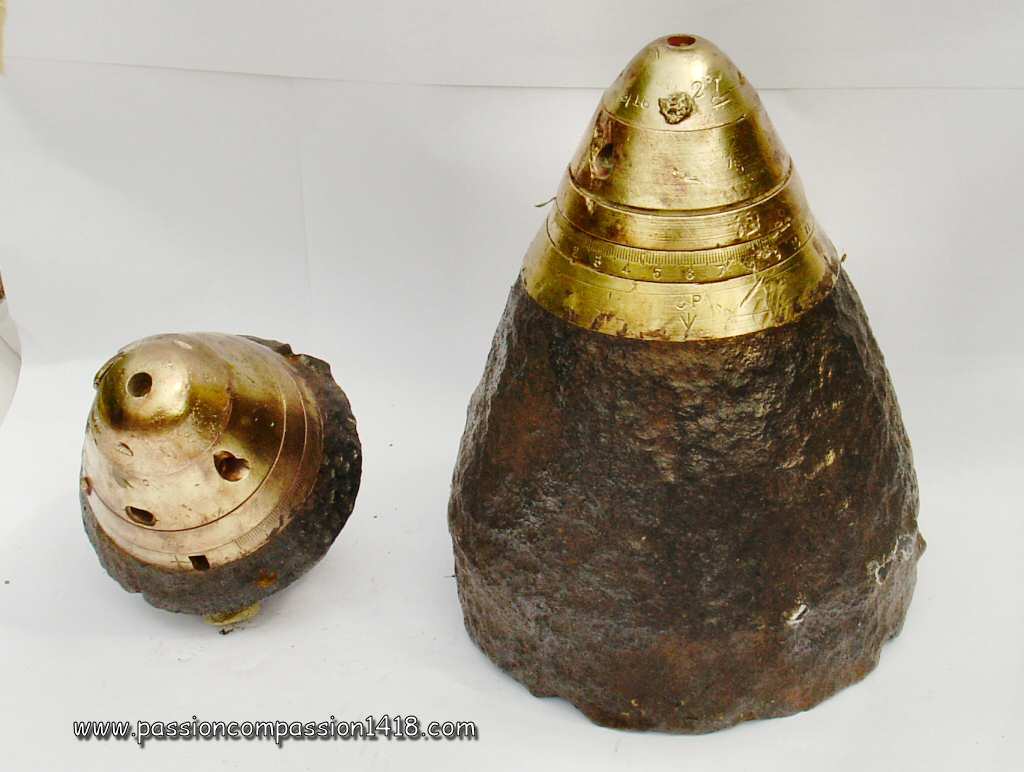
Time and percussion fuze N°83. The one at the right is still mounted to a 5 inches shrapnell shell |
Time and percussion fuze N°83 mounted on shrapnell shell head. Picture courtesy Luc Malchair ? |
|
 |
 |
|
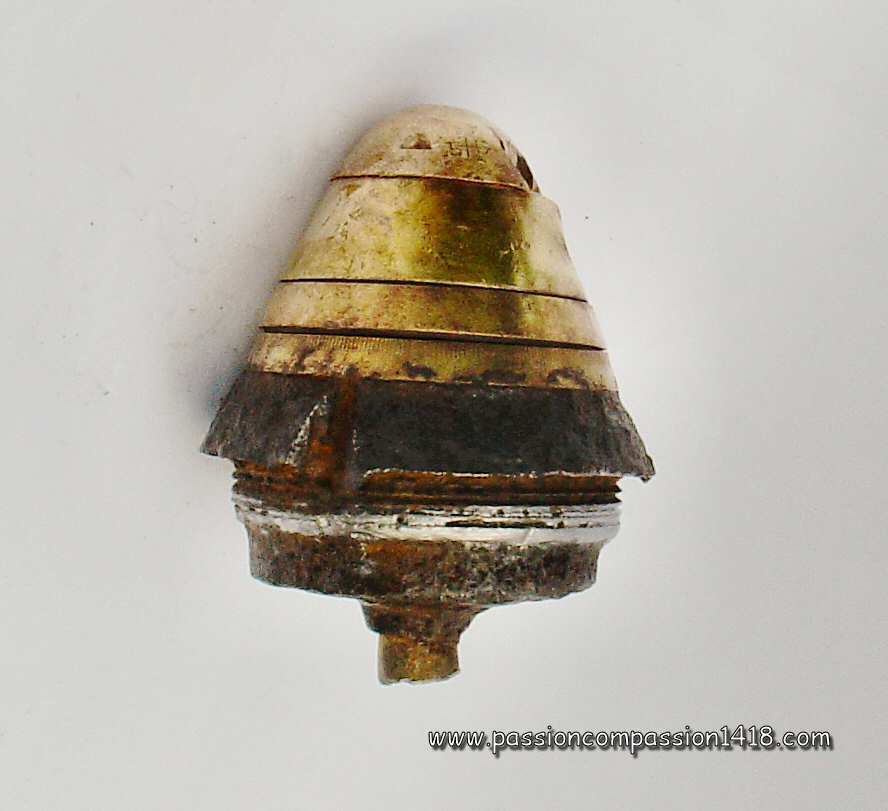
Time and percussion fuze N°83. Shot with a time setting at 17.5 seconds. Markings 'N°83 I 2 - 5/17'. Mounted on a steel thread adaptor |
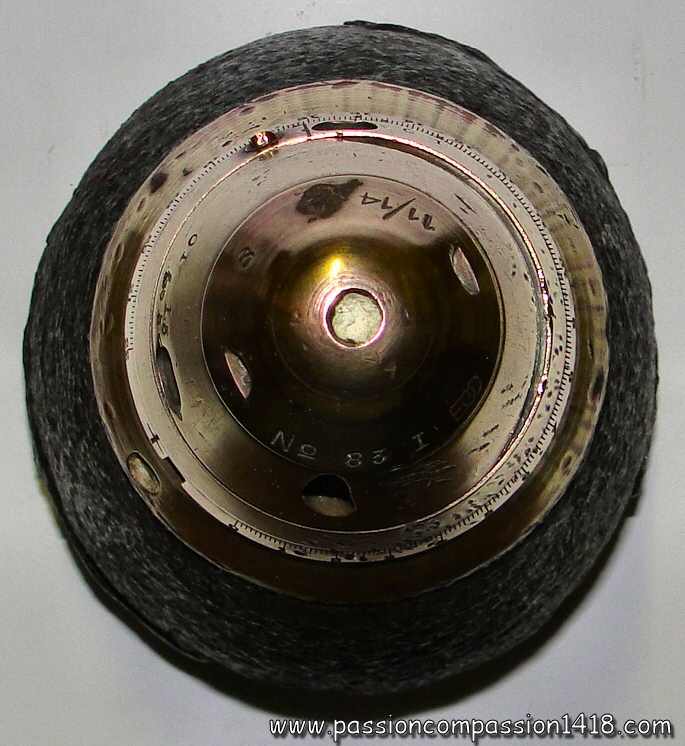
Time and percussion fuze N°83. View from the top. Markings 'N°83 I - 11/14' |
|
 |
||
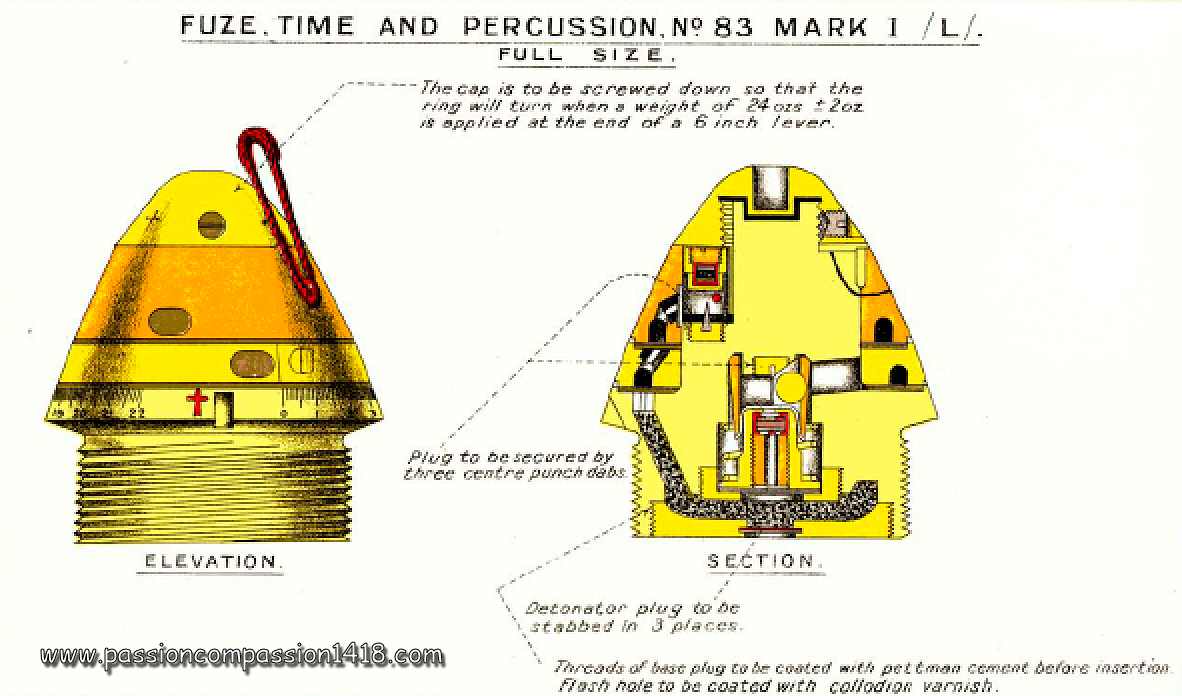
Time and percussion fuze N°83. Wartime scheme |
||
Return at the top of the page |
||
N°85, N°85/44 and N°185 fuze |
||
 |
Before joining the war in 1917, the USA allowed its industry to sell weapons and ammunitions to their fighting friend countries. It is worth remembering that this is the reasons why the Kaiser's submarines torpedoed the US civil ship 'Lusitania' that was transporting thousands of civilians, but also tons of war ordnance. This tragedy has been one of the elements that triggered the decision of USA joining the war against Germany.
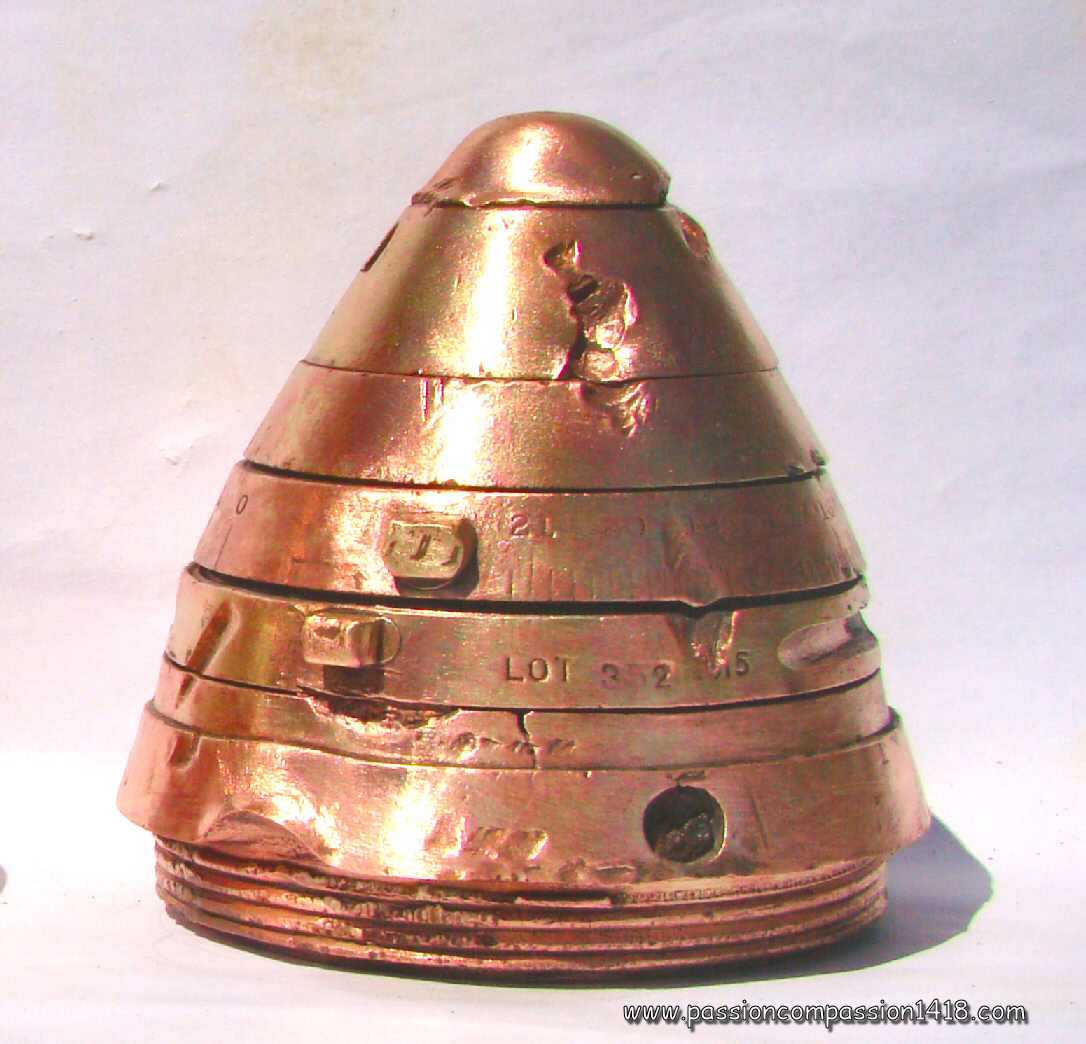
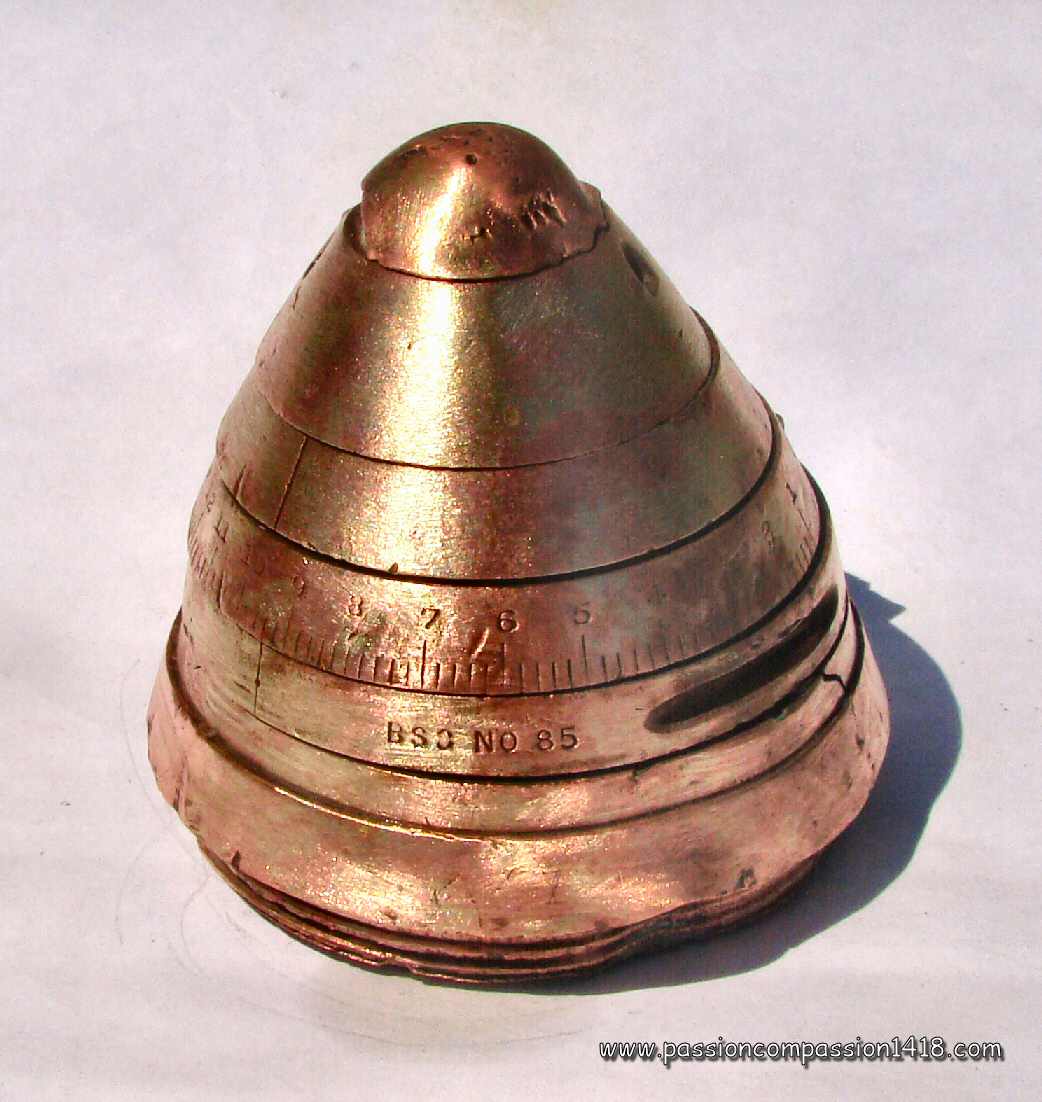
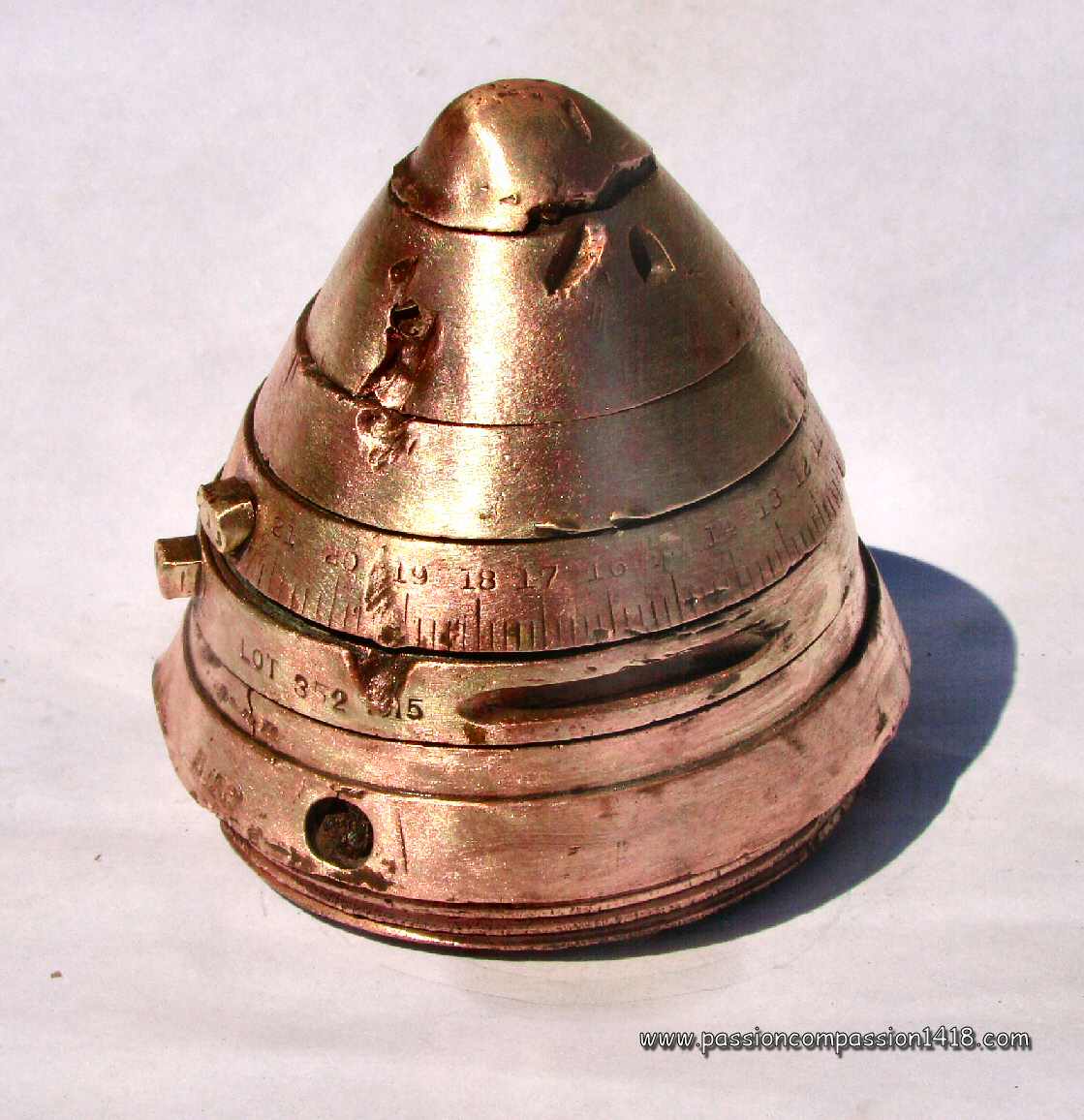
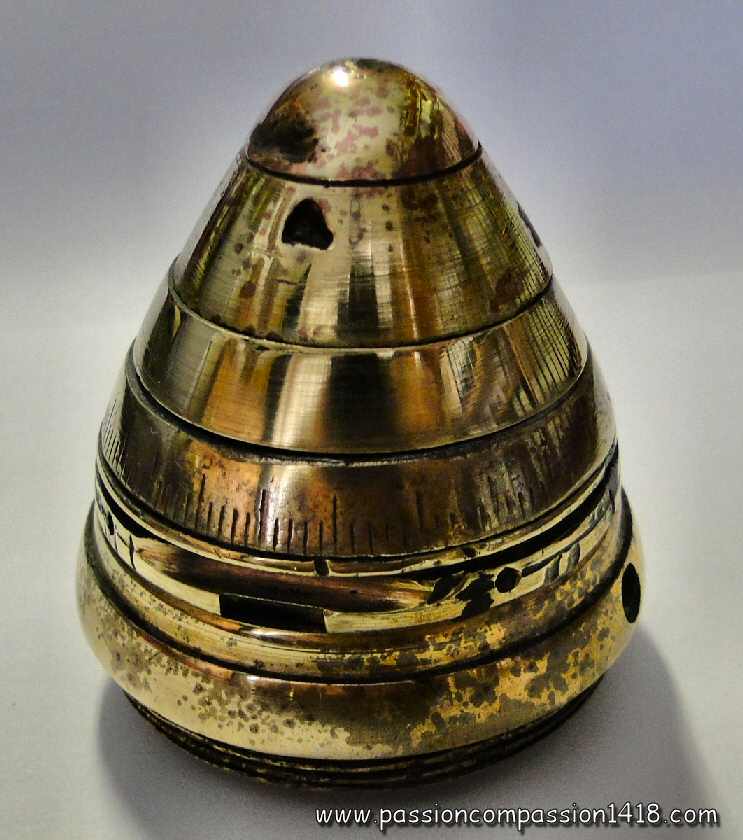
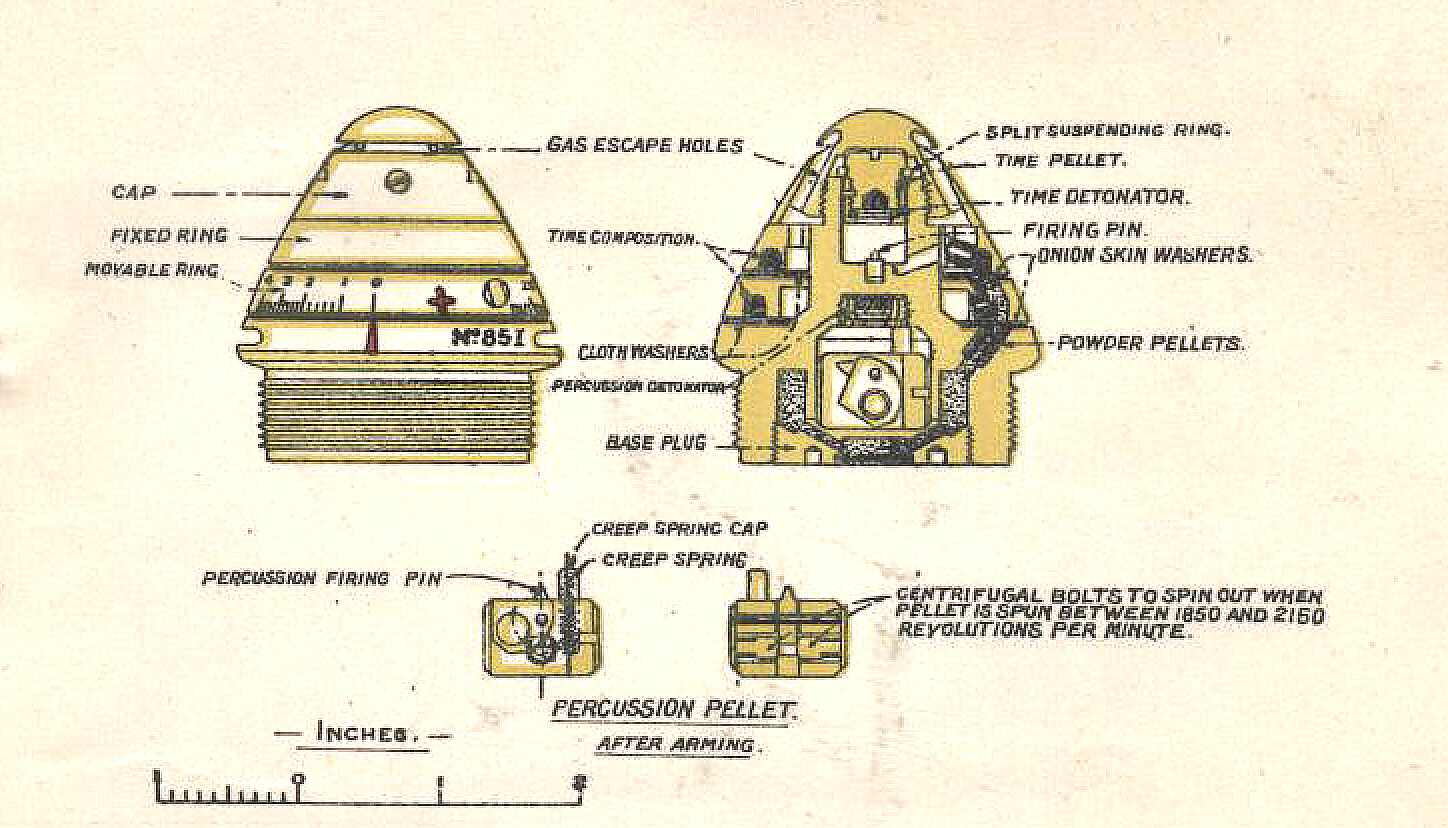
Perhaps some N°85 fuzes are still lying within the Lusitania remains in the North sea : the 'time and percussion fuze N°85' is indeed the name given by the British army to designate fuzes made by US metallurgist to UK thread standards on the base of an existing US fuze model 1907 and imported in huge quantities as an alternative to the N°80 fuze. The characteristics of these two fuzes were similar, but it was far from being identical items. For instance the N°85 fuze had a nose exhaust for combustion gazes escape, protected by a hat. It was also equipped with a percussion system safety mechanism composed with two centrifugal bolts activated between 1850 and 2150 rpm. The maximum combustion time was 23 secondes, corresponding to the graduations on the mobile disc. This fuze was mainly used with the shrapnell shells of the :
|
|
Time and percussion fuze N°85. |
||
 |
 |
|
Time and percussion fuze N°85. BSC (Bethlehem Steel Co - US steelmaker). Markings : BSC N°85 - Lot 352 1915 |
Time and percussion fuze N°85. heavily deformed by the impact on target |
|
 |
||
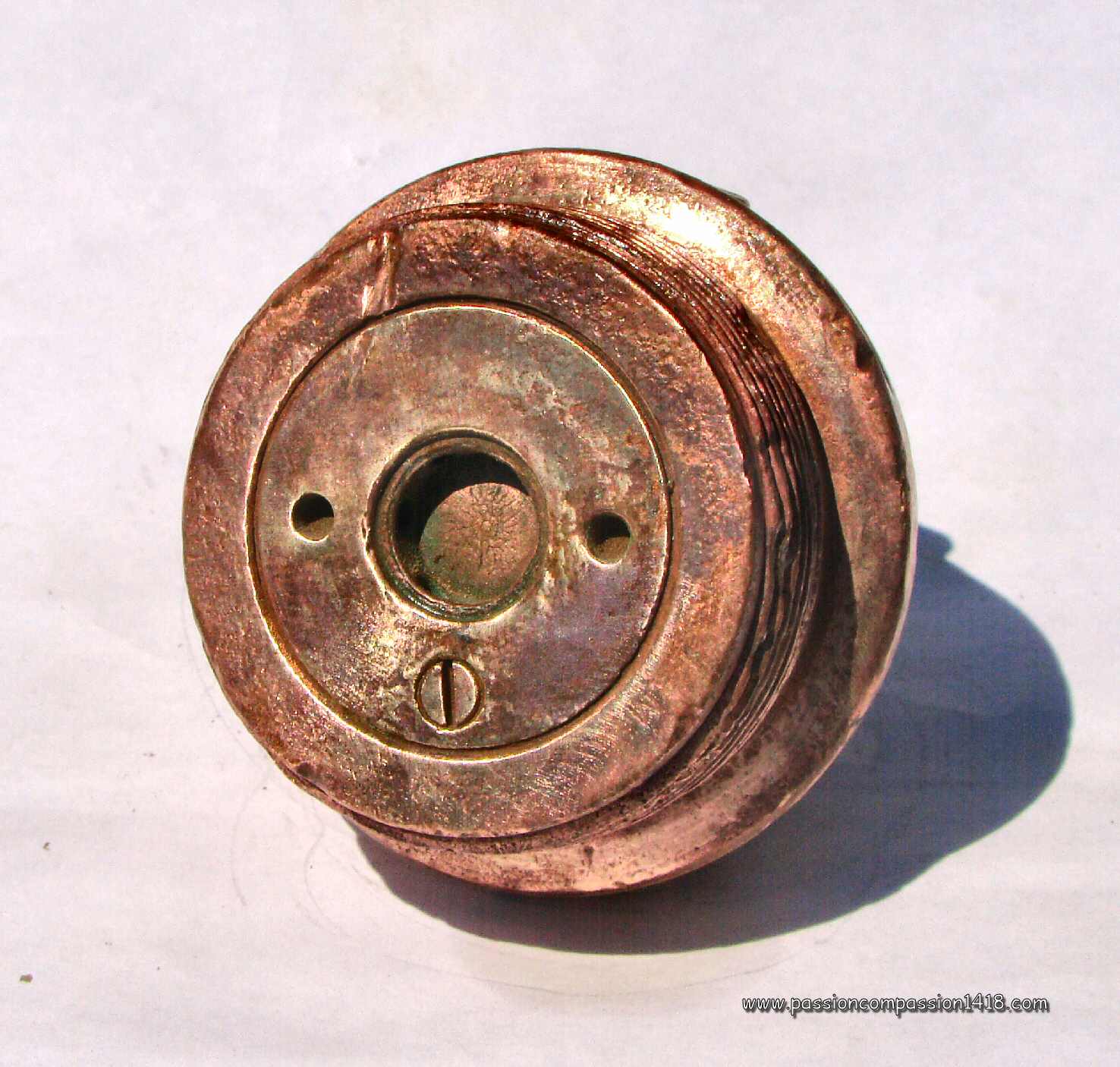
Time and percussion fuze N°85. Another US manufacturer A F Co. Markings 'A F Co N°85 - Lot I o7 1916 aside to the previously commented one (BSC 1915) and mounted on a brass adaptor. |
||
 |
 |
|
Time and percussion fuze N°85. Unknown markings. Picture courtesy Luc Malchair |
Time and percussion fuze N°85. Rear view |
|
 |
||
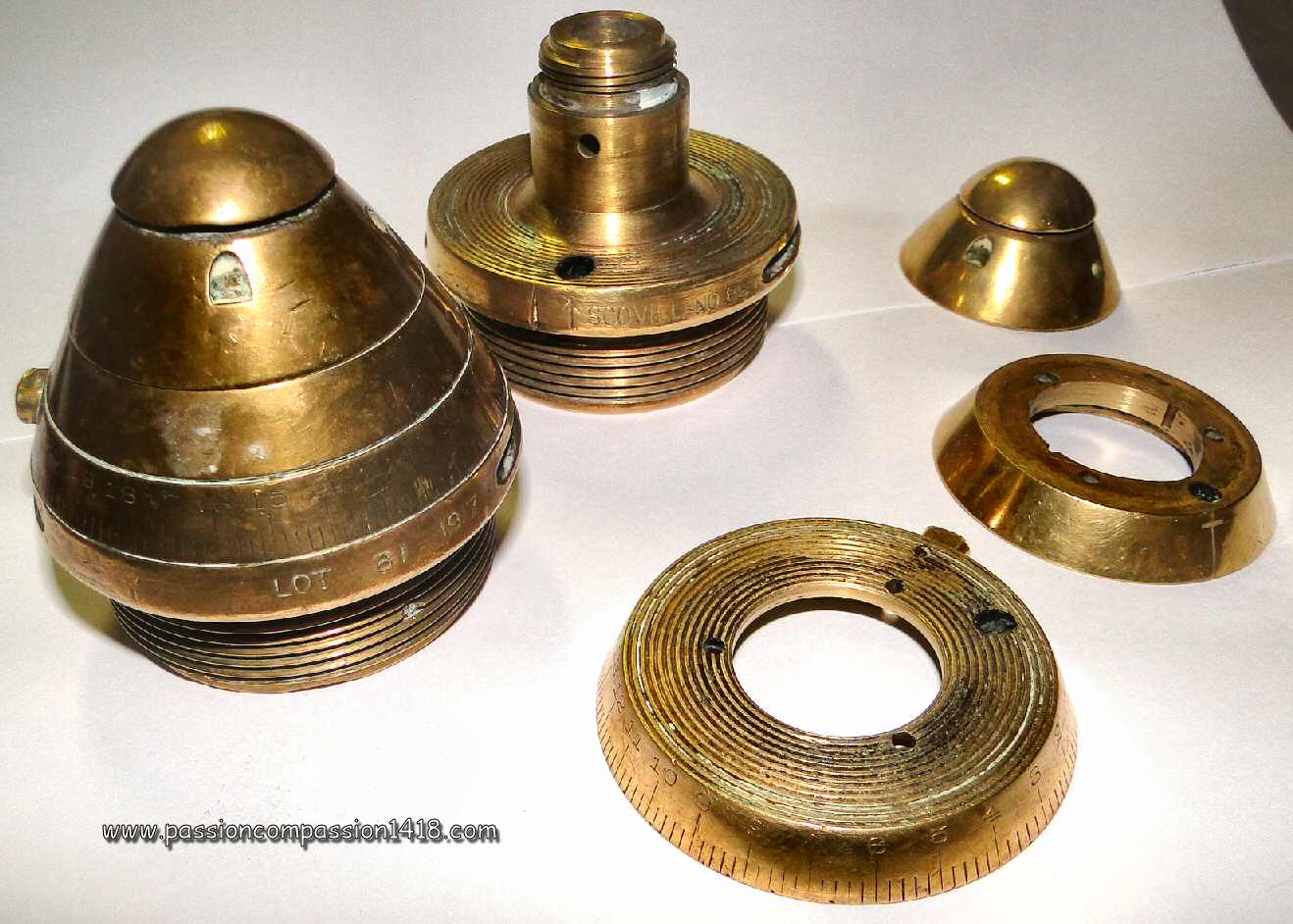
Time and percussion fuze N°85. Disassembled fuze with markings 'SCOVILL - NO 85 I'. Picture courtesy Luc Malchair |
||
 |
||
Time and percussion fuze N°85. Wartime scheme |
||
Return at the top of the page |
||
N°88 and N°88R fuze |
||
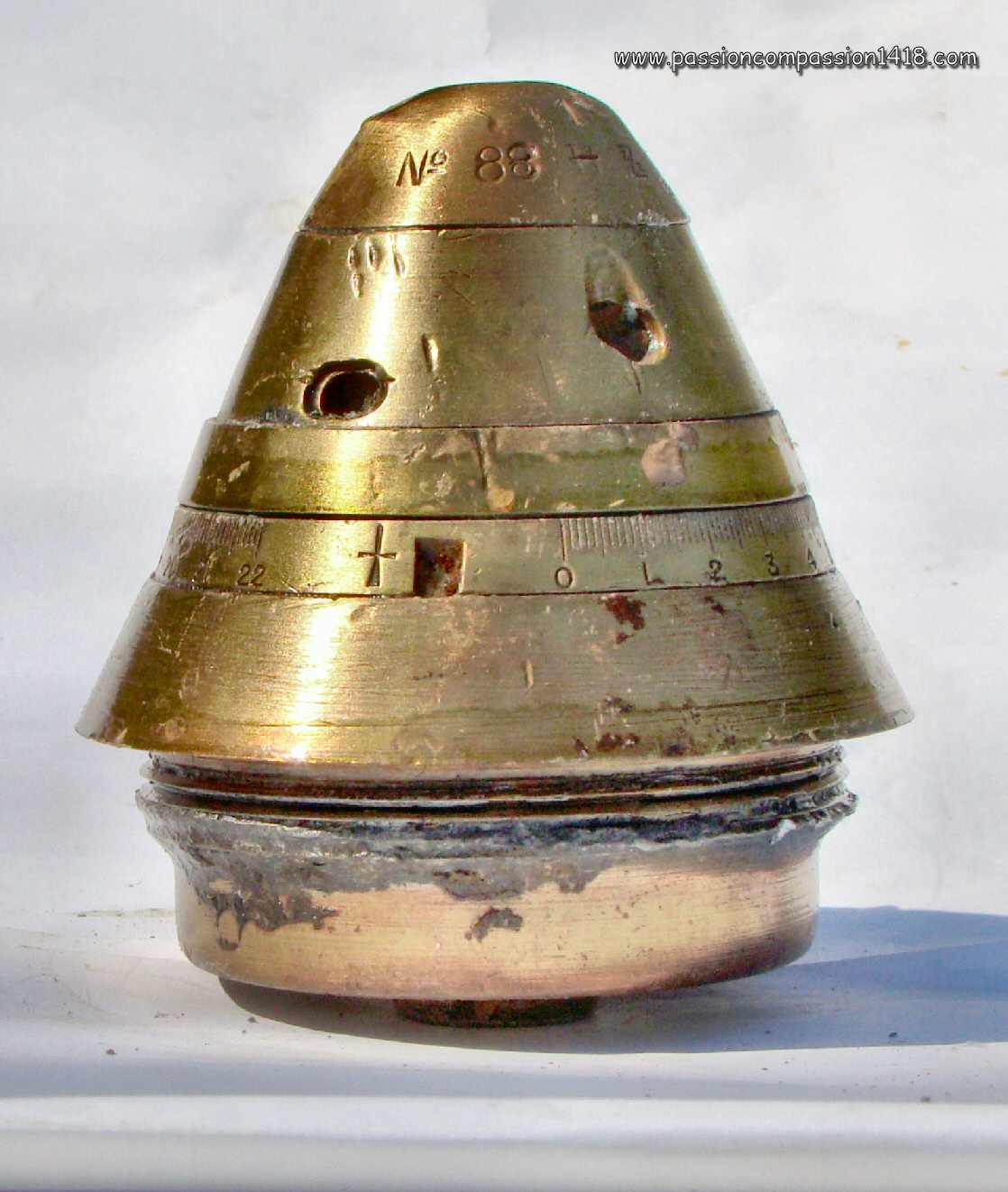 |
The time and percussion fuze N°88 was a variant of the fuze N°83, with a slow burning time composition path, allowing the system to reach a maximum burning time of 45 seconds instead of 30 seconds for longer ranges. Entirely made of brass and graduated from 0 to 22 time units plus a roman cross for percussion behaviour.
The time and percussion fuzes N°88R, was a variant with a modified time pellet creep spring for use with low muzzle speed howitzer shells. This fuze was dedicated to the shrapnell shells of the :
|
|
Time and percussion fuze N°88. |
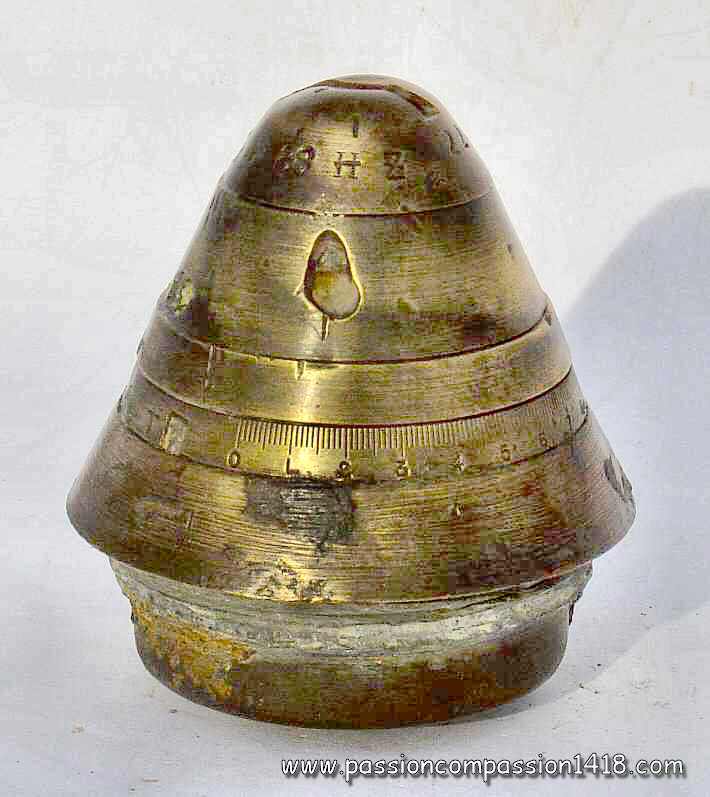 |
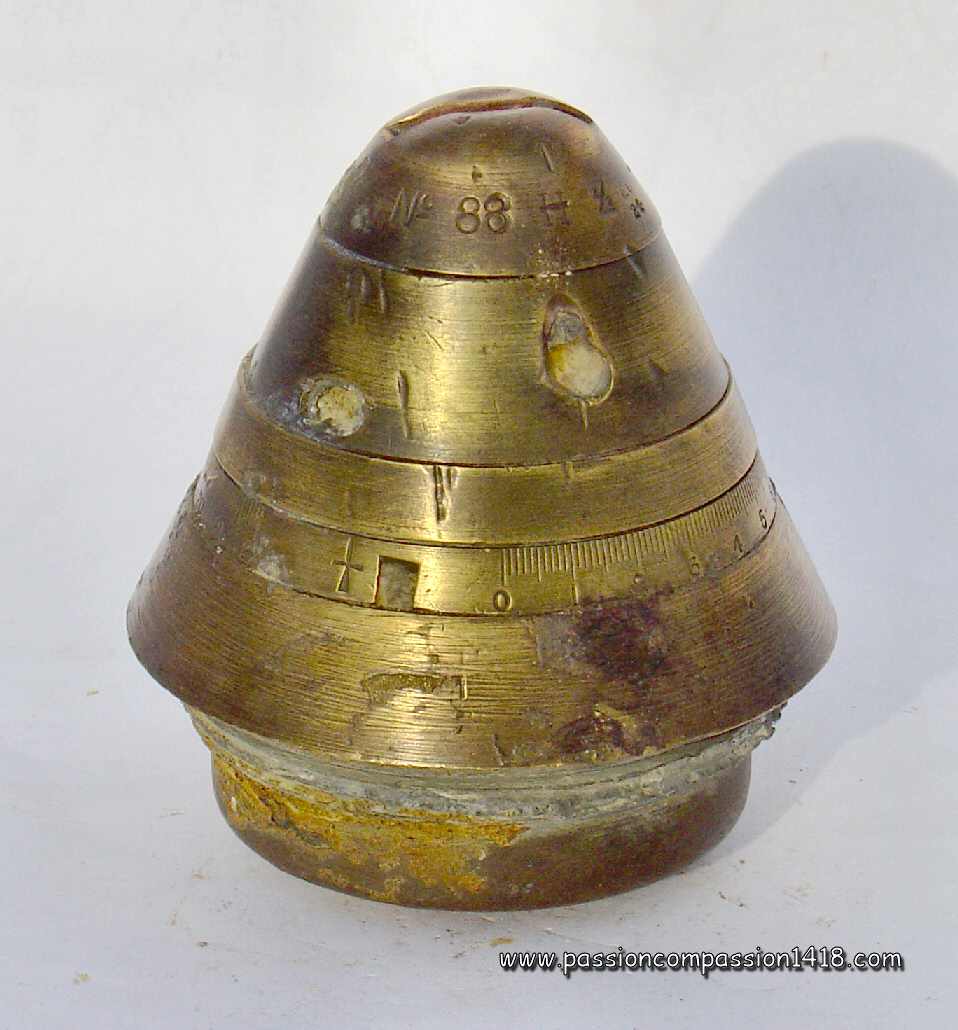 |
Time and percussion fuze N°88. Markings : '1/18 - N°88 HZ - 1 - ED 24 - 222 - 70(barred)' |
Time and percussion fuze N°88. Mounted on an adaptor. |
|
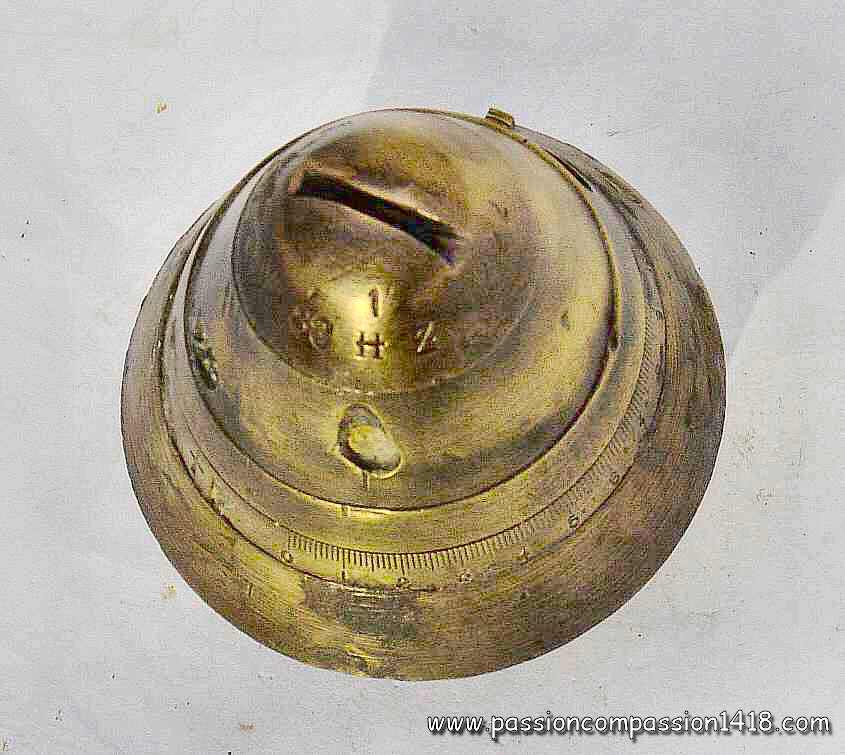 |
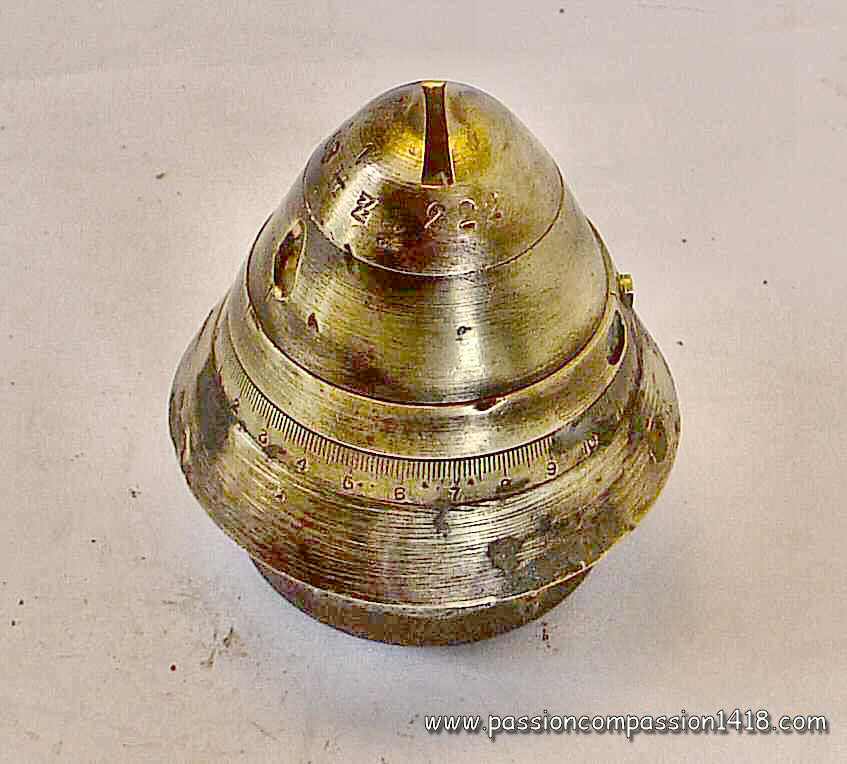 |
|
Time and percussion fuze N°88. Top view. |
Time and percussion fuze N°88. |
|
Return at the top of the page |
||
N°89 fuze |
||
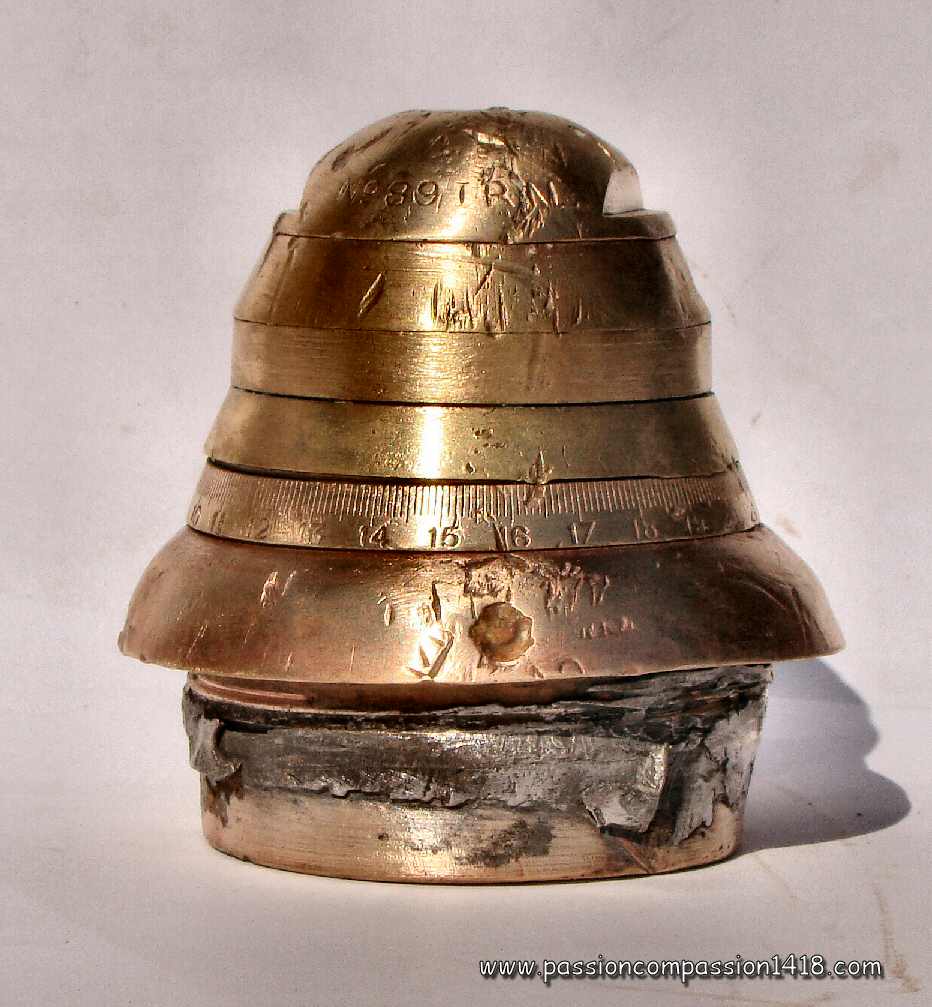 |
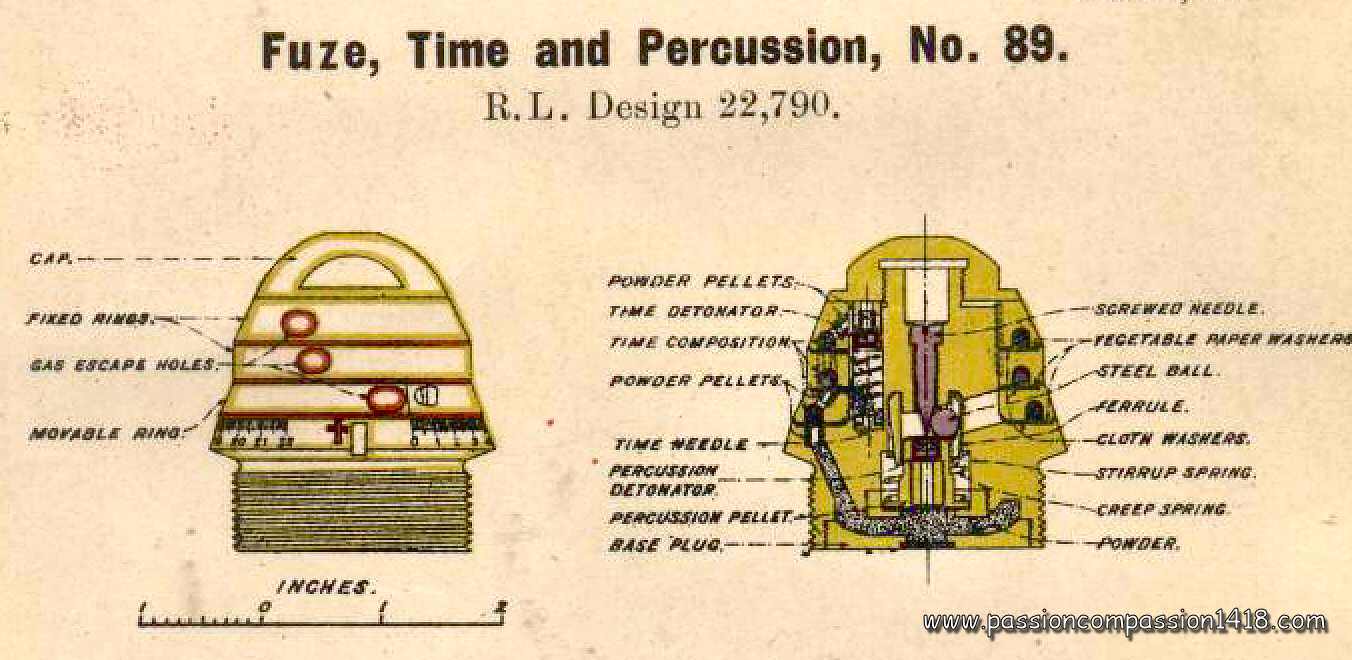
Initially developped in 1917 for BL 4.7in and BL 60pr field guns in anti-aircraft role, the time and percussion fuze N°89 was the longer range fuze that was used by the British army in WW1, with a maximum combustion time of 60 seconds, 15 seconds longer than the long range fuze N°88.
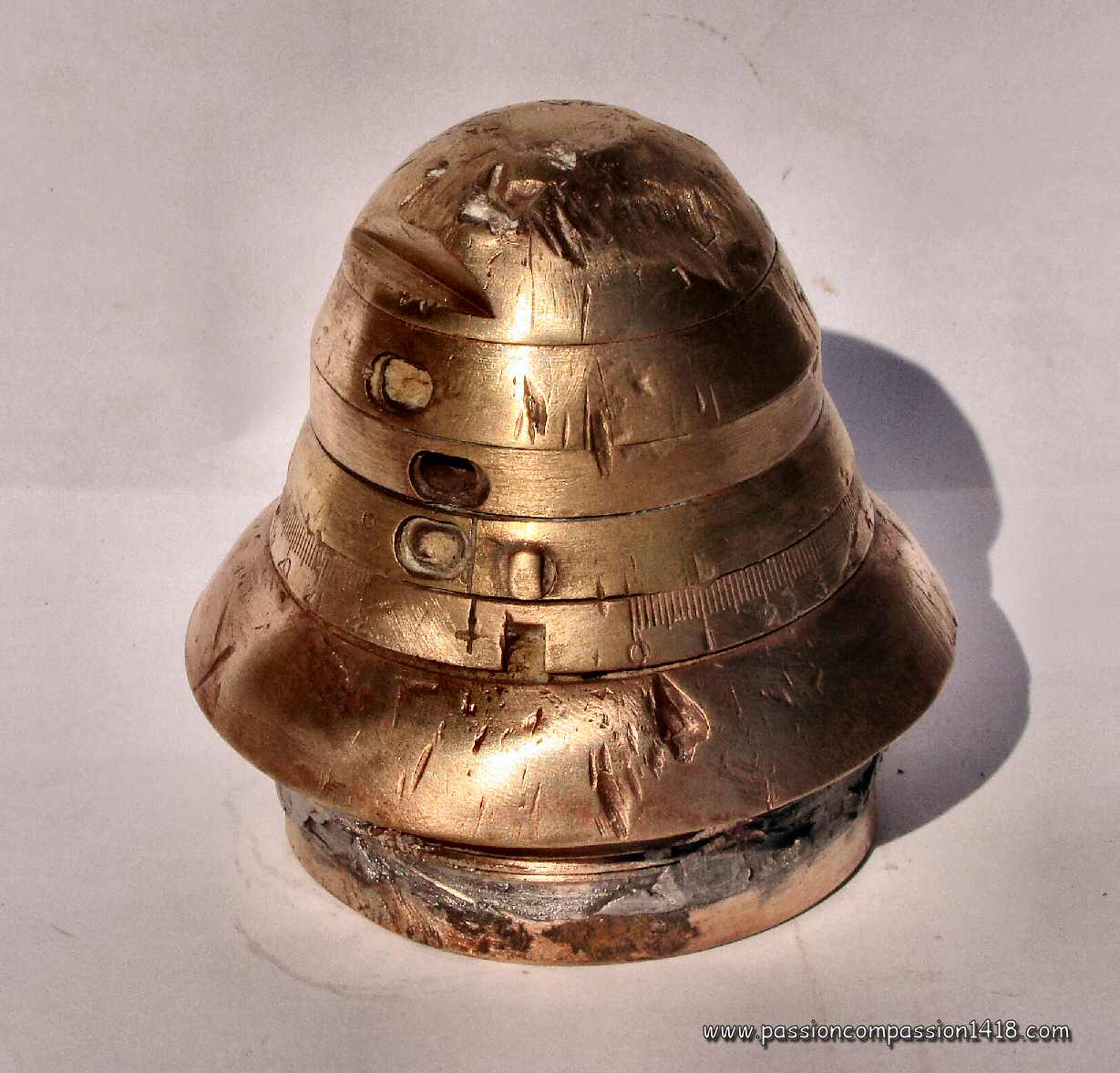
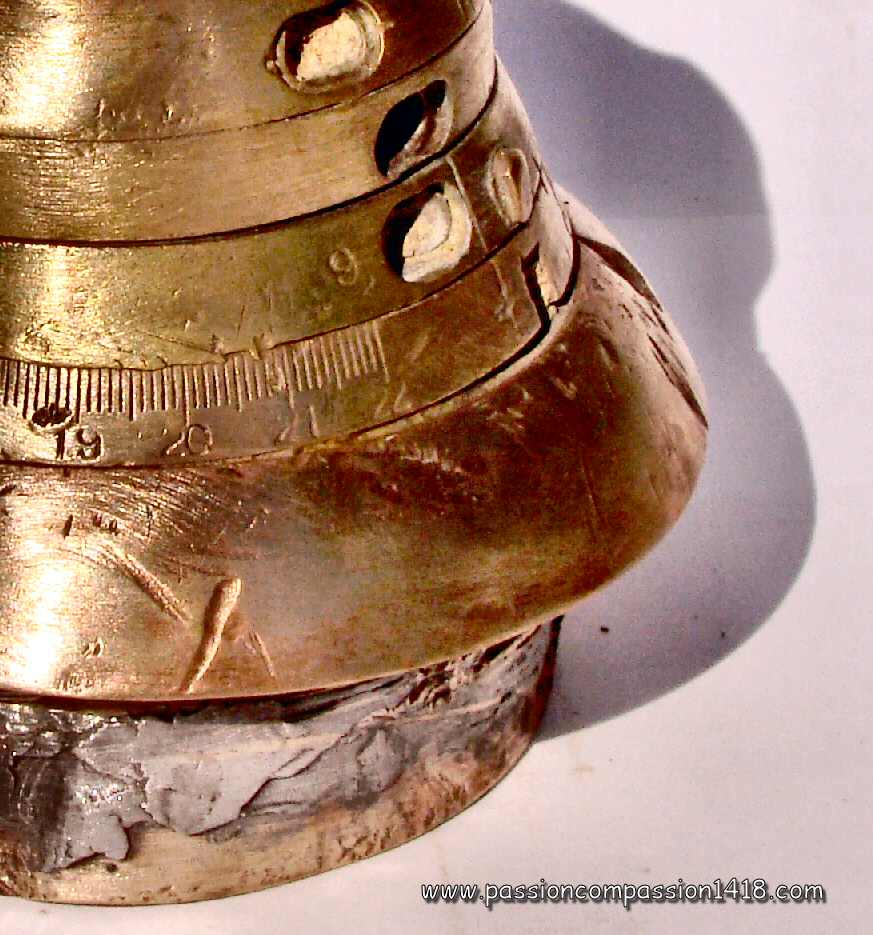
Designed to reach that long delay, the N°89 was another evolution of the fuze N°83, keeping the same graze percussion system with a centrifugal ball safety system and the eccentric time pellet system, but with 3 time combustion rings instead of 2 as in every other British T & P fuze. The lower disk was graduated from 0 to 22 time units as usual, but even set to '0', the to ring composition had to burn completely before the burst. Its long range properties later made this fuze the conventionnal one for shrapnell shells of the heavy guns up to 12 inches. It stayed in service until 1934. This fuze was dedicated to the shrapnell shells of the :
|
|
Time and percussion fuze N°89. |
 |
 |
Time and percussion fuze N°89. Mounted on an adaptor. Note the roman cross setting mark for a percussion behaviour, and the time graduation beginning at 0. |
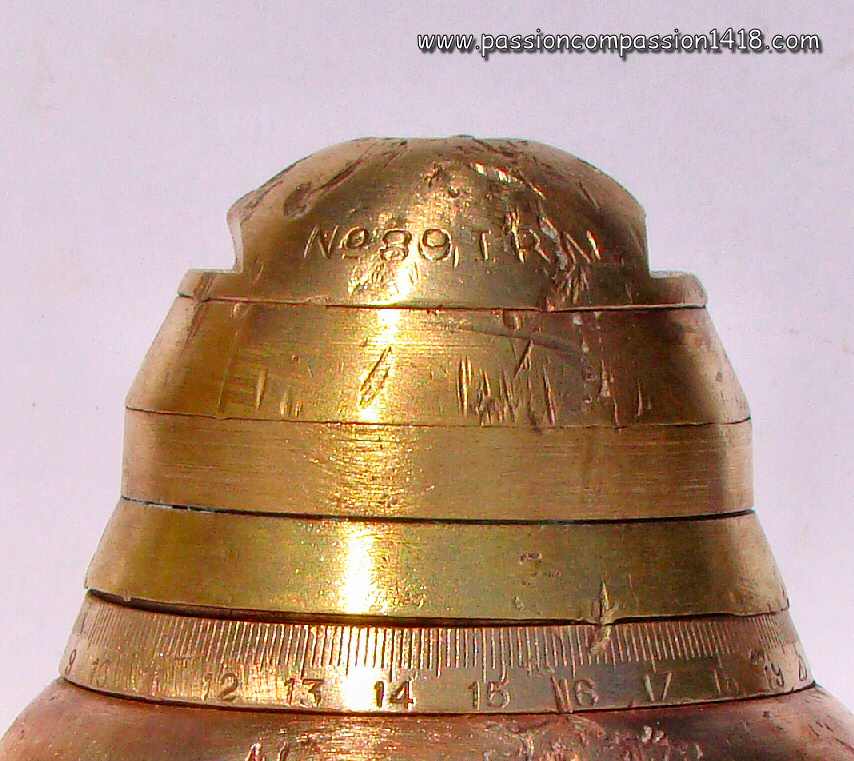
Time and percussion fuze N°89. Markings : 'N°89 - I.R.N. - 1 17 - 9'. |
|
 |
 |
|
Time and percussion fuze N°89. Zoom showing the 3 combustion gazes escape vents, one for each of the 3 combustion rings. |
Time and percussion fuze N°89. Bottom view, with the specific cross-shape flame communication hole. |
|
 |
||
Time and percussion fuze N°89. Wartime scheme |
||
Return at the top of the page |
||